


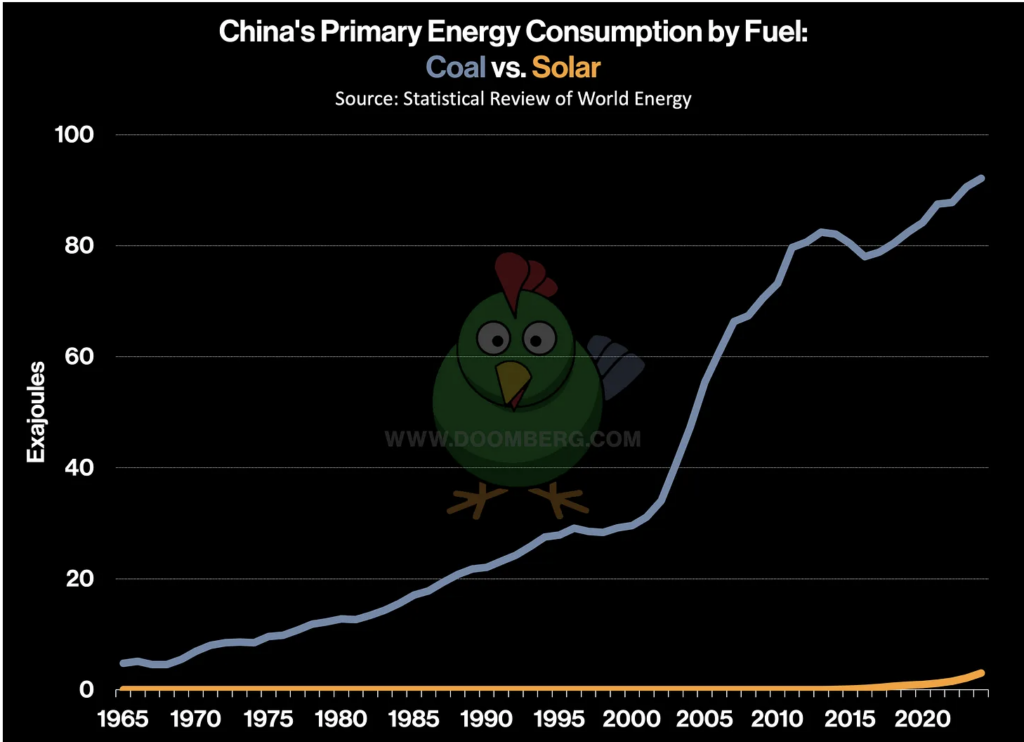
The Statistical Review of World Energy reports that coal accounted for 58% of China’s primary energy consumption in 2024. Oil was at 20% and natural gas at 10%. That means that 88% of China’s energy came from fossil fuels. Carbon-free energy (nuclear, hydroelectric, solar, wind, and most other renewables) only provided 12%. Since 2000, China has more than tripled its coal consumption and now uses more coal than the rest of the world’s combined usage, burning 56% of the world’s coal. As Doomberg points out, China consumes almost 20 times the combined consumption of coal by the 27 member states of the European Union, based on 2024 data.

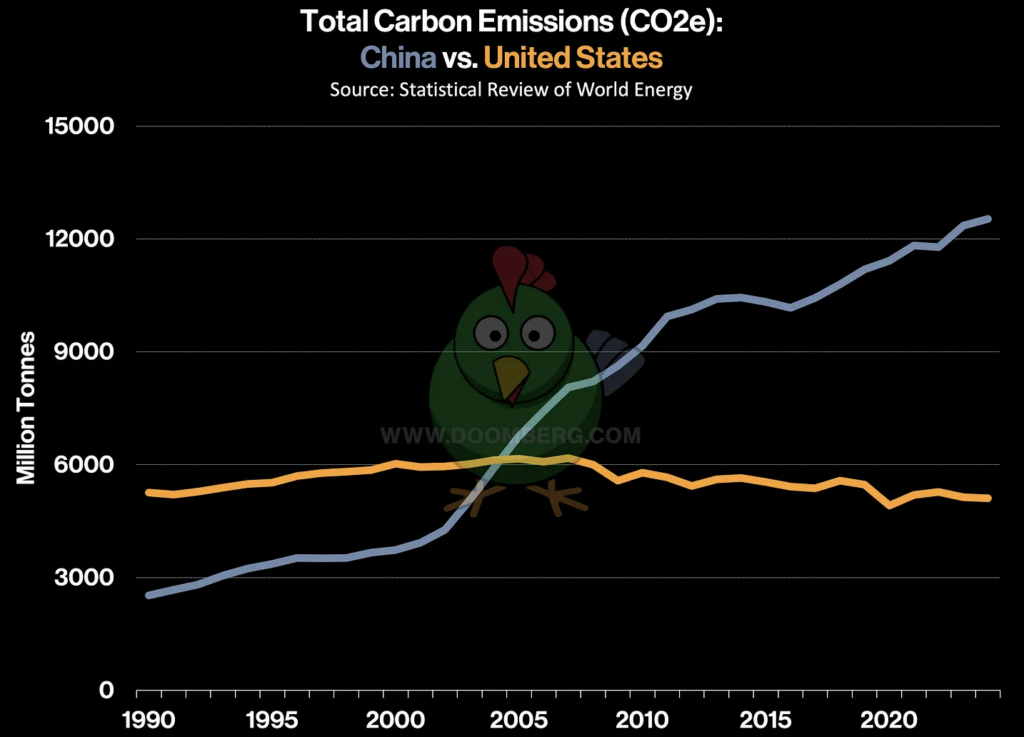
In 2024, China released 11,173 million metric tons of carbon dioxide — 31.5% of the world’s total. That was about 4.5 times as much as the European Union and almost 2.5 times the amount that the United States released.

News reports are touting that renewable energy, including hydroelectricity, has overtaken coal as the primary source of electricity around the world, indicating a shift in the global reliance on fossil fuels based on data for the first half of 2025. That shift is not surprising, since 2024 data shows that once renewable data is supplemented by hydro data, coal and renewables plus hydro had generation shares that were very close. In 2024, coal produced 33.95% of the world’s electricity, while renewables plus hydro produced 31.6%. Thus, coal outproduced renewables plus hydro by slightly more than two percentage points.
In the first half of 2025, Ember found that renewable energy plus hydroelectricity contributed 34.3% of all global electricity generated, while coal generated 33.1%. Ember claims that populous developing countries like China and India “led the charge in adding more renewable energies,” according to an NPR report. But, in 2024, China produced 57.8% of its electricity from coal and 33.7% from renewables and hydropower. It is unlikely that China has since switched those numbers so radically when it expanded the capacity of coal-fired plants more in the first half of 2025 than at any time in the past nine years, according to DW. It did so by adding between 80 and 100 gigawatts of new coal power to its grid in 2025, with 21 gigawatts of those gigawatts added in the first half of 2025.
Similarly, in 2024, India produced 74.8% of its electricity from coal and just 19.6% from renewables plus hydroelectricity. India added 221,813 megawatts of coal as of March 2025. While both countries added more renewable capacity than coal, the efficiency of wind and solar power at a quarter or a third of that of coal, meaning their contribution would not make a radical change in terms of the fuel driving the economies of China or India. Capacity factors for wind and solar are much lower than those of other sources.
One reason that China has added renewable generating technologies is to manufacture and sell them to countries that have goals of reducing greenhouse gas emissions and are instituting policies to enforce those goals. Europe, in particular, is touting the growing share of generation they are getting from renewable energy. This is occurring while their electricity costs are skyrocketing and their industry is moving overseas because European industries can no longer compete with countries with much lower energy costs. Wind and solar power are not the cheap power sources that many have hyped because they add to system costs, including increased transmission costs and duplicate generating capacity from the need to provide back-up power when the wind is not blowing, and the sun is not shining. Back-up power is supplied by very expensive batteries or coal and natural gas generating units that are forced to play second fiddle by only generating power when wind and solar power cannot perform, meaning that the fossil technologies cannot recover their full costs due to less generating time. Building duplicate systems because of renewable energy’s inherent intermittency is expensive, while consuming more resources and making the system less efficient.
Analysis
Despite the growing prominence of renewable energy generation, which is mostly buttressed by hydropower — a more reliable source than wind and solar — coal still remains the dominant source of electricity for China and India. Even if these countries continue to increase renewable generation, it’s unlikely that they’ll move off coal anytime soon. The reason that China and India will not divest themselves of coal is that they need affordable and reliable power for their industries and for their residents. With the advent of artificial intelligence data centers that are energy hungry, China will be relying on its vast coal-fired grid — larger than all the generating capacity in the United States — to lead the race. It also needs coal capacity to process the rare earth and other critical minerals that the world needs for “green” technologies. It currently dominates the world in their supply and processing, having spent decades to gain that edge.
*This article was adapted from content originally published by the Institute for Energy Research.