

E&E News reported recently that Senate Democrats gathered to “reinforce a core midterm message: Republican policies have driven up energy prices for Americans.” Before Democrats cast blame for electricity prices, they need to look in the mirror.
The Map That Tells the Story
Recently, along with Always On Energy Research, the Institute for Energy Research (IER) released a report called “Blue States, High Rates” that tells the real story of the electricity prices in the United States:

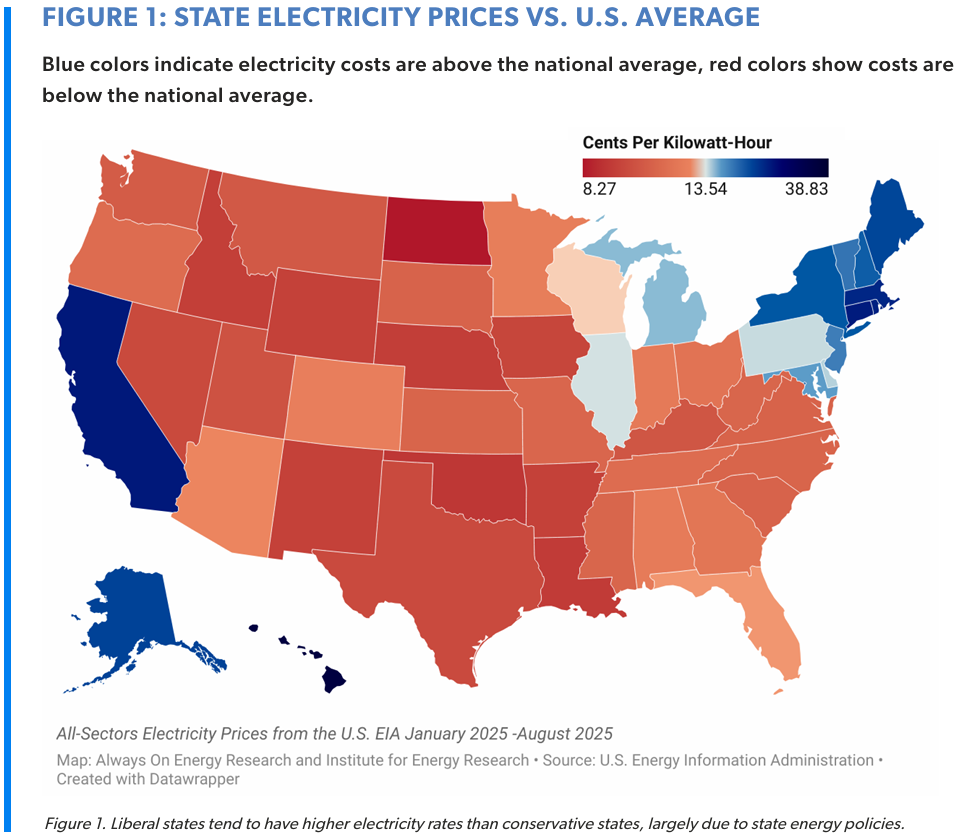
What’s striking about the map is that if you didn’t know what you were looking at, you might assume it was a map of how states voted in the 2024 presidential election. It’s not—it’s a map of electricity prices.
The correlation is unmistakable: The vast majority of states with electricity prices above the national average voted for the Democratic nominee in both 2020 and 2024. Meanwhile, 8 of the ten states with the lowest electricity prices are reliably red.
But here’s what Democratic Senators need to understand: this isn’t a map of politics. It’s a map of policy consequences. The correlation exists not because of how people vote, but because of what elected officials do once in office. And Democrats in office consistently enact policies that intentionally increase the price of electricity.
The Numbers Don’t Lie
From 2014 to 2024, electricity rates in blue states increased by 32.4%. In red states, they increased by 18.5%. That’s a difference of nearly 14 percentage points.
The pattern holds across multiple policy categories:
- States with mandatory Renewable Portfolio Standards saw rates increase 28.8%, compared to just 17.0% in states without such mandates—a difference of nearly 12 percentage points.
- States with 100% net-zero targets experienced rate increases of 31.2%, versus 20.9% in states without such targets.
- RGGI member states saw rates climb 33.8%, compared to 21.3% in non-RGGI states.
Democrats’ Real Priorities
These price increases are not coincidences. Democrats have policy priorities other than electricity affordability. They want to reduce carbon dioxide emissions. They want to promote renewable energy. They want to electrify transportation and buildings.
People can debate the validity of these policy goals, but what’s not debatable is that these policies raise electricity costs. That’s not a bug—it’s a feature. Carbon pricing, carbon dioxide taxes, renewable mandates, and renewable energy standards are designed to make conventional electricity more expensive relative to preferred alternatives.
The problem for Democrats is that they want credit for caring about affordability while implementing policies that do the exact opposite.
Consider Governor Abigail Spanberger in Virginia, who announced shortly after taking office that she wanted the commonwealth to rejoin the Regional Greenhouse Gas Initiative (RGGI). The entire purpose of RGGI is to tax carbon dioxide emissions, which means intentionally increasing the cost of electricity from natural gas and coal generation. RGGI states have seen electricity prices rise 12.5 percentage points faster than non-RGGI states.
If your central goal is reducing carbon dioxide emissions, that’s a defensible policy. But you cannot simultaneously claim that electricity affordability is your priority.
The “Cheap Clean Power” Fantasy
Politico, writing about the same meeting of Senate Democrats, notes that Senator Schatz (D-Hawaii) “called for advocating for cheap clean power that allows Democrats to ‘keep it extremely simple as it relates to the affordability question.’” The problem is when Democrats try to require “cheap clean power” the power turns out to be anything but cheap.
California, which wants to lead the nation in renewable energy deployment, has electricity rates that are double the national average. Rates increased 78% from 2014 to 2024, the highest increase in the country.
Massachusetts, with its aggressive clean energy mandates, saw rates climb 56%. Maine, another RGGI state with aggressive renewable policies, experienced a 55% increase.
Meanwhile, states that prioritized affordability over climate mandates tell a different story. Texas, with its market-oriented approach, saw rates increase just 9.5%. Louisiana, relying heavily on natural gas without aggressive mandates, saw increases of less than 9%. North Dakota actually saw rates decline by nearly 6%.
What Republicans Have Achieved
Ranking Member Heinrich suggested Democrats should message around “how the Trump administration’s policies are impacting electric bills.” But the data shows that Republican-led states have consistently delivered better affordability outcomes.
This isn’t complicated. States that have:
- Avoided mandatory renewable portfolio standards
- Rejected carbon pricing schemes like RGGI
- Allowed utilities to use the most cost-effective generation sources
- Maintained diverse fuel portfolios, including natural gas and coal
…have delivered lower electricity prices and smaller rate increases than states that pursued aggressive climate policies.
Florida, under continuous Republican governance since 1999, only saw prices rise prices 16% from 2014 to 2024, less than the average increase of 24.5%, despite near-universal air conditioning demand and the challenges of mitigating frequent hurricane damage. Kentucky has the lowest rates of any state east of the Mississippi. Louisiana enjoys the third-lowest rates in the nation.
The Real Choice
At the meeting of Senate Democrats reported on by E&E News and Politico, Senator Schatz stated he wants to start discussions around “what-would-we-do-if-we-were-in-charge” policies. State governments play a significant role in electricity policy, and we already know what Democrats do when they’re in charge. We can see it in California, New York, Massachusetts, and many other blue states, where electricity has become dramatically more expensive.
If Democrats truly want to “keep it extremely simple as it relates to the affordability question,” the answer is straightforward: stop implementing policies that intentionally increase the price of electricity.
You cannot have carbon dioxide taxes, mandatory renewable standards, 100% renewable energy targets, and aggressive restrictions on natural gas and coal while also claiming to prioritize affordability. The data from 50 states and a decade of policy decisions and price changes make this abundantly clear.
Americans struggling with their electric bills don’t need new messaging strategies. They need state and federal leaders willing to prioritize affordability over ideological mandates. Until Democrats are willing to do that, the map of electricity prices will continue to look like a map of election results—and for good reason.