


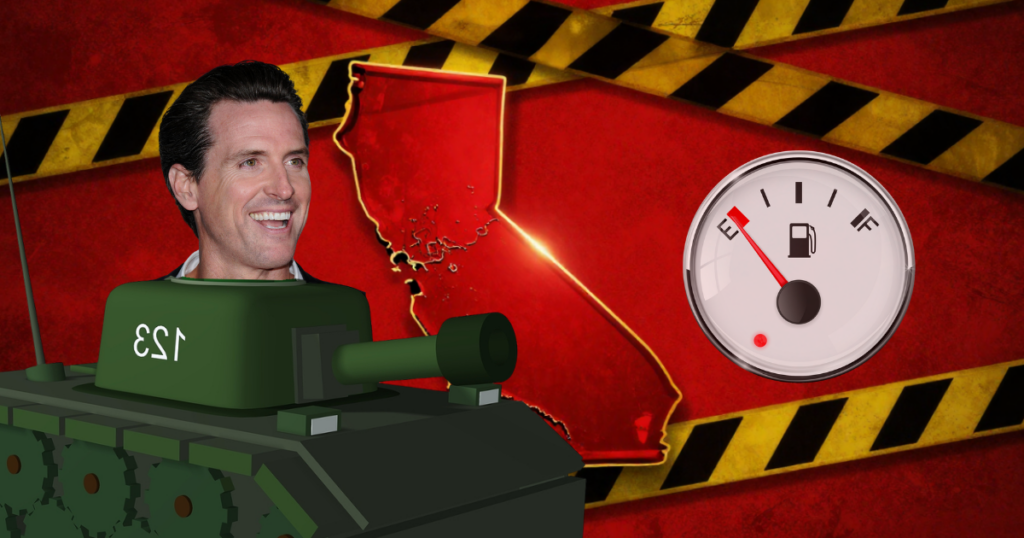
The Trump administration is considering creating a Strategic Petroleum Reserve in California to enhance national security and address the state’s energy isolation, according to Energy Secretary Chris Wright. The proposed reserve would initially store 370,000 barrels of oil, with a potential expansion to 30 million barrels, and would support military installations and refineries in the state. The action would undermine Governor Gavin Newsom’s goal to continue reducing the state’s dependence on fossil fuels.
A document that lawyers for Sable Offshore Corp. sent to the Energy Department shows that the company proposed a West Coast Strategic Petroleum Reserve “in response to the inquiries made by the Trump administration and in the furtherance of Sable’s ongoing discussions with the Department of War for the supply of oil and gas to California.” Sable began producing oil offshore Santa Barbara earlier this year as the Trump administration invoked national defense powers—an action opposed by Governor Newsom. Newsom has criticized Sable’s relationship with the Trump administration, accusing the company of defying court orders during its restart.
The document also states, “The storage facilities and the connected and adjacent pipelines would make any oil stored in the facility available to serve the military installations in central, northern, and southern California, the remaining refineries in California’s major population centers, and further available for maritime transport via the port facilities in both the San Francisco and Los Angeles metropolitan areas, for onward transport to the military installations in the Asia Pacific region.”
The U.S.’s current Strategic Petroleum Reserve (SPR) is located in a series of salt caverns in Texas and Louisiana and has been seriously depleted of oil reserves during the Biden administration in its quest to lower gasoline prices before the mid-term election in 2022. Oil prices had risen due to Russia’s invasion of Ukraine, prompting the Biden administration to release over 400 million barrels from the SPR.
Due to the conflict in Iran, the Trump administration is in the process of releasing 172 million barrels of oil from the SPR to ease the higher oil prices that resulted from the closure of the Strait of Hormuz. California, which is dependent on oil and petroleum imports, recently received oil from the SPR. About 460,000 barrels of Bayou Choctaw Sweet oil are moving to Chevron’s Richmond refinery in Northern California, while an additional 50,000 barrels were delivered to the company’s El Segundo refinery near Los Angeles.
It is unclear how effective a SPR in California will be, given the state’s closure of its refineries and its retooling of some refineries to produce expensive biofuels that the state heavily subsidizes. Two California refineries closed in the past year due to onerous regulations and policies from the Newsom administration. California lost about 17% of its refining capacity with the closure of the Phillips 66 refinery in Los Angeles and the Valero refinery near San Francisco. California now has 11 refineries, down from 42 refineries 40 years ago.
The state is increasingly dependent on gasoline imports from Asia, where it gets about 20% of its gasoline supply. Due to the conflict in Iran and the effective closure of the Strait of Hormuz, Asian refineries are unable to obtain oil imports from the Middle East and have had to scale back their petroleum exports, exacerbating California’s petroleum problems. With President Trump’s waiver of the Jones Act, California has received some gasoline shipments from Gulf Coast refineries.
California boasts the highest gasoline prices in the nation, about $1.70 higher than the national average due to its policies and regulations. California has the highest combined gas tax in the nation at $0.709 per gallon, plus numerous hidden fees resulting from a cap-and-trade program to lower greenhouse gas emissions, a low-carbon fuel program, underground gas storage fees, and a state and local sales tax, all of which add to the price of gasoline. While fuel tax revenues are typically used for road repair, California diverts some of them to subsidize “green” jet fuel production. Newsom has proposed a $1- to $ 2-per-gallon credit for every gallon of alternative jet fuel, sustainable aviation fuel (SAF), “produced for use in California,” funded by the road repair budget.
Conclusion
The Trump administration is considering an SPR in California to enhance national security, as a number of military bases are located within the state, and to address the state’s isolation, since its fuel specifications differ from those of the rest of the nation, and few pipelines connect it to the rest of the country. The state is dependent on imports to supplement its declining oil and petroleum production, which, due to the conflict in Iran, have been limited. California, under Governor Newsom, has enacted anti-oil-and-gas policies and regulations, resulting in higher fuel prices than the rest of the nation, refinery closures, and declining oil production. However, the current SPR has frequently been used as a political tool, rather than a strategic asset, and there’s no reason to believe a Californian SPR would be handled much differently.