

September 3, 2026
China Triples Down On Coal While Still In The Paris Agreement
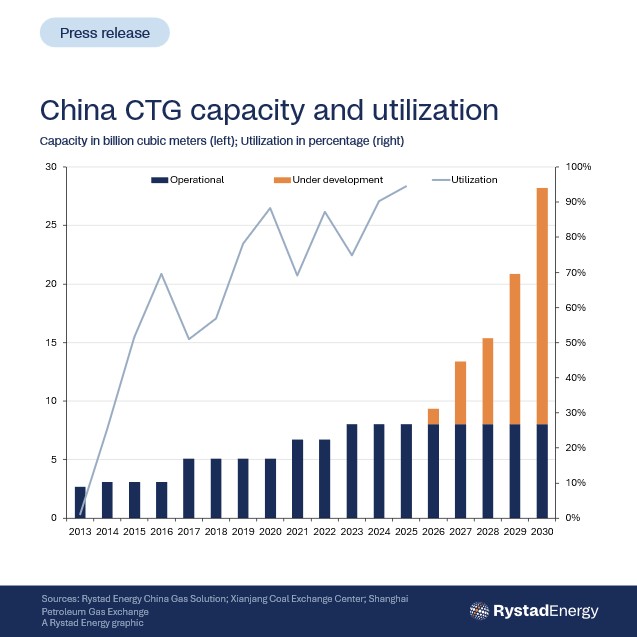
China is building the world’s only large-scale coal-to-gas industry as a buffer against supply shocks and to supplement its national security. China’s 15th Five-Year Plan, covering 2026 to 2030, moves coal-to-gas’ role into active implementation. Rystad Energy estimates China’s coal-to-gas capacity is on track to reach 9.4 billion cubic meters per year by end-2026, growing to 28 billion cubic meters per year by 2030 — a tripling. Cheap mine-mouth coal in Xinjiang is producing gas for $9.1 to $9.6 per million Btu, generally undercutting China’s average LNG import price. Mine-mouth coal prices in China’s Xinjiang province averaged 214 yuan, or $30 per metric ton, between April 2025 and May 2026, less than 40% of the equivalent price in Inner Mongolia. Existing plants are operating at over 90% utilization, indicating the cost competitiveness of domestic synthetic gas versus imported alternatives. China is currently developing about 20 billion cubic meters per year of coal-to-gas capacity, much of it in Xinjiang, and project approval times in the region are dropping from three years or more to under 12 months in several recent cases. China clearly means business when it comes to increasing the coal gasification industry.
Lacking the oil and gas reserves of countries like the United States and Russia, China is converting its vast coal reserves into synthetic gas as a national security and economic hedge. China’s using its cheap coal to produce gas that costs less than buying LNG from abroad, as LNG prices have spiked due to the conflict in the Middle East, which has disrupted global gas supplies. At 28 billion cubic meters per year, however, China’s coal-to-gas industry would supplement LNG rather than replace LNG imports, which fell 14% in 2025, slowing the pace of China’s LNG demand growth.
In 2025, China imported 39% of its natural gas supply (168.6 billion cubic meters), slightly lower than 2024 at 43%, due to a 6% increase in domestic production, totaling 264.1 billion cubic meters. China imported 90.8 billion cubic meters of LNG in 2025, with 29.4% coming from Qatar. Because Iran effectively closed the Strait of Hormuz, those imports essentially stopped during the conflict. Other major LNG suppliers to China are Australia, Russia, and Malaysia. With Qatar’s LNG exports cut off, the LNG spot price in Asian markets spiked to over $20 per million Btu, confirming China’s expectations that LNG import dependency is a strategic vulnerability. China’s pipeline gas imports in 2025 were less than its LNG imports at 77.8 billion cubic meters, coming mainly from Russia and Turkmenistan, which together provided 86% of its pipeline gas imports.
China is the world’s largest coal producer and consumer by a wide margin. According to the Statistical Review of World Energy, coal accounted for 57% of China’s primary energy consumption in 2025. Domestic coal production reached approximately 4.7 billion metric tons (1.7% higher than in 2024)—a new record. Nonetheless, China also imported coal, mainly from Indonesia, Mongolia, Russia and Australia. China’s coal mining is slated to expand by an additional 25% by 2030.
Besides coal-to-gas conversion, China’s 5-year plan expects growth in all areas of natural gas imports, including pipeline gas and LNG imports. China’s current LNG receiving capacity is about 130 to 157 million metric tons per year, spread across more than 30 operational receiving and regasification terminals, and it plans to expand it to 200 million metric tons per year by 2030. The country also plans to increase the import capacity of its onshore natural gas pipelines to 114 billion cubic meters annually by 2030. To strengthen energy distribution, it plans to build 20,000 kilometers of long-distance oil and gas pipelines by 2030, increasing the nation’s total long-distance pipeline network to 220,000 kilometers and significantly enhancing domestic supply chain resilience. Natural gas storage capacity will also expand, accounting for more than 13% of the country’s total natural gas consumption by 2030.
Because China is the world’s largest importer of oil and LNG, it is concerned about energy supply security due to the risk of a maritime blockade of its energy imports, supporting its decision to increase domestic production and coal conversion projects. Coal-to-gas projects, however, emit nearly three times as much carbon dioxide during conversion as is released when the gas is burned, which is the main reason China is behind on its 2025 carbon intensity target. Because China prioritizes energy security over carbon dioxide emissions growth, the conversion sector is likely to continue to grow, and its industrial sector will have the energy it needs to prosper, unlike countries in Europe.
Conclusion
China is expected to triple its coal-to-gas conversion from 2026 to 2030, reaching 28 billion cubic meters for national security and economic reasons. At that level, China’s coal-to-gas industry would be a supplement to LNG rather than a replacement for LNG imports, but its growth could slow the pace of Chinese LNG demand growth. China currently has about 20 billion cubic meters per year of coal-to-gas capacity under development, much of it in Xinjiang, where coal is cheap. Mine-mouth coal prices in China’s Xinjiang province average around $30 per metric ton, less than 40% of the equivalent price in Inner Mongolia. China’s 5-year plan not only supports increased coal-to-gas conversion, but also increased infrastructure for pipeline gas and LNG imports.
*This article was adapted from content originally published by the Institute for Energy Research.
You Might Also Be Interested In