EPA's Regulatory Blinders

A Washington Times article by Art Fraas and Randall Lutter exposes a systemic flaw in the way EPA attempts to justify its regulations, including the new Tier 3 rules. In March, EPA prosed new regulations on gasoline to reduce the sulfur content of gasoline. In this forum, we have written plenty of critiques of the Tier 3 regulations, showing the flaws in the case for it. However, Fraas and Lutter point out a new problem, which affects not just Tier 3 but EPA’s approach in general: When assessing the costs and benefits of a proposed rule, EPA only considers the rule versus the status quo, rather than other alternatives that might be even superior. In a cast like Tier 3, this is an expensive omission because the rule would cost Americans $3.4 billion annually. First I’ll quote from Fraas and Lutter, and then I’ll give an illustrative example to see how powerful their objection is.

Here Fraas and Lutter make their case against the EPA’s failure to truly consider alternatives:

…the [EPA] did not make reasoned determinations that new rules are the best or most cost-effective way to protect public health.

One of the rules in question — the EPA’s recent Tier 3 proposal to reduce emissions from cars and light trucks — illustrates the problem. This rule would cost Americans about $3.4 billion annually, according to the agency, placing it among the administration’s most costly rules. The EPA, however, proposed the rule while estimating net benefits of only the proposed option. It did not identify, let alone evaluate, any alternatives.

Failure to analyze alternatives is first among the cardinal sins that tempt regulators. Without analysis of alternatives, they may claim that their preferred alternative is good — meaning better than doing nothing. They have no basis, however, for saying that their rule is cost-effective or best among plausible alternative approaches.

The EPA’s failure to analyze alternatives violates White House directives. President Clinton’s Executive Order 12866, which President Obama endorsed, requires “an assessment, including the underlying analysis of costs and benefits of potentially effective and reasonably feasible alternatives.” [Bold added.]

Let me illustrate Fraas and Lutter’s important point with a simplistic example. Suppose UPS is trying to decide on the appropriate rule for how often each 18-wheeler in its fleet should have its oil changed. If there’s no policy—meaning that the oil is never changed—then eventually each truck will break down and require major repairs to the engine, costing many thousands of dollars per truck, per year.

To avoid this horrible outcome, a dashing executive gives a PowerPoint presentation to his fellow UPS decisionmakers, and shows them the cost/benefit analysis of requiring daily oil changes. True, it would be expensive, not only in terms of paying for the oil change itself, but also (more important) UPS is losing out on the shipping that can’t be achieved while each truck is being serviced. The policy of insisting on daily oil changes effectively reduces the capacity of UPS’ fleet of trucks, for a given number of vehicles.

Even so, the hotshot executive makes a convincing case that UPS can’t afford not to implement this new rule. Without daily oil changes, the engines eventually break down, often leaving drivers stranded on the interstate, with trucks loaded with time-sensitive packages. Thus, although the costs of the new policy are admittedly high, the benefits (in terms of avoided expenses, but also extra revenue from happier customers) are much greater. The new rule thus easily passes the cost/benefit test, and UPS implements the policy of requiring all of its trucks to receive daily oil changes.

A silly story, to be sure. But what specifically is wrong with our tale? The answer is obvious, because I’ve picked such an exaggerated example: Just because getting a daily oil change is more profitable than never getting oil changes at all, doesn’t mean that it’s a sensible policy. A policy of weekly oil changes would be better still, since it would lower the costs while retaining just about all of the benefits of the daily policy. And switching to a more flexible rule, where the oil is changed based on a two-pronged trigger of either miles driven or time elapsed, would be even better still.

As the silly UPS example illustrates, it’s not enough to evaluate a proposed policy in a vacuum, comparing it only to the status quo. Even if it passes a cost/benefit test in isolation, it still might be a ridiculous policy. Rather, the appropriate approach is to compare a proposal to a range of policies, to see if any outperforms it. Furthermore, when it comes to government regulations, it would be nice to see considerations of how introducing pro-market reforms could help matters—rather than piling on ever more mandates and restrictions.

Beyond the specific problems with the new Tier 3 rules, Fraas and Lutter have penned a general critique of EPA. When performing cost/benefit analyses of proposed rules, EPA should consider several alternatives, to test the robustness of its results. After all, these costs cost Americans billions of dollars. As Fraas and Lutter put it: Just because a policy is better than nothing, doesn’t make it a good policy.

IER Senior Economist Robert P. Murphy authored this post. 

Lawsuits Challenge Unrealistic RFS Mandate

The American Fuel & Petrochemical Manufacturers (AFPM) and the American Petroleum Institute (API)  have filed lawsuits with the D.C. Circuit Court challenging EPA’s unrealistic 2013 cellulosic biofuel requirement under the Renewable Fuel Standard (RFS)—requirements that were released nine months late.

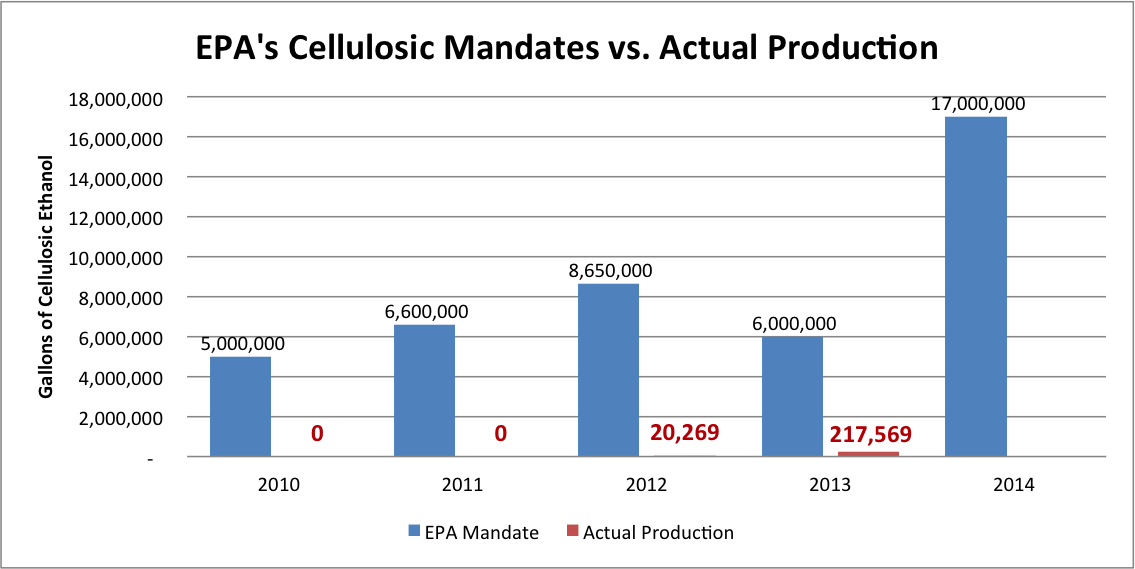
This year’s cellulosic mandate requires refiners to blend 6 million gallons into the nation’s fuel supply, but cellulosic ethanol remains essentially nonexistent. The actual amount of cellulosic ethanol available to refiners so far this year is closer to 142,000 gallons, far from the EPA’s 6 million gallon mandate. Despite the disparity between the mandate and reality, refiners are forced to pay fines for not meeting the requirements.

This gross overestimate is nothing new for EPA. Earlier this year, the D.C. Circuit Court rejected the agency’s 2012 mandate on the grounds that EPA “let its aspirations for a self-fulfilling prophecy divert it from a neutral methodology.”[i] This decision came after EPA fined refiners almost $7 million in 2011 for failing to blend fuels that did not exist.

As we have reported on several occasions, and as shown in the graph below, there has been a consistent gap between the amount of cellulosic ethanol mandated by EPA and the amount actually produced.

Naturally, supporters of the RFS are crying foul over the lawsuit. Bob Dinneen, president of the Renewable Fuels Association, went as far as to call API’s actions “frivolous” and “slavish.” He also said the following about the 2013 requirements:

“While the 2013 [Renewable Volume Obligations] were issued later than anyone would have liked, the fact is the statute is crystal clear, and all stakeholders have been producing and blending at levels that will unquestionably meet the 2013 requirements.”[ii]

Dineen is correct, the statute is crystal clear, but he is wrong about what it means. The statute clearly gives EPA the ability to waive the ethanol requirements and the statute clearly requires EPA to use a “neutral methodology” as the D.C. Circuit stated to actually estimate the RFS requirements. EPA has failed to do this.

Dinneen’s claim that all stakeholders will “unquestionably” meet the 2013 requirements is far from reality. As IER has pointed out before, cellulosic ethanol production continues to fall short of expectations. For example, the KiOR Inc. plant in Columbus, Mississippi, which was projected to produce the bulk of the 2013 mandate[iii], missed its second quarter production forecast by 75 percent. How can refiners blend a fuel that is not being produced?

The RFS, and the cellulosic ethanol mandate in particular, has no basis in reality. The EPA continually overestimates cellulosic ethanol production, but refuses to adjust the mandate accordingly. It is absurd to force refiners to pay a fine for failing to blend a fuel that is basically nonexistent. This is yet another example of why the government should step aside, end the harmful ethanol mandate, and allow the market to function.

IER Press Secretary Chris Warren authored this post.


[i] http://www.instituteforenergyresearch.org/2013/01/29/d-c-circuit-chastises-epa-for-biofuel-bias/

[ii] http://thehill.com/blogs/regwatch/court-battles/327269-industry-sues-epa-over-renewable-fuel-standard-

[iii]Federal Register 78.158. p. 49808 August 15, 2013. http://www.gpo.gov/fdsys/pkg/FR-2013-08-15/pdf/2013-19557.pdf

Bob Dinneen: Let Them Eat Ethanol!

A recent poll conducted by Harris Interactive on behalf of the American Petroleum Institute (API) finds that the vast majority of Americans are concerned about the negative consequences of the Renewable Fuels Standard (RFS). In a previous post we walked through some of the major results, including the fact that 77 percent of Americans are concerned that higher ethanol blends will damage their engines. The response from the head of the Renewable Fuels Association (RFA), Bob Dinneen, shows his perverse grasp of reality, especially when it comes to consumer choice.

When presented with the poll and its negative assessment of the RFS, Bob Dinneen said:

“Instead of scaring people, Big Oil should invest in the infrastructure to expand choice at the pump. Seriously, they need to stop baking the numbers to shield from the fact that they are losing market share and the only way out is to attack the RFS.”

Dinneen’s remarks would impress George Orwell. The federal government is forcing refiners to put more ethanol into the fuel mix than they would voluntarily choose to do, and—as the poll results indicate—Americans are being forced to put more ethanol into their vehicles than they would voluntarily choose. Contrary to Dinneen’s claim, this doesn’t represent “expand[ed] choice at the pump,” but in fact restricts consumer choice. If the government, say, mandated that all sodas sold in the U.S. contain 15 percent vinegar, that wouldn’t expand consumer choice either.

Moreover, Dinneen should hardly be patting the renewables industry on the back for its growing “market share,” at the same time he is defending the government’s role in forcing that outcome. If Dinneen is so convinced that the American public really wants more ethanol in their vehicles, then he should put it to the market test—not ram it down people’s engines and then explain away clear-cut poll results showing why this is a problem.

IER Senior Economist Robert P. Murphy authored this post. 

Americans Agree: RFS Damages Engines, Raises Food Costs

A new poll shows that the American people understand the harmful effects of mandating ever-rising ethanol volumes in gasoline under the Renewable Fuel Standard (RFS).

Seventy-seven percent of likely voters are concerned about higher ethanol blends in vehicles, according to a Harris Interactive poll released on Oct. 2. Gasoline blended with more than 10 percent ethanol can cause engine damage in the vast majority of vehicles on the road, while most automakers say their warranties will not cover claims related to improper E15 use.

Moreover, 69 percent of voters agree that burning food to produce fuel raises household grocery bills. The U.S. currently diverts about 40 percent of U.S. corn supplies to produce ethanol, leaving less corn crop available for food and animal feed. As IER explains here, corn prices are 70 percent higher than before the RFS was enacted in 2005.

Half of U.S. voters agree that blending corn-based ethanol into gasoline, even at current levels, “could increase costs for consumers.” Only 28 percent of respondents do not agree that ethanol can hurt consumers.

When presented with the facts, as opposed to the ethanol lobby’s spin, Americans draw sensible conclusions about ethanol and the federal biofuel mandate. The RFS is a fatally flawed mandate that damages engines and raises food prices. The American people deserve better.

IER Policy Associate Alex Fitzsimmons authored this post.

Will U.S. Policy Makers Oppose a Carbon Tax?

WASHINGTON — The American Energy Alliance begins today the third phase of a nation-wide $750,000 anti-carbon tax initiative. This phase of the initiative includes a series of online banner advertisements urging Americans to tell their Member of Congress to oppose a carbon tax.

The ads are currently running in areas of the country represented by Reps. Bruce Braley (D- Iowa), Cheri Bustos (D- Ill.), Ann Kirkpatrick (D- Ariz.), Patrick Murphy (D- Fla.), Rick Nolan (D- Minn.), Bill Owens (D- N.Y.) and Senators Kay Hagan (D- N.C.) and Mark Begich (D- Alaska). By enlisting these constituent groups to sign a petition against the carbon tax, AEA hopes to build on its 2.1 million-strong online community fighting to keep Washington from imposing a new harmful tax on American consumers.

The ads are geo-targeted for viewers on a number of national websites, including RealClearPolitics, Townhall, USA Today, and Washington Post, as well as a number of local news information sites in the targeted areas.

AEA President Thomas Pyle released the following statement along with the ads:

“Whether a Member of Congress has supported a carbon tax outright or supported legislation that assumes future revenues from a carbon tax, the practical result is the same — higher taxes on more Americans to feed Washington’s never-ending hunger for bigger government and more spending. The American Energy Alliance is committed to public accountability for elected officials and will continue our efforts to educate and equip American consumers to combat policies that increase the cost of energy their families and jobs depend on. By using every available medium — radio, TV, print and Internet — we will push back against Washington power brokers who don’t understand the real world harm that a carbon tax would cause.”

To see phase one of the initiative, click here.

To see phase two of the initiative, click here.

###

Ethanol Production Down in 2013 Despite Federal Mandate

Despite federal law requiring refiners to blend increasing amounts of ethanol into gasoline, domestic ethanol production has actually declined over the last year. The U.S. ethanol industry produced 6.40 billion gallons of ethanol through the first half of 2013, down from 6.89 billion gallons over the same period last year, according to the Energy Information Administration’s (EIA) Monthly Energy Review. As the following chart shows, this is the third straight year that domestic ethanol production is stagnating.

Source: The Energy Information Administration

The data reflect a growing disconnect between federal law and economic reality. Under the Renewable Fuel Standard (RFS), refiners are required to blend greater amounts of ethanol into the nation’s transportation fuel supply, with the goal of blending 36 billion gallons by 2022. Even though production was flat last year, the Environmental Protection Agency (EPA) raised the ethanol mandate to 16.55 billion gallons for 2013, up from 15.2 billion gallons in 2012.

Mandating ever-rising volumes of ethanol regardless of whether it makes sense harms American families. The RFS burdens refiners with massive compliance costs, which get passed on to consumers in the form of higher gas prices. The cost of ethanol credits, which refiners use to demonstrate compliance, skyrocketed from 7 cents in January to a high of $1.43 in July, settling at about 60 cents. Valero, a major refiner, announced earlier this year that they will spend between $500 million and $750 million on ethanol credits in 2013, compared to $250 million in 2012.


Source: The New York Times

The dramatic spike in the price of ethanol credits makes gasoline more expensive for Americans. Gas prices could spike as much as $1 per gallon in 2014 due to the rising cost of ethanol credits, according to the Energy Policy Research Foundation. A study by NERA Economic Consulting finds that the RFS could raise gasoline prices by 30 percent in 2015 if action is not taken to correct the government’s unrealistic projections.

In addition to an unrealistic overall mandate, EPA also imposes an unattainable cellulosic mandate. As we have written before, EPA required refiners to blend 5 million gallons and 6.6 million gallons of cellulosic ethanol in 2010 and 2011, respectively, but not a single drop was produced in either year. EPA actually raised the mandate to 8.65 million gallons in 2012, but just 20,069 gallons were produced. In 2013, EPA lowered the requirement to 6 million gallons, yet EPA data show that only 129,731 cellulosic ethanol credits have been generated so far this year.

That ethanol production has declined despite rising federal mandates demonstrates the failure of energy central planning. Consumers, including motorists and refiners, will always make more economical decisions than bureaucrats in Washington. It is no more possible for regulators to predict precise volumes of ethanol in a given year than it is for meteorologists to predict the weather on a given day in some distant future. This just shows, once again, that the RFS is fatally flawed.

IER Policy Associate Alex Fitzsimmons authored this post.

Binz Bows Out

WASHINGTON — Upon report today that Ron Binz has formally withdrawn his name from further consideration to serve as chairman of the Federal Energy Regulatory Commission, AEA President Thomas Pyle released the following statement:

“Ron Binz was the wrong nominee at the worst possible time for American consumers. His record of radical advocacy and regulatory bias was too much to overcome, even for Harry Reid’s rubber-stamp Senate. His performance during the confirmation process left much to be desired, in the end proving the nominee too inartful and potentially untruthful for the Senate to confirm. Going forward, the White House would be well-advised to nominate only the most impartial and balanced regulators to serve on independent commissions. Senator Harry Reid would be well-advised to stop pushing his controversial hand-picked candidates. And Tom Steyer would be well-advised to stop hiring lobbyists and expensive public relations firms to promote anti-carbon zealots for the nation’s top energy posts.

“Senators Lisa Murkowski and Joe Manchin, specifically, are to be commended for their careful approach to the Binz nomination. Every Senator who put America’s working families ahead of Harry Reid’s and the White House anti-coal, anti-natural gas agenda have served their constituents well throughout this process.

“The American Energy Alliance was joined by principled consumer advocates to oppose this nomination, and today we look forward to working together with policymakers to ensure that just and reasonable electricity prices continue to be the top priority of the Federal Energy Regulatory Commission. Stopping the Binz nomination was about more than a single regulator or a single commission. It was about American consumers and promoting affordable energy solutions for our nation’s ratepayers. The Obama Climate Action Plan is about restricting access to America’s vast resources of coal and natural gas, which together supply approximately two-thirds of our nation’s affordable electricity. Ron Binz was only a part of that plan, and today’s announcement in no way means that the White House is backing down. The American Energy Alliance will continue to monitor these developments and redouble our efforts to promote just and reasonable energy policies at every turn.”

###

Biofuels: A Little Green Lie

This is Part 3 of a three part series comparing biofuel mandates in the United States and the European Union. Part 2, which focused on increasingly unattainable mandates in the U.S. and EU, was published yesterday

Biofuel mandates in the U.S. and EU impose enormous burdens on energy producers and consumers for negligible if not negative environmental impacts. These burdens include higher food prices, increasingly unattainable mandates, and the unintended consequence of fuels that produce more pollution, not less.

This is part three of a three part series on U.S. and EU biofuel policies. Part 1 examined the impact of U.S. and EU biofuel policies on food prices. Part 2 highlighted the unrealistic burdens that U.S. and EU biofuel mandates place on obligated parties. Now we turn our attention to environmental myths surrounding biofuels.

Biofuels: A Little Green Lie

U.S. and EU biofuel policies are similar and provide for useful comparisons. America’s Renewable Fuel Standard (RFS) requires oil refiners to blend increasing amounts of biofuel, mostly corn-based ethanol, into gasoline, with the goal of blending 36 billion gallons by 2020. In contrast, Europe’s Renewable Energy Directive (RED) mandates that 10 percent of the EU’s transportation fuels come from renewable sources by 2020. However, the European Parliament voted last week to slash the biofuel mandate by 40 percent amid concerns about rising food prices and environmental damages.

One of the assumptions underlying U.S. and EU biofuel mandates is that biofuels are good for the environment. Recent studies have cast doubt on these claims. While some studies find that some biofuels have a net positive impact on the environment, other studies find that many biofuels are either not as green as initially thought or produce more greenhouse gas emissions than the fuels they are intended to replace.

For example, burning ethanol versus gasoline can actually increase air pollution, particularly ozone. Stanford environmental engineer Mark Jacobson finds that burning ethanol adds 22 percent more hydrocarbons to the atmosphere than burning gasoline, leading to increases in tropospheric ozone that have been linked to a variety of negative health effects. As Jacobson explains, “Due to its ozone effects, future E85 may be a greater overall public health risk than gasoline…It can be concluded with confidence only that E85 is unlikely to improve air quality over future gasoline vehicles.”

More recent research has reached a similar conclusion that ethanol increases ozone pollution. The Union of Concerned Scientists, an environmental group, cautions, “If done wrong, the production of biomass for biofuels like ethanol could destroy habitats, worsen water or air quality, limit food production and even jeopardize the long-term viability of the biomass resource itself.” That hardly sounds good for the environment.

In addition to air pollution, there is evidence that biofuels can also increase greenhouse gas emissions. A study published in Science, a peer-reviewed journal, finds that corn-based ethanol nearly doubles greenhouse gas emissions over the next three decades and continues to increase emissions for the next 167 years. The Energy and Resources Group of the University of California, Berkeley finds that “if indirect emissions [resulting from the production of ethanol] are applied to the ethanol that is already in California’s gasoline, the carbon intensity of California’s gasoline increases by 3% to 33%.”

Unlike the U.S., the EU has a statutory goal of reducing the carbon intensity of motor fuel. The EU’s Fuel Quality Directive (FQD) mandates fuel suppliers and refiners to reduce the carbon intensity of transportation fuel by 6 percent in 2020. EU planners likely thought RED and FQD were mutually supportive mandates, when in fact it is possible that compliance with the ethanol mandate comes at the expense of the fuel quality mandate. This highlights the unintended consequences so common when government bureaucrats try to engineer what they view as more desirable economic outcomes.

Conclusion

The United States and the European Union have strikingly similar biofuel policies. Both require adding greater and greater amounts of biofuel into gasoline, regardless of whether it makes economic sense. America’s RFS requires blending 36 billion gallons of biofuel into gasoline by 2022, while EU’s RED mandates that 10 percent of the fuel supply comes from renewable sources by 2020.

Although their broad mandates are similar, the U.S. and EU are currently moving in different directions. Finally realizing the error of their ways, the EU Parliament voted to cut its RED to from 10 percent to 6 percent of the EU’s fuel supply by 2020. Meanwhile, the U.S. EPA recently increased the overall RFS for 2013, though the agency signaled a willingness to reduce the 2014 mandate given the looming blend wall.

The facts are clear: biofuel mandates in the U.S. and EU raise food prices and can harm the environment. Moreover, the mandates imposed by government bureaucrats in Washington and Brussels are unrealistic and increasingly unachievable. It is time for America to take the lead—as opposed to following Europe—in eliminating unworkable and counterproductive energy mandates.

IER Policy Associate Alex Fitzsimmons authored this post.

Free Market Coalition Calls for End to Wind PTC

WASHINGTON — The American Energy Alliance has joined 23 other free-market organizations in a letter to Congress urging members to oppose the extension of the wind production tax credit (PTC). The letter states:

“On behalf of the millions of members that our organizations represent, we encourage you to oppose extending the main source of federal support for wind energy, the production tax credit (PTC). The problems with bestowing government favors on wind energy are myriad—it doesn’t produce cheaper energy, it threatens electrical grid reliability, it’s inefficient, it’s unprincipled tax policy, to name a few—and it’s time to end this misguided handout.

“Proposals to phase out the credit over time are a red herring. A phaseout is still an extension, and it does not address any of the problems that arise from government backing for wind energy. Besides, the PTC in its current form already has a phaseout built in: Wind farm projects may claim the tax credit for 10 years following receiving an investment letter.”

To read the full letter, click here.

###

U.S. and EU Biofuel Mandates Tighten Grip on Energy Producers

This is Part 2 of a three part series comparing biofuel mandates in the United States and European Union. Part 1, which focused on rising food prices, appeared yesterday. Part 3 will be published tomorrow.

Despite what the ethanol industry would have you believe, biofuel mandates place unrealistic and ever-rising burdens on energy producers. In America, for example, the Renewable Fuel Standard (RFS) will soon require oil refiners to blend more ethanol into gasoline than the nation’s fuel supply can safely sustain. The European Union also mandates rising biofuel volumes in gasoline. Unsurprisingly, they are also finding compliance more difficult.

Unfortunately, America and Europe have both experienced the negative effects of energy central planning, including higher food prices, increasingly unattainable mandates, and the unintended consequence of fuels that produce more pollution, not less.

Part 1 of this three part series examined the impact of U.S. and EU biofuel policies on food prices. Part 2 highlights the unrealistic burdens that U.S. and EU biofuel mandates place on obligated parties.

Biofuel Mandates Are Increasingly Unattainable

U.S. and EU biofuel policies are similar and provide for useful comparisons. America’s Renewable Fuel Standard (RFS) requires oil refiners to blend increasing amounts of biofuel, mostly corn-based ethanol, into gasoline, with the goal of blending 36 billion gallons by 2020. In contrast, Europe’s Renewable Energy Directive (RED) mandates that 10 percent of the EU’s transportation fuels come from renewable sources by 2020. However, the European Parliament voted last week to slash the biofuel mandate by 40 percent amid concerns about rising food prices and environmental damages.

In another area of similarity between America and Europe, refiners are having increasing difficulty complying with government biofuel mandates. Obligated parties in both America and Europe are echoing concerns that mandated biofuel levels are outstripping biofuel production and that many vehicles are not equipped to run on higher ethanol blends that would be necessary to achieve compliance. Both concerns, in both cases, are warranted.

In America, the RFS has mandated unrealistic volumes of cellulosic ethanol for years. In 2010, the RFS required refiners to blend 5 million gallons of cellulosic ethanol into gasoline, yet not a drop of cellulosic ethanol was produced for commercial use. The Environmental Protection Agency (EPA) raised the mandate the next year to 6.6 million gallons, but still no cellulosic ethanol was produced. In 2012, EPA raised the mandate yet again to 8.65 million gallons of cellulosic ethanol, but just 20,069 gallons were produced.

The cellulosic ethanol mandate may seem insignificant given that the RFS requires blending 36 billion gallons of biofuel by 2022. Indeed, the cellulosic mandate for 2013 represents less than 1 percent of the overall biofuel mandate. But as the law is currently written, obligated parties will be forced to rely increasingly on cellulosic ethanol and other so-called “second generation” biofuels to comply with the RFS. The RFS caps corn-based ethanol at 15 billion gallons in 2015 and requires at least 16 billion gallons of cellulosic biofuels in 2022. But as explained above, cellulosic ethanol remains essentially nonexistent; the ethanol industry is nowhere close to being on track to achieve this lofty target.

Source: Institute for Energy Research

Unfortunately for refiners, who face penalties for failing to blend fuels that essentially do not exist, the future of cellulosic ethanol does not look bright. EPA based its cellulosic ethanol mandate for 2013 on two particular plants, one of which is a KiOR plant based in Columbus, Mississippi. Last month, KiOR announced that it missed its second-quarter production forecast by an astounding 75 percent. Now KiOR faces legal action from an investor who alleges that the company made false and misleading statements about projected production levels at the Columbus facility.

In addition to unrealistic cellulosic ethanol projections, it is becoming difficult to find a place to use all of the mandated ethanol.  Ninety-five percent of vehicles on the road in America are certified to run on E10, gasoline that contains no more than 10 percent ethanol. As AAA explains, using gasoline blended with more than 10 percent ethanol in vehicles not certified to run on it can accelerate engine failure and void manufacturer warranties. This practical barrier to adding more ethanol into gasoline is known as the blend wall.

The 2013 RFS nearly breaches the blend wall, requiring 9.74 percent of the nation’s transportation fuel to come from renewable sources. With U.S. gasoline consumption flat in recent years, ethanol advocates are banking on widespread adoption of higher ethanol blends, namely E15 for most cars and E85 for flexible-fuel vehicles, to meet the rising federal mandate.

Broad adoption of E15 and E85 is unlikely. Most automakers have said their warranties will not cover claims related to improper E15 use, leaving only about 12 million out of the more than 240 million vehicles on the road that are approved for E15, according to AAA. The problem is that as of June, only about 24 out of the nation’s more than 180,000 gas stations are currently offering E15, an infinitesimal figure that reflects the fact that there isn’t much of a market for a fuel that could damage the majority of car engines on the road.

A similar story is playing out in Europe. The European Commission’s Joint Research Centre (JRC) organized a workshop in 2012 on the future of EU agricultural markets. According to JRC’s report summarizing the workshop, participants identified biofuel production as a “key source of uncertainty.” Specifically, workshop participants contend that EU Member States are being “overly optimistic” that RED, the EU’s biofuel mandate, will be met in 2020. Participants also explained that “second generation” biofuels, such as cellulosic ethanol, are “still expected to stay at a low level” of production.

The European auto industry, like the U.S. auto industry, is not prepared to accommodate the higher ethanol blends that are necessary for future compliance. As the JRC explains, compliance with the EU’s ethanol mandate is dependent on 18.3 percent ethanol blends in gasoline by 2020. This implies broad adoption of E15 and the spread of flexible-fuel vehicles that can run on E85 beyond Sweden and France, where most of these vehicles are currently found. Given these unrealistic assumptions, JRC contends that “reaching such a level of ethanol use by 2020 is not very likely.”

Conclusion

America’s and EU’s troubles with cellulosic ethanol and higher ethanol blends reflect the reality that ethanol mandates are economically untenable. If it made economic sense to blend greater and greater amounts of ethanol into gasoline, refiners would simply purchase more ethanol. The reality is that even with government mandates that give ethanol producers repeat customers and guaranteed demand, cellulosic ethanol production remains weak in Europe and almost nonexistent in America, while the auto industries in the U.S. and the EU show little interest in accommodating higher ethanol blends. The inescapable conclusion is that energy central planning does not work.

IER Policy Associate Alex Fitzsimmons authored this post.