May 13, 2026
New Report Highlights Dangers Of Government Auto Mandates
In 2024, the Biden administration finalized the tailpipe emissions rule that effectively forced electric vehicles (EVs) on the American public, as automakers could not meet the mandate only by making changes to internal combustion vehicles. Furthermore, automakers felt the regulation would not be achievable for model years 2027 to 2032 due to challenging market demand for EVs, lack of charging infrastructure, loss of federal EV incentives, supply chain challenges, and affordability issues. While the Trump administration is making changes to both the Biden tailpipe emissions rules and the Biden auto efficiency standards that mandate the increased EV penetration in the U.S. auto market, the Annual Energy Outlook 2026 incorporated the laws and regulations in effect by December 2025.
For the transportation sector, the 2026 outlook included the early expiration of clean vehicle and charging infrastructure tax credits under the One Big Beautiful Bill Act in all cases. However, the Counterfactual Baseline included the Biden Environmental Protection Agency’s Model Year 2027–2032 tailpipe emissions standards, and evaluated the impact of removing it in the Alternative Transportation case and the Combination case, which also includes the Alternate Electricity case.
In these cases, the Annual Energy Outlook 2026 found that transportation energy use would decrease from 27 quads in 2025 to between 21 and 25 quads in 2050, despite increasing travel demand as newer, more efficient powertrains make up a larger portion of on-road vehicles. The larger decreases occur when the Biden 2024 U.S. Environmental Protection Agency Model Year 2027–2032 tailpipe greenhouse gas emissions standards are enforced, as the standards require significant fuel-efficiency improvements and greater adoption of zero-emission vehicles. In these cases, energy use by the transportation sector falls by 13% to 25% between 2025 and 2050, compared to about 9% in cases where these standards are not enforced.
When the tailpipe emissions rule is suspended, the share of registered light-duty battery EVs and zero-emission freight trucks on the road decreases. The EV share of the light-duty vehicle stock decreases from about 40% to 46% in 2050 in cases that incorporate the tailpipe emissions rule, to about 18% in cases that do not include it. Zero-emission freight trucks, including both battery electric and fuel cell powertrains, decrease from about 21% to 24% in 2050 in cases that include the rule, to about 5% in cases that do not.
According to the Energy Information Administration, new vehicles remain on the road for an average of 18 to 28 years, depending on type and usage. As a result, the mix of new vehicle sales changes more rapidly than the total on-road vehicle stock. Light-duty battery electric vehicles reach 50% of total light-duty vehicle sales by 2032 in most outlook cases, while it takes an additional 28 years for them to attain 46% of total light-duty vehicle on-road stocks.
In cases that incorporate the tailpipe emissions rule, the share of electric light-duty vehicles and zero-emission freight trucks sold increases through 2032 as the rule tightens, then levels off. By 2032, about 53% of light-duty vehicles sold in the United States each year are expected to be electric before stabilizing. Without the rule, the EV sales share gradually increases to around 20% by 2050. Similarly, sales of zero-emission freight trucks increase to about 30% in 2032 in cases that incorporate the tailpipe emissions rule, and then remain relatively steady through the projection period. Without the rule, sales of zero-emissions freight trucks do not begin increasing until the 2040s, when falling battery costs are expected to make electric freight trucks more economical. In the absence of the rule, they increase to about 20% of all freight truck sales by the end of the projection period.
In the Alternative Transportation case, where the emissions tailpipe rule is not in place, electricity demand decreases, and oil demand increases relative to other cases. By 2050, liquid fuel consumption is three million barrels per day higher in the Alternative Transportation case than in the Counterfactual Baseline case, with 2.3 million barrels per day of the additional consumption as motor gasoline and 0.7 million barrels per day as distillate. With higher domestic demand, refiners in the United States process about 1.1 million barrels per day more oil in 2050 compared with the Counterfactual Baseline case, and product exports decrease by about 1.7 million barrels per day.
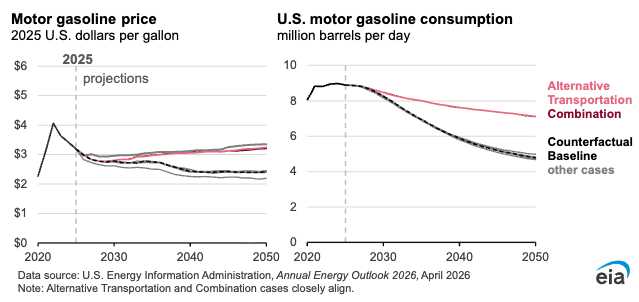
Despite higher prices at the pump, domestic crude oil production does not increase proportionately because a larger share of oil refiners’ feedstock comes from trade. In the Alternate Transportation Case, U.S. oil exports decrease by about 0.5 million barrels per day, and U.S. oil imports increase by about 0.3 million barrels per day compared with the Counterfactual Baseline case. With less electricity demand from the transportation sector, the EIA projects 9% less electricity sales than in the Counterfactual Baseline case.
Analysis
The 2026 Annual Energy Outlook incorporates Biden’s tailpipe emissions rule in its Counterfactual baseline. The rule was effectively a mandate for EV sales, which the cases clearly depict. Without it, EV sales fall relative to the baseline, indicating that projections of rising EV sales are largely driven by government incentives rather than consumer preferences. As we explain in When Government Chooses Your Car, “History shows that top-down mandates often fail to achieve their intended outcomes, imposing significant costs and generating resentment among those most affected by the regulations.”
*This article was adapted from content originally published by the Institute for Energy Research.
You Might Also Be Interested In