
July 9, 2026
The Hidden 37-Cent Gas Tax (and How President Trump Can Immediately End It)
President Trump wants gasoline prices to “IMMEDIATELY” fall. Like the president, we all would like to see lower prices at the pump. With more tanker traffic flowing through the Strait of Hormuz (though that may change now that peace talks appear to be stalled), oil prices have fallen, which means gasoline prices have begun to decline as well. Historically, however, gasoline prices do not fall as quickly as crude prices, as most politicians (and motorists) would prefer. But there is something that the Trump administration can do to immediately impact high gasoline prices.
A federal mandate, called the Renewable Fuels Standard (RFS), has been supported by every president, Democrat and Republican, since President George W. Bush. President Trump, also a supporter of the mandate, even increased it earlier this year when the Environmental Protection Agency (EPA) finalized a record-high biofuel quota. But there is a hidden cost to propping up ethanol: higher gasoline prices. And it’s not just a small increase.
That mandate now amounts to a “tax” of about 37 cents per gallon of gasoline and diesel Americans buy. To put that number in perspective, it is more than double the 18.4-cent federal gasoline tax. The President has floated a federal gas-tax holiday for the summer driving season, a suspension Congress has not enacted. We support that. But suspending the 18.4-cent tax while leaving the 37-cent “RFS tax” in place is treating the symptom and ignoring the disease. If the President wants cheaper fuel, the federal gas tax is a small lever. The RFS is a big one. The good news is that his own administration can pull that lever at any time.
How we got here: Washington chose this number
Congress created the RFS in the Energy Policy Act of 2005 and expanded it in the Energy Independence and Security Act of 2007, forcing a rising volume of corn ethanol, biodiesel, and other biofuels into the fuel supply on a schedule that climbed to 36 billion gallons in 2022. Then the schedule ran out. For every year after 2022, Congress did not include any numbers in the statute. Instead, it handed the dial to the EPA to decide. The only floor Congress left standing is 1 billion gallons of biomass-based diesel; for conventional ethanol and advanced biofuel, the law sets no minimum at all. Therefore, as a matter of statute, the Trump EPA could set the mandate to zero.
But instead, the EPA did the opposite. A regulation called “Set 2,” finalized on March 27, 2026, covers 2026 and 2027. It is the most aggressive mandate in the program’s twenty-year history. EPA ordered refiners to blend a record 26.81 billion Renewable Identification Numbers (RINs) worth of biofuel in 2026, including a 61% one-year jump in biomass-based diesel, from 3.35 to 5.40 billion gallons, while keeping the conventional ethanol mandate at 15 billion gallons. With no legal obligation to require a single gallon beyond the biodiesel floor, the administration chose record-setting biofuel volumes instead.
The Renewable Fuel Standard is a climate mandate
The RFS is an especially strange policy for this administration. At its core, it is a greenhouse-gas program. The categories of biofuel credit are not defined by energy content, cost, or even by the crop involved. They are defined by how much each fuel is supposed to cut lifecycle carbon emissions compared with petroleum. Under the 2007 statute, conventional corn ethanol must show a 20% reduction, biomass-based diesel and advanced biofuel must show 50%, and cellulosic biofuel must show 60%. Take the climate accounting away, and the four credit categories have no reason to exist. In other words, the entire structure is designed to chase carbon dioxide reductions.
That is the same climate agenda this administration repeatedly and soundly rejected. The White House published a fact sheet titled “Ending the Green New Scam.” The President told the United Nations that climate change is “the greatest con job ever perpetrated on the world.” Yet the RFS acts as a carbon dioxide-reduction mandate, built entirely on greenhouse-gas math, that his EPA just expanded to the largest level in its history. And the program is working. The price of gasoline and diesel is higher because of it.
What happened this year and how it lands at the pump
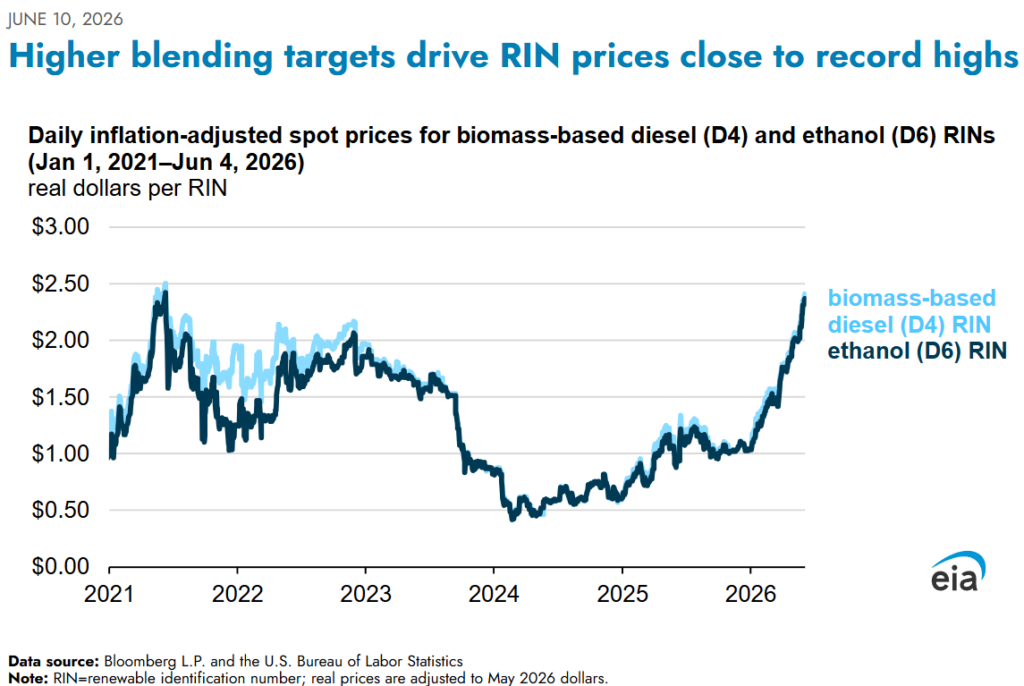
Refiners and importers comply with the mandate by retiring credits called Renewable Identification Numbers (RINs). When the EPA raises the quota, RINs get scarce and their price climbs. According to the U.S. Energy Information Administration (EIA), RIN prices have doubled since the start of 2026. As of June 4, biomass-based diesel (D4) RINs traded at $2.41 and ethanol (D6) RINs at $2.37, near their all-time highs. EIA names the cause directly: EPA’s March 27 rule and its “significantly higher” mandates. Here’s EIA’s graphic:
That regulatory compliance is not absorbed by refiners; it is passed straight through to drivers. A definitive peer-reviewed study by MIT’s Christopher Knittel and Harvard’s James Stock found that RIN costs pass through to wholesale fuel prices at a coefficient of nearly 1.00—complete pass-through, within two business days (Journal of the Association of Environmental and Resource Economists, 2017). The EPA agrees. In its own analysis of RIN prices, the agency concluded that obligated parties “are generally able to recover the cost of the RINs they need for compliance… through the cost of the gasoline and diesel fuel they produce.” Translation: When the RIN price doubles, the consumer’s bill at the pump goes up by essentially the full amount. Thus, today’s 37-cent regulatory compliance tax on refiners is currently being paid at the pump.
The math behind the 37-cent RFS tax
The 37-cent figure is not an estimate or an advocacy number. It is the result of two things: EPA’s own mandate and the market price of a RIN.
First, the mandate. EPA does not simply set biofuel volumes; it converts them into a percentage that every refiner must hit. For 2026, the agency divided the 26.81 billion RINs of required renewable fuel by the roughly 173 billion gallons of gasoline and diesel it projects obligated parties will sell, arriving at a “total renewable fuel” standard of 15.50% (rising to 15.78% in 2027). In plain English, for every gallon of gasoline or diesel a refiner sells, it must hand the government RIN credits equal to 15.5% of a gallon. That 15.5% is the sum of four nested obligations, each tied to a credit type:
| Obligation (Credit Type) | 2026 Standard | × RIN Price | ≈ Cents/Gallon |
| Conventional ethanol (D6) | 9.08% | $2.37 | 21.5 |
| Biomass-based diesel (D4) | 5.24% | $2.41 | 12.6 |
| Cellulosic (D3) | 0.79% | ~$2.40 | 1.9 |
| Other advanced (D5) | 0.39% | ~$2.41 | 0.9 |
| Total renewable fuel | 15.50% | ≈ 37 |
Now the price. Each of those credits currently trades at about $2.40. The arithmetic: 15.5% of a gallon, at roughly $2.40 per credit, is about 37 cents per gallon. Run the same 15.5% across the entire obligated fuel supply, 26.81 billion RINs at about $2.40 each, and the RFS is a roughly $64-billion-a-year cost in 2026 alone, paid by everyone who fills their tank. At the start of this year, when RINs traded near $1.20, that same mandate cost only about 18 cents a gallon (roughly the same amount as the federal gasoline tax). By making RINs more scarce, EPA’s larger quota doubled the per-gallon cost in five months.
Conclusion
Like President Trump, we all want lower prices at the pump. The good news is that he can address it by instructing the EPA to reconsider its biofuel mandate. Ethanol interests will surely complain that this would hurt farmers, but the President is already doing plenty to help America’s farmers. For example, through the $12 billion Farmer Bridge Assistance payments, permanent tax relief on the One Big Beautiful Bill (including death tax elimination for family farms), enhanced crop insurance, new trade deals opening export markets for American agriculture, and a supplemental request to Congress (submitted in June) that includes $11.1 billion in additional agricultural assistance.
With talks with Iran once again stalled, gasoline and diesel prices are likely to rise. But President Trump – and only President Trump – has the power to immediately lower gasoline and diesel prices by 37 cents a gallon. That would be a welcome relief for all of us.

You Might Also Be Interested In