New Initiative Targets Carbon Tax Supporters

WASHINGTON — The American Energy Alliance begins tomorrow a new $750,000 initiative with a series of radio and television advertisements holding Members of Congress accountable for their votes on the controversial issue of a carbon tax. The first phase of the initiative will include two weeks of statewide broadcast and cable television spots targeting Sen. Mark Begich (D-Alaska) and statewide radio spots targeting Sen. Kay Hagan (D-N.C.). Other efforts will be announced in the coming weeks.

“Congress has now had numerous attempts to go on record in support of a carbon tax, and the American Energy Alliance has been watching closely to see where elected officials stand on the issue. When Members of Congress refuse to protect taxpayers from energy and tax policies that will harm American families and small businesses, undermine an economic recovery, and do nothing to achieve the purported benefits to the environment, they deserve to hear from their constituents,” AEA President Thomas Pyle said of the organization’s newest initiative.

“A well-funded propaganda campaign has arisen to support various carbon tax schemes, but the American people demand sensible policies guided by the facts. A carbon tax isn’t a tax on carbon, because carbon doesn’t pay taxes. In reality, it’s a tax on people who will pay for it every month in their utility bills, every week at the gas pump, and every day with increased tax burdens and shrinking discretionary income.”

The Alaska television spot, entitled “Carbon Games,” will begin airing on Sept. 5 in the state’s three major markets: Anchorage, Fairbanks, and Juneau. The North Carolina radio ads will air statewide via markets in Asheville, Charlotte, Fayetteville, Greensboro, Winston-Salem, Greenville, New Bern, Raleigh-Durham, and Wilmington. The initial financial commitment for phase one of the AEA initiative exceeds $250,000.

To view the “Games” television spot, click here.
To read supporting documents for the “Carbon Games” ad, click here.

To hear the North Carolina radio ads, click here.
To read the supporting documents for the North Carolina ad, click here.

###

How Big Ethanol Hopes You're a Dope

Growth Energy recently unveiled a national ad campaign to tell “the truth about ethanol” and the Renewable Fuel Standard (RFS)—the federal mandate that requires oil refiners to blend ethanol into gasoline. But the ethanol lobby has a curious definition of “truth,” as many of their claims are incomplete, misleading, or outright false.

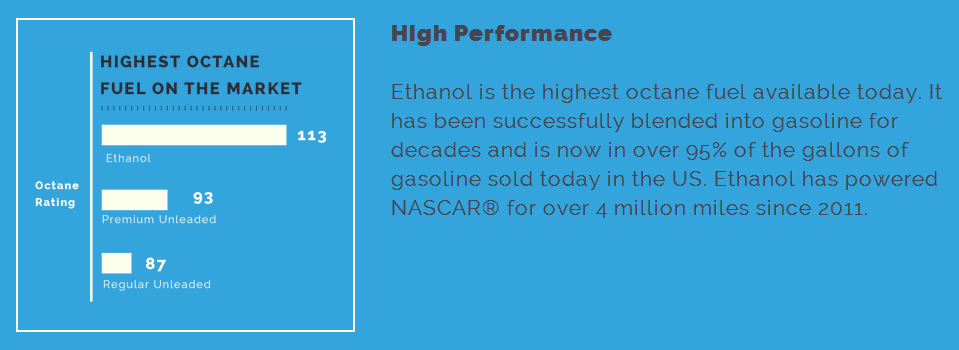
NASCAR doesn’t use ethanol because it is a “high performance” fuel, but because it is “product placement”

Graphic from Growth Energy:

growthenergy1

Growth Energy proudly declares that NASCAR uses ethanol. This should not be a surprise, however, because Growth Energy and the National Corn Growers Association are official sponsors of NASCAR. As a NASCAR official confirmed to Delaware Online, ethanol’s relationship with NASCAR amounts to a “sports product placement agreement.”

When we see LeBron James wearing Nikes, Phil Mickelson swinging Callaway golf clubs, or people in the TV show The Office using Apple products, we should not be surprised because these are all paid product placement. The fact that NASCAR uses ethanol does not say much if anything about ethanol, other than the fact that NASCAR is paid to use it.

Ethanol increases ozone air pollution

Graphic from Growth Energy:

growthenergy2

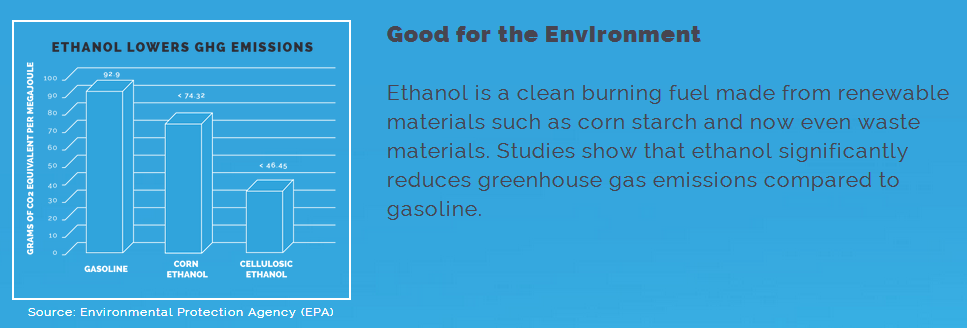
When Growth Energy says that ethanol is “clean burning,” they fail to mention that burning ethanol increases air pollution, particularly ozone. As Scientific American explains:

Because burning ethanol can potentially add more smog-forming pollution to the atmosphere, however, it can also exacerbate the ill effects of such air pollution. According to [Stanford University environmental engineer Mark] Jacobson, burning ethanol adds 22 percent more hydrocarbons to the atmosphere than does burning gasoline and this would lead to a nearly two parts per billion increase in tropospheric ozone. This surface ozone, which has been linked to inflamed lungs, impaired immune systems and heart disease by prior research, would in turn lead to a 4 percent increase in the number of ground level ozone-related deaths, or roughly 200 extra deaths a year. “Due to its ozone effects, future E85 may be a greater overall public health risk than gasoline,” Jacobson writes in the study published in Environmental Science & Technology. “It can be concluded with confidence only that E85 is unlikely to improve air quality over future gasoline vehicles.”

More recent research has reached a similar conclusion that ethanol increases ozone pollution. The Union of Concerned Scientists, an environmental group, cautions, “If done wrong, the production of biomass for biofuels like ethanol could destroy habitats, worsen water or air quality, limit food production and even jeopardize the long-term viability of the biomass resource itself.” That does not sound “good for the environment.”

Growth Energy’s argument that ethanol has lower greenhouse gas emissions is also debatable. Lifecycle greenhouse gas emission studies are difficult and complicated to conduct. As a result, some say ethanol decreases greenhouse emissions, while others say that ethanol increases greenhouse gas emissions. A study published in Science that includes land use changes finds that corn-based ethanol nearly doubles greenhouse gas emissions over the next three decades and continues to increase emissions for the next 167 years. The Energy and Resources Group of the University of California, Berkeley finds that “if indirect emissions [resulting from the production of ethanol] are applied to the ethanol that is already in California’s gasoline, the carbon intensity of California’s gasoline increases by 3% to 33%.”

Lastly, it is disingenuous for Growth Energy to include the greenhouse gas emissions of cellulosic ethanol in its graphic because only miniscule amounts of cellulosic ethanol are produced. Currently, the U.S. consumes more than 133,000,000,000 gallons of motor gasoline a year. In contrast, in 2011, zero gallons of cellulosic ethanol were sold commercially; last year only 20,069 gallons of cellulosic ethanol were sold commercially; and so far this year only 129,731 gallons have been sold.

Ethanol has helped increase domestic fuel production, but not nearly as much as increases in domestic oil production

Graphic from Growth Energy:

growthenergy3

If ethanol improves the economy, as Growth Energy argues, then there is no reason for the Renewable Fuel Standard to exist. If that is Growth Energy’s argument, we agree. The problem with the Renewable Fuel Standard is that as a mandate, its purpose is to force people to use something they would not otherwise use, or to use it in higher quantities than otherwise. By forcing people to use more ethanol that they would otherwise use, the Renewable Fuel Standard harms the economy, because “the economy” is simply a way for us to trade with each other and improve our situations through cooperation. If someone forces vegetarians to buy hamburgers, or non-smokers to buy cigarettes, that might look like “economic growth” and “job creation” but it doesn’t actually make Americans better off. By the same token, if the government forces people to use ethanol, that’s not genuine prosperity.

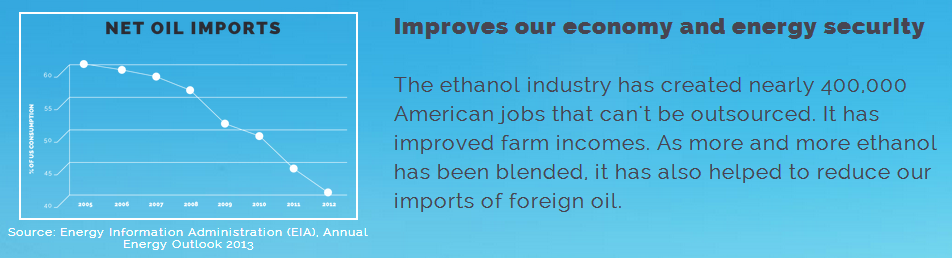
Growth Energy’s chart showing declining net oil imports is accurate, but it fails to state the biggest reason for the reduction in oil imports—increasing domestic oil production, not ethanol. Net oil imports are falling because U.S. oil consumption is holding steady, domestic fuel production is increasing, and the U.S. is exporting a greater amount of petroleum products. U.S. liquid fuels production rose 39 percent from 2005 to 2012, according to data from the Energy Information Administration (EIA). Biofuels accounted for 32 percent of the increase, while petroleum contributed about 68 percent. Because of increased domestic production and fairly flat demand, the United States is exporting petroleum. U.S. petroleum exports almost tripled between 2005 and 2012. Growth Energy’s chart is based on net imports, which are gross imports minus exports. Increased domestic petroleum production, not ethanol production, is the biggest force behind America’s reduction in imports.

Earlier in the year, EIA projected that monthly domestic oil production was on track to surpass net imports for the first time since 1995. EIA attributes this change primarily to “rising domestic crude oil production, particularly from shale and other tight rock formations in North Dakota and Texas.” America is indeed weaning itself off of foreign oil, but the ethanol industry does not deserve nearly as much credit as they claim.

Oil companies oppose the Renewable Fuel Standard because it hurts their business, and ethanol companies support the Renewable Fuel Standard because it requires the American people to use their product

Growth Energy writes, “For every gallon of renewable fuels that is blended into gasoline, it’s one less gallon of gasoline the oil industry can sell…It’s really quite simple. It’s all about money.” Growth Energy knows this statement is incorrect. They are correct, this is about money—that’s not the issue. The issue is whether “for every gallon of renewable fuel that is blended into gasoline, it’s one less gallon the oil industry can sell.” This is inaccurate because a gallon of ethanol is not the same as a gallon of gasoline. A gallon of ethanol contains 33 percent less energy than a gallon of gasoline and therefore it takes more gallons of ethanol to travel the same distance as using gasoline.

The argument about money applies equally to the ethanol industry. Of course oil companies do not want to be forced to sell their competitors’ products, in the same way Honda would not want to be forced to sell a certain percentage of Chryslers. But this is exactly what the Renewable Fuel Standard does.

Growth Energy and ethanol companies support the Renewable Fuel Standard because it forces oil companies to sell ethanol. Growth Energy, Cargill, ADM and other major ethanol producers could start their own gas stations and sell as much ethanol as people would like to buy, but that is not what they want. By supporting the Renewable Fuel Standard, Growth Energy wants to force people to sell Growth Energy’s products.

Subsidies for some energy sources does not justify subsidies for ethanol

Graphic from Growth Energy:

growthenergy4

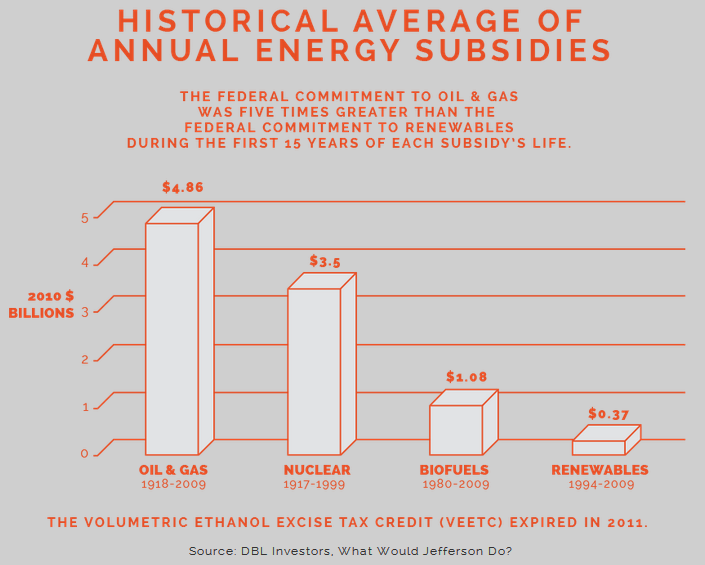
This chart is misleading for several reasons. The most obvious is that the chart conveniently excludes most of the Obama administration, when subsidies for green energy technologies skyrocketed.  For example, according to the Energy Information Administration, between fiscal year 2007 and fiscal year 2010, subsidies for renewable energy almost tripled. In fiscal year 2010, biofuels received 3.5 times the subsidy level that petroleum liquids and natural gas received outside the electricity generation sector.

The chart correctly notes that the Volumetric Ethanol Excise Tax Credit (VEETC), which paid the ethanol industry to produce ethanol, expired at the end of 2011. According to the White House’s budget, in 2011, the VEETC was worth $6.5 billion and in 2012 it was worth $3.6 billion.[1] That’s nearly twice as much money as the oil and gas tax credits were worth over 91 years.

Another problem is the way oil subsidies are calculated. According to the report the chart is based upon, the only “subsidies” for oil and natural gas companies were “the expensing of intangible drilling costs and the excess of percentage over cost depletion allowance.”[2]  These tax deductions are akin to those that businesses receive for depreciation (percentage depletion allowance) and research and development (expensing of intangible drilling costs). All businesses receive the domestic manufacturing tax deduction, but the oil and gas industry can only claim a 6 percent deduction of its profits, while all other manufacturers can deduct 9 percent.  Large oil companies, however, are specifically excluded from some of the incentives that the small independent oil and gas companies receive, as IER explains in a recent analysis.

So-called subsidies for oil are much different than subsidies for ethanol. The VEETC, on the other hand, provided 45 cents for every gallon of ethanol blended with gasoline. Though the ethanol tax credit expired, the federal government continues to offer tax credits to biodiesel producers.

Lastly, ethanol has been used in internal combustion engines for nearly 190 years—ever since Samuel Morely experimented with ethanol mixed with turpentine. Ethanol is not a “new fuel” that needs subsidies to compete.

Ethanol damages engines, especially small engines

Graphic from Growth Energy:

growthenergy5

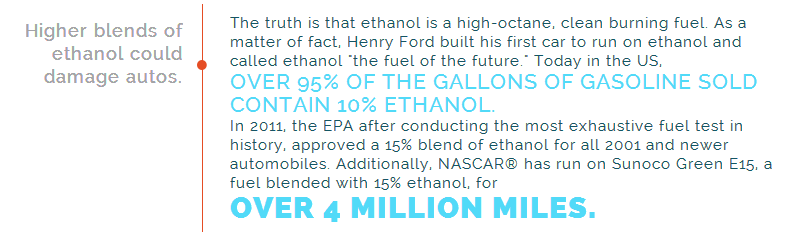
Growth Energy tries to argue that higher ethanol blends won’t damage automobiles. This is false. EPA has only said that E15 is okay for cars model year 2001 and newer. Cars older than model year 2001 could be damaged, according to EPA’s waivers. But this assumes that EPA’s study of the impact of E15 is correct. A study by the Coordinating Research Council finds that 5 million cars could experience engine damage or failure from E15. As such, several automobile manufacturers will not warranty vehicles using E15.[3] Furthermore, AAA has called for a suspension of E15 sales, citing “consumer confusion and the potential for voided warranties and vehicle damage.”

But the problem with ethanol is not isolated to just automobiles. Ethanol poses even more problems for machines with small engines. As AAA explains, gasoline blended with even as little as 10 percent ethanol can accelerate engine failure in boats, motorcycles, lawnmowers, and other small engines. As a result, some boaters are turning to ethanol-free gasoline. A gas station owner in North Carolina, for example, says many customers are willing to travel across the county for gasoline that they know won’t harm their boats. The National Marine Manufacturers Association (NMMA), the trade group for the recreational boating industry, also opposes gasoline blended with more than 10 percent ethanol.

Forcing oil companies to blend greater and greater amounts of ethanol increases gas prices

Graphic from Growth Energy:

growthenergy6

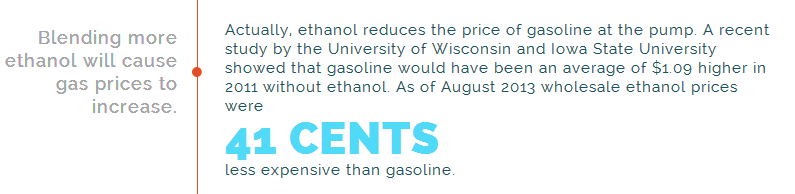
While it is true that on a per gallon basis, ethanol is less expensive than pure gasoline, that is not the correct measure. The real unit of comparison is not the cost per gallon, but the cost per unit of energy. Because ethanol contains about 33 percent less energy than gasoline, as ethanol content increases, fuel economy decreases. AAA’s Daily Fuel Gauge Report reflects this scientific fact; the BTU-adjusted price of E85, ethanol that contains up to 85 percent ethanol, is consistently higher than conventional gasoline. A year ago, regular gasoline cost about 70 cents less than E85 on a miles-per-gallon basis. Even with a record corn harvest driving down corn prices this year, E85 still costs about 20 cents more than conventional gasoline.

As for the study Growth Energy references, the Iowa State study claiming that ethanol production has suppressed the growth in gasoline prices is very misleading. It takes for granted the current refinery capacity and other infrastructure that industry uses to deliver gasoline to motorists, without realizing that federal policies over the years have distorted the development of these markets. Ethanol only survives in the market place at its current levels because it is propped up by artificial mandates and preferential tax treatment.

The regression analysis of the Iowa study doesn’t accurately capture the timeline that would have occurred had the free market been allowed to operate. Of course, a sudden disappearance of all ethanol would cause a bigger price spike in the Midwest than in the East Coast. That’s because the artificial federal support has displaced the development of oil-based gasoline delivery in the Midwest more than in other regions. The fact remains that ethanol (at its current market share) is very inefficient. Taxpayers and consumers would be richer if the government dropped its support programs for it. For a more complete explanation, see this analysis.

Even if the Wisconsin and Iowa State study is correct that ethanol decreased gasoline prices in 2011, blending increasing amounts of ethanol threatens to increase, not decrease, gas prices in the near future.  A recent study by the Energy Policy Research Foundation, Inc (EPRINC) finds that E10 prices could spike as much as 50 cents to $1.00 per gallon in 2014. EPRINC attributes the increase to “constraints in cost effective opportunities to blend larger volumes of renewable fuels into the U.S. gasoline pool,” otherwise known as the blend wall. When the blend wall is hit, refiners must purchase Renewable Identification Number (RIN) credits, which allows them to not meet their required biofuel quotas. The value of RINs has skyrocketed by 2300 percent during the past year due to the approaching blend wall. The cost of the RINs is passed onto the distributor and then to the customer. Another study by NERA Economic Consulting finds that by 2015 the federal ethanol mandate could raise diesel costs by 300 percent, gasoline prices by 30 percent, and reduce take-home pay for American workers by $580 billion.

As we get closer to the blend wall, the impact of the Renewable Fuel Standard will become more and more severe.

The ethanol industry no longer receives direct subsidies; instead they have something better—a mandate that Americans use their product

Graphic from Growth Energy:

growthenergy7

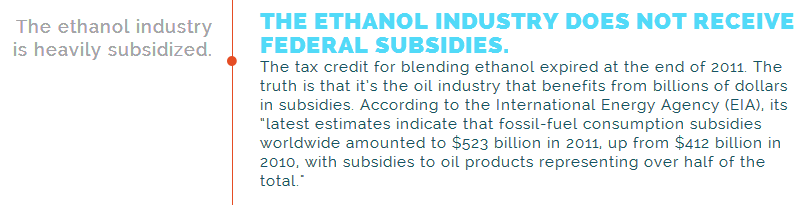
The ethanol tax credit may have expired, but the ethanol industry continues to enjoy what is arguably an even more attractive subsidy: the Renewable Fuel Standard (RFS). Passed in 2005 and expanded in 2007, the RFS requires oil refiners to blend increasing amounts of ethanol and other biofuels into the nation’s transportation fuel supply, with the goal of blending 36 billion gallons by 2022.

As Kevin Drum of Mother Jones observed soon after the ethanol tax credit expired, ethanol subsidies are “not gone, just hidden a little better.” The Congressional Budget Office (CBO) noted in 2010 that the ever-rising federal mandate would obviate the need for a tax credit: “In the future, the scheduled increase in mandated volumes would require biofuels to be produced in amounts that are probably beyond what the market would produce even if the effects of the tax credits were included.” As Drum explains, “Demand for ethanol is driven by the mandates, not by the tax credit.”

By forcing refiners to purchase ethanol regardless of whether it makes economic sense, the RFS creates artificial demand for ethanol. Tax credits, on the other hand, make production more profitable, but don’t compel people to purchase the products produced. In other words, the RFS gives ethanol producers a much more valuable gift than tax credits—it gives them repeat customers.

Further, the U.S. oil and gas industry does not receive the federal subsidies that Growth Energy cites in the above graphic. The International Energy Agency (IEA) annually estimates global fossil-fuel consumption subsidies that measure what developing countries spend to provide below market cost fuel to their citizens. The IEA is a creation of the Organization for Economic Cooperation and Development (OECD), which represents the developed nations of the world. In 2011, IEA found fossil fuel consumption subsidies total $523 billion, 27 percent higher than the 2010 total of $412 billion. This increase is almost entirely due to the increase in international energy prices, particularly oil prices. Oil subsidies make up over half of the total fossil fuel consumption subsidies, while electricity makes up 25 percent, natural gas 20 percent and coal less than 1 percent.

Developing countries artificially lower energy prices to their citizens, paying the difference from their government resources. Such welfare transfers are akin to the U.S.’s Low Income Home Energy Assistance Program (LIHEAP), and are different from subsidies in the name of commercializing uneconomic energy sources such as on-grid wind or solar. The United States and other developed countries offer support to energy production in the form of tax credits, loan guarantees or use mandates, which are not included in IEA’s fossil fuel consumption subsidy calculations since they are directed towards production rather than consumption of the fuel. For a greater discussion, click here.

Conclusion

Millions of gallons of ethanol would be produced and used every year without the Renewable Fuel Standard since refiners would use it as an oxygenate. The problem is not ethanol per se, the problem is the Renewable Fuel Standard, which artificially increases the amount of ethanol required. The Renewable Fuel Standard increases gas and food prices, decreases fuel economy, and damages small engines. As such, it is time for Congress to repeal the mandate.

IER Policy Associate Alex Fitzsimmons authored this post.


[1] Analytical Perspectives: Fiscal Year 2013 Budget of the United States, http://www.whitehouse.gov/sites/default/files/omb/budget/fy2013/assets/spec.pdf, p. 253 footnote 2.

[2] Nancy Pfund & Ben Healey, What Would Jefferson Do, Sept. 2011, http://www.dblinvestors.com/documents/What-Would-Jefferson-Do-Final-Version.pdf p. 20.

[3] Ford and General Motors have approved the use of E15 but only for new cars starting in 2012 for GM and 2013 for Ford. http://thehill.com/blogs/e2-wire/e2-wire/259785-biofuels-industry-lauds-automakers-for-approving-higher-ethanol-fuel-blend

Ethanol, Corn Prices, and RINs, Oh My!

What do ethanol mandates, corn prices, and renewable identification numbers have in common? The answer is the Renewable Fuel Standard that was first passed in 2005 and then increased in 2007 when the Energy Security and Independence Act was enacted, requiring specified annual amounts of corn-based and cellulosic ethanol to be produced and blended into gasoline. The outcome of this poorly conceived legislation is skyrocketing corn and food prices, a blend wall where ethanol blended into gasoline has almost hit its 10 percent share, and skyrocketing prices for renewable identification number (RIN) credits that refiners must purchase if they cannot blend the required composition of ethanol-based fuels. The next question is: If a law is having bad outcomes, why isn’t it being repealed, or at least fixed? Unfortunately, to some, these higher prices and demand limitations aren’t a concern; they welcome higher prices and intend to find ways to increase ethanol’s share regardless of what the ramifications are to our cars, boats, lawn mowers, weed eaters, and anything else with a small motor.

Corn Prices

Corn is the biggest U.S. crop and it is grown on more than 400,000 farms with a total area harvested for grain as large as New Mexico. About 40 percent of the U.S. corn crop is used to make ethanol.

Before the ethanol mandate became law, corn prices averaged less than $2.50 a bushel. Due mainly to growing demand by the ethanol industry, corn prices surged in 2008, around $7 a bushel. Although the recession lowered those prices, they rebounded strongly hitting over $8 a bushel last year, remaining above $6 a bushel for the past 2 years. Prices though have begun to fall due to the nearness of the blend wall and a very strong crop this year. The Department of Agriculture projects that this year’s corn harvest will total about 14 billion bushels, about 30 percent higher than last year’s harvest of 10.8 billion bushels and more than 10 percent higher than the corn harvest in 2011 of 12.4 billion bushels. The record crop is expected to bring corn prices down to around $4.25 a bushel, which is still 70 percent higher than before the ethanol mandate.[i]

Source: The Wall Street Journal

But these lower expected prices are coming too late for some. Feedlot operators, who fatten cattle for slaughter, are closing operations at escalating rates. Last year, about 2,000 of the nation’s 77,120 feedlots exited their business, up from 20 the preceding year. The number of feedlot operators has dropped 20 percent during the past decade with the biggest impact on small operators with less than 1,000 cattle.[ii]

Feedlot owners buy roughly one-year-old cattle that weigh about 750 pounds and feed them a corn-heavy diet for 6 months bringing their weight up to as much as 1,400 pounds at time of slaughter. Last year, feedlots with 1,000 or more cattle sold 24.95 million animals, 12 percent less than the 28.29 million sold in 2000. On average, U.S. feedlots have lost money for a record 27 straight months, with the losses equaling an average of $141 per head of cattle over that period.

Feedlot operators have been squeezed by rising prices for young cattle and high feed costs that have outstripped prices paid to them by meatpackers. U.S. beef consumption last year was 15 percent lower per person than a decade earlier.

Source: The Wall Street Journal

The Blend Wall Nears

Because gasoline consumption has declined since 2005 and is remaining fairly flat resulting from high gasoline prices, a weak economy with fewer people working and more mandated fuel-efficient cars, in order to use more ethanol as the renewable fuel standard requires, the share of ethanol blended into gasoline needs to be increased from its current 10 percent share. The Environmental Protection Agency wants to increase it to 15 percent. However, car manufacturers will not warranty their engines when they run on a blend higher than the current 10 percent ethanol. Further, there are other small motors and products that cannot even use a 10 percent blend without destroying the motor.

Renewable Identification Numbers

Under the Renewable Fuel Standard, oil-and-gas companies are required to blend biofuels such as ethanol with conventional gasoline. By 2022, the standard calls for 36 billion gallons of renewable fuel to be mixed with transportation fuels. If refiners cannot blend the required amount of renewable fuel (ethanol), they must purchase credits known as Renewable Identification Numbers (RINs) with each credit allowing a refiner to reduce its blend amount by a gallon of ethanol. The increased costs are passed onto distributors, who then pass it onto consumers.

Renewable Identification Number credits have escalated in cost from a few pennies last year to as much as $1.40 this year. Major refiners have had to spend hundreds of millions of dollars on them, passing along their additional costs by raising fuel prices. It is estimated that the cost to consumers is about 10 cents per gallon. According to the National Policy Research Association, by next year, when the renewable mandate will increase to 18.2 billion gallons from 16.6 billion gallons currently[iii], the purchase of RIN credits is expected to increase the price of a gallon of gasoline by 20 cents to $1.[iv] And, according to a study by NERA Economic Consulting, exceeding the blend wall could result in diesel fuel costs increasing by as much as 300 percent and a 30 percent increase in gasoline costs by 2015.[v]

Unless the law is repealed or changed drastically when the 2022 mandate is reached at twice the 2014 level, there will be a  large impact from these credits  on consumer prices. This is only exacerbated by President Obama’s corporate average fuel economy standards, which are doubling by 2025 to 54.5 miles per gallon, thus reducing demand for gasoline further.

Why the Law Is No Longer Needed

When the renewable fuel standard was originally passed in 2005 and and then quintupled (from 7.5 billion gallons to 36 billion gallons) in 2007, the expectations for the U.S. oil market were for declining production. The success of hydraulic fracturing and directional drilling has turned those expectations around to the point that the United States will soon become the world’s largest producer of oil. These new drilling technologies have increased domestic oil production by 1.3 million barrels per day between 2005 and 2012. Due mainly to the production increase and a decline in gasoline consumption, imports have declined by 3.1 million barrels per day since 2005. Net imports (imports minus exports) now account for just 40 percent of consumption, down from 60 percent in 2005, and are expected to decline to 34 percent by 2019, according to the Energy Information Administration.[vi]

Thus, the stated goals of reducing overseas oil imports that the renewable fuels mandate was supposed to meet by 2022 have been surpassed by developments that were unimaginable when the bill was passed.

Conclusion

The Maine House Republicans have summarized the renewable fuel issue well:

“[E]vidence is mounting that ethanol is a failure in virtually every way. It takes more energy to produce it than the fuel provides. Food supplies around the world have been disrupted because so much of the corn crop now goes to ethanol. It costs taxpayers billions of dollars in subsidies at a time when our nation is already $12 trillion in debt. Even environmentalists have turned against it; research shows that ethanol production increases the amount of carbon dioxide released into the atmosphere.”

What’s missing from the above statement, however, is the increased cost Americans are now paying for their transportation fuels due to bad legislation. Because refiners cannot blend the required amount of renewable fuel into transportation fuels, they must purchase credits, which have increased by 2300 percent and which are passed onto distributors and consumers. Thus, our federal government has come up with what amounts to a hidden tax on gasoline!


[i] Wall Street Journal, A Corn Boom Starts to Wilt, August 11, 2013, http://online.wsj.com/article/SB10001424127887323446404579006594160246998.html

[ii] Wall Street Journal, Cheaper Feed Comes Too Late for Some Cattle Feeders, August 13, 2013, http://online.wsj.com/article/SB10001424127887323997004578642550438797168.html?mod=WSJ_WSJ_US_News_4

[iii] Energy Security and Independence Act of 2007, http://www.gpo.gov/fdsys/pkg/BILLS-110hr6enr/pdf/BILLS-110hr6enr.pdf

[iv] USA Today, Ethanol quotas pump money from your pocket, August 18, 2013, http://www.usatoday.com/story/opinion/2013/08/15/ethanol-mandate-energy-editorials-debates/2663215/

[v] Daily Caller, Industries spar over the future of renewable fuel subsidies, July 23, 2013, http://dailycaller.com/2013/07/23/industries-spar-over-the-future-of-renewable-fuel-subsidies

[vi] Energy Information Administration, Annual Energy Outlook 2013, http://www.eia.gov/forecasts/aeo/source_oil_all.cfm#ussupply

Valero Dumps Cellulosic Ethanol Project

A company that received lavish subsidies to build a cellulosic ethanol plant in Michigan recently lost a major private-sector investor.

Mascoma Corp.[i] must now look elsewhere for funding its ethanol facility in Kinross, Michigan, after news that Valero Energy Corp. is withdrawing its $50 million dollar investment. Mascoma, a New Hampshire-based renewable fuels company, received nearly $120 million in federal and state grants for its $233 million project[ii], yet construction of the plant remains far behind schedule.

Plans for the plant began in 2008 when Mascoma joined with J.M. Longyear, a Michigan-based natural resources company, to form Frontier Renewable Resources LLC. Frontier was expected to build a facility that could initially produce 20 million gallons of ethanol per year from hardwood pulpwood[iii] and eventually produce 40 million gallons of cellulosic ethanol annually.[iv] This is a lofty goal considering the entire industry produced just 20,069 gallons of cellulosic ethanol in 2012, even though the EPA mandated 8.65 million gallons under the Renewable Fuel Standard (RFS).[v]

Prior to Valero’s investment, Mascoma received a $20 million grant from the State of Michigan and nearly $100 million from the U.S. Department of Energy (DOE). In December 2011, Mascoma, through its subsidiary Frontier, established a joint venture with Valero to construct the facility. Construction was scheduled to start in 2012 and be completed by the end of 2013. Highlights from the deal include[vi]:

  • Valero would provide project management to build and operate the facility and hold majority interest.
  • Mascoma, through its subsidiary Frontier, would hold a minority interest.
  • Mascoma would contribute the proceeds from its DOE cooperative agreement award and its State of Michigan grant to the joint venture, while Valero would provide additional financing.

Despite funding from Valero and generous government subsidies, construction has yet to begin. Additionally, Mascoma promised to create 70 jobs by the end of 2012, but the company has thus far created just three new jobs.[vii] With the loss of Valero’s investment, it is likely that the project will be delayed even longer.

While the Kinross facility falls even further behind schedule, Mascoma plans to move forward with the development of a second project in Drayton Valley, Alberta. Mascoma predicts that this facility, which is partially funded by the Canadian government, will produce 19 million gallons of cellulosic ethanol annually.[viii]

Mascoma’s Kinross project is just the most recent example of the struggles the biofuel industry has faced in producing cellulosic ethanol. As the following chart shows, EPA has a history of grossly overestimating cellulosic ethanol production. Moreover, EPA levied $6.8 million in penalties against oil refiners for failing to purchase cellulosic ethanol that does not exist.


The EPA lowered the cellulosic mandate to 6 million gallons for 2013, but it appears that production will fall well short once again. As we mentioned in a previous post, the Kior cellulosic ethanol plant in Columbus, Mississippi, which was supposed to fulfill the bulk of EPA’s mandate for 2013, fell 75 percent short of its volumetric estimates in the second quarter of this year.

Despite a combination of federal grants and mandates, cellulosic ethanol remains essentially non-existent. Valero’s departure from with the Mascoma deal delivers a serious blow not just to the Kinross facility, but also to the industry as a whole. If the industry cannot even manage to build the facilities necessary to produce cellulosic ethanol, then refiners should not be expected to blend unrealistic amounts of it into the fuel supply.

IER Press Secretary Chris Warren authored this post.


[i] http://www.vnews.com/news/townbytown/lebanon/8003877-95/mascoma-corp-loses-a-50-million-partner-valero-pulls-out-of-michigan-project

[ii] ibid 1

[iii] http://www.frontier-renewable.com/about/

[iv] http://www.frontier-renewable.com/images/news/2011-12-09-Mascoma-Valero-Kinross.pdf

[v] http://www.instituteforenergyresearch.org/2013/01/11/cellulosic-biofuels-basically-still-nonexistent-but-must-be-purchased-anyway/

[vi] ibid 4

[vii] http://www.michigancapitolconfidential.com/17123

[viii] http://www.ethanolproducer.com/articles/10150/valero-pulls-out-of-mascomas-michigan-proposed-plant-project

Fact Check: Dinneen Misleads in USA TODAY

Renewable Fuels Association President Bob Dinneen penned an op-ed in USA TODAY last week in which he offered several misleading claims about ethanol and the Renewable Fuel Standard (RFS). Dinneen’s piece preceded a USA TODAY editorial calling on Congress to repeal the RFS. Some of Dinneen’s most misleading statements are addressed below.

CLAIM: “Since it was enacted in 2005, U.S. dependence on imported oil has decreased from 60% to 40% largely because of biofuels.” 

FACT: According to Energy Information Administration data, U.S. liquid fuels production increased 39 percent from 2005 to 2012. Biofuels accounted for 39 percent of the increase, while petroleum contributed about 61 percent. The domestic oil boom brought about by hydraulic fracturing, not ethanol, is the true driving force behind America’s reduction in imports.

This oil boom is not over. Earlier in the year, EIA predicted that U.S. crude oil production was on track to surpass imports later this year for the first time in more than 15 years. In its analysis, EIA notes, “This projected change is primarily because of rising domestic crude oil production, particularly from shale and other tight rock formations in North Dakota and Texas.”

We are not going to run out of oil any time soon. In fact, our proven oil reserves are increasing, not falling. U.S. proved crude oil reserves increased by a record level for the second consecutive year, reaching a nearly 24-year high of 7.57 million bpd for the week ending August 9. Moreover, oil production in North Dakota rose to a record 24.6 million barrels in June, a 24 percent jump from a year earlier.

Meanwhile, ethanol production is flat in recent years. Between January 2012 and July 2013, ethanol production dropped from 0.953 million bpd to 0.854 millon bpd, a decline of more than 10 percent in just over a year and a half. Ethanol output decreased despite the federal mandate requiring refiners to blend increasing amounts of ethanol into gasoline.

CLAIM: “Because ethanol costs less than gasoline, it saves motorists more than $1,200 per year.”

FACT: Dinneen has it backwards: ethanol actually costs more than gasoline. This is primarily because ethanol is less energy dense than gasoline. A gallon of ethanol contains about 33 percent less energy than a gallon of conventional gasoline. Indeed, the BTU-adjusted price of E85 (ethanol that contains up to 85 percent ethanol) is consistently higher than regular gasoline. A year ago, regular gasoline cost about 70 cents less than E85 on a miles-per-gallon basis according to AAA’s Daily Fuel Gauge Report. Even with a record corn harvest driving corn prices down this year, E85 still costs about 20 cents more than regular gasoline.

Dinneen is correct that a gallon of ethanol (unadjusted for energy density) costs less than a gallon of gasoline, but that misses the point of why people use gasoline in ethanol in the first place. The point of transportation fuel is to fuel your vehicle and as explained above, when cars run on ethanol, they only get about 70 percent of the fuel economy as when they run on gasoline.

Not only does ethanol reduce fuel economy, but the RFS hurts all Americans, not just motorists. A recent study by the Energy Policy Research Foundation Inc (EPRINC) finds that failure to reform the RFS will cause E10 prices to spike as high as 50 cents to $1.00 per gallon in 2014. EPRINC attributes the increase to “constraints in cost effective opportunities to blend larger volumes of renewable fuels into the U.S. gasoline pool,” otherwise known as the blend wall. Another study by NERA Economic Consulting finds that by 2015 the RFS could raise diesel costs by 300 percent, gasoline prices by 30 percent, and reduce take-home pay for American workers by $580 billion. The facts simply do not support Dinneen’s claim that ethanol saves motorists $1,200 per year.

CLAIM: “By keeping cellulosic ethanol from the marketplace, Big Oil seeks to discourage investors from betting on the next generation of biofuels.”

FACT: The problem is that Dinneen is ignoring both the history and reality of cellulosic ethanol. The only thing keeping cellulosic ethanol out of the market is the price. Cellulosic ethanol is nothing new. In fact, cellulosic ethanol is nearly 200 years old and it was first commercialized over 100 years ago in the United States. Products like cellulosic ethanol aren’t produced in large quantities because they are expensive.

Despite a federal mandate to produce hundreds of millions of gallons of cellulosic ethanol a year, cellulosic ethanol until recently essentially was not produced commercially. In 2010, the Environmental Protection Agency (EPA) required refiners to purchase 5 million gallons of cellulosic ethanol, but not a single drop of commercially available cellulosic ethanol was produced. EPA actually increased the mandate in 2011 to 6.6 million gallons, but again no cellulosic ethanol was produced for commercial use. In 2012, EPA raised the mandate yet again to 8.65 million gallons, but the U.S. produced barely 20,000 gallons. So far this year, 73,272 gallons of cellulosic ethanol have been produced.

Oil companies are not “keeping cellulosic ethanol from the marketplace;” the marketplace isn’t producing it. Furthermore, oil refiners cannot purchase a product that does not exist. Nevertheless, EPA forced refiners to pay about $6.8 million in penalties for failing to blend cellulosic ethanol in gasoline. Not long after EPA handed down the fines, the D.C. Circuit Court ruled that EPA violated the Clean Air Act’s requirement that the agency develop the renewable fuel mandates in an objective, scientific manner. In its decision, the court described EPA’s attitude toward refiners as, “Do a good job, cellulosic fuel producers. If you fail, we’ll fine your customers.” If anything, Big Ethanol and EPA seem to be doing everything in their power to keep affordable gasoline from the marketplace.

Conclusion

It is time to end the subsidies for ethanol. Ethanol subsidies increase food and fuel prices on the American people. Instead of trying to force ethanol into the market, people should be able to choose how much ethanol they want to use. Ethanol has a role, but the role should not be dictated by bureaucrats in Washington, D.C.

IER Policy Associate Alex Fitzsimmons authored this post.

In the Pipeline: 8/19/13

Woods (Dynegy), Spitzer (Steptoe), Naeve (Skadden), Santa (INGAA), Kelliher (NextEra), Kelly (Akin Gump), Bailey (Cheniere), Moler (Exelon pensioner), Brownell (Comverge or Spectra, whichever you prefer). Say what you want, these people have vested interests that are very much involved with who might be the next Chairman of FERC. So let’s not kid anyone about why they signed that letter.

PoliticoPro (8/16/13) reports: “When a dozen former FERC commissioners lined up last week to defend President Barack Obama’s nominee to lead the agency against a scathing Wall Street Journal editorial, it was no easy task. The Journal’s editorial represented either a purposeful attack or ‘just an ignorance of how commissions work,’ said former FERC Commissioner Nora Mead Brownell, a George W. Bush appointee who organized the rebuttal by both Democratic and Republican former commissioners. The Journal’s July 29 editorial pummeled former Colorado Public Utilities Commission Chairman Ron Binz, calling him ‘the most important and radical Obama nominee you’ve never heard of.’ But it also criticized FERC, saying the agency has gone beyond its ‘narrow legal obligations’ and ‘deputized itself as a Wall Street regulator.’”

Our own Bob Murphy is from Rochester. It must be something in the groundwater.

The Democrat and Chronicle (8/13/13) reports: “The 20 solar panels Jeffrey Punton installed in the backyard of his Weldon Street home won’t ever generate enough electricity to cover their cost. Which is the whole point. He means them as a cautionary tale, one that Punton said cost him $13,000 and received another $29,500 in state and federal subsidies and tax credits. He installed the panels in 2009, and they work: he has generated about 15,000 kilowatt hours of electricity in four years, saving several hundred dollars a year on his energy bill. That’s a lot of savings, but barely enough to recoup his initial investment over several decades, and not enough to cover the public money involved. It’s that public money that chafes him, evidence of governmental intrusion in the marketplace.”

“Let me die in this old uniform in which I fought my battles. May God forgive me for ever having put on another.”

The Hill (8/15/13) reports: “A group run by a former GOP lawmaker that advocates for a carbon tax has lured Americans for Prosperity’s grassroots director to lead its outreach efforts. Laquan Austion will join ex-Rep. Bob Inglis’s (R-S.C.) Energy and Enterprise Initiative as its new director of outreach, the organization announced Thursday. The move is an interesting one, as the AFP strongly opposes a carbon tax, which Inglis’s group is pushing. ‘E&EI is blazing the trail for free-market solutions to a demanding issue that Americans care about,’ Austion said in a statement. ‘I’m excited for the opportunity to contribute to the growing coalition of conservatives offering the country real solutions for energy security and climate change.’ A carbon tax is a fee imposed either at fossil fuel extraction or generation with the goal of reducing greenhouse gas emissions. Under most schemes, some revenues are returned to residents to offset higher energy costs.”

So the wind guys and the solar crew is on the Binz bandwagon. How much more obvious does it have to get?

The Daily Caller (8/6/13) reports: “The bill passed and the Colorado PUC voted to have Xcel shut down six coal-fired generators and replace them with natural gas-fired ones. However, the Denver Post reported that prior to the enactment of the bill, Binz had engaged in meetings with executives in the natural gas industry and from Xcel, according to government documents. ‘By early March 2010, he was even reassuring Xcel officials on how the commission would treat cost recovery under draft language — eventually crowing, ‘The eagle has landed. The commission and Xcel have agreed on language for cost recovery,’’ the Post reported.”

Working Group Broke the Rules With Its 'Social Cost of Carbon' Estimate

In my recent testimony to the Senate Environmental and Public Works committee, I explained that (among its other problems) the Obama Administration’s Working Group on climate change had explicitly ignored the Office of Management and Budget (OMB) guidelines stating that cost/benefit analyses had to be conducted using both a 3 percent and a 7 percent discount rate. Rather than following these instructions, the Working Group chose to report its estimate of the “social cost of carbon” at 3 percent and 5 percent. This was very significant, I explained to the senators, because the higher the discount rate, the lower the dollar impact of projected climate change damages. I said that if the Working Group had followed OMB’s guidelines, it very well could have come up with social cost of carbon estimates near zero, or even negative—meaning the entire case for regulating carbon dioxide emissions would collapse.

A colleague recently sent me the information pertaining to a new rule proposed by EPA, which illustrates just how amazing the Working Group’s omission is. Look at the following screen shot, which is an excerpt from EPA’s discussion of the costs and benefits of the rule (which regulations emissions from steam electric power plants):

As the above table shows, EPA is being a dutiful federal agency, following Executive Branch guidelines on how to calculate costs and benefits—it reports its findings using both a 3 percent and a 7 percent discount rate. Yet as the footnote explains, when reporting the benefits of reducing CO2 emissions, the EPA actually can’t use a 7 percent discount rate, because an estimate of the SCC (social cost of carbon) for a 7 percent rate is “not available.” Why is it not available? Because the Working Group explicitly ignored the OMB guidelines, and only reported the figures for 3 percent and 5 percent.

We thus have an absurd situation, in which EPA and other regulatory agencies will be following the rules and calculating benefits and costs at both the 3 percent and 7 percent discount rates. Yet, when they express the “social benefits” of reducing greenhouse gas emissions at the 7 percent rate, they are actually going to plug in the wrong number, and explain in a footnote why they are doing so. To repeat, this is important, because the “right” number would show that there are virtually no “social benefits” from reducing greenhouse gas emissions.

As I have explained elsewhere, there are far more problems to the Obama Administration’s computer-model-case against carbon, than just the choice of discount rate. Yet the knots into which the federal government has tied itself, in order to avoid revealing the truth about the actual economic literature, is quite revealing—not to mention hilarious.

IER Senior Fellow Robert P. Murphy authored this post.

In the Pipeline: 8/16/13

You got to know when to hold ’em, know when to fold ’em…

The Boston Globe (8/9/13) reports: “A group of environmentalists has dropped its campaign to place a so-called carbon tax on the next statewide ballot, citing the complexity of the issue, weak fund-raising, and potential constitutional challenges to the question. The group, the Committee for a Green Economy , had hoped to place a question on the 2014 ballot asking voters to approve a new tax on gasoline, heating oil, and other fossil fuels based on the amount of carbon dioxide they produce, with the aim of reducing pollutants that contribute to climate change. The committee, however, failed to file a petition with Attorney General Martha Coakley by Wednesday’s deadline, the first step in qualifying an initiative for the ballot.”

It’s never fun to say I told you so with so many Spaniards suffering as a result of their inept government.

Salon (8/14/13) reports: “The Spanish government is in debt to its power producers to the tune of 26 billion euros, the results of years spent regulating costs. To make up the difference, it’s imposing a levy on rooftop solar panels — effectively negating the economic benefit of generating clean energy. The tax will more than triple the time it takes for consumers to recoup their investment in rooftop panels, reports Reuters. It will also prevent people from selling any extra energy they generate that way back to the grid. Those who leave their panels up without connecting them to the grid, which is how the government will monitor and tax their energy production, face a fine of between 6 million and 30 million euros.”

Intermittent is a four letter word. 

The New York Times (8/14/13) reports: “The 21 turbines at the Kingdom Community Wind farm in Vermont soar above Lowell Mountain, a testament in steel and fiberglass to the state’s growing use of green energy. Except when they aren’t allowed to spin at their fastest. That has been the case several times in the farm’s short existence, including during the record July heat wave when it could have produced enough much-needed energy to fuel a small town. Instead, the grid system operator held it at times to just one-third of what it could have produced.”

We look forward to Admiral McGinn supporting opening ANWR, the OCS, and onshore as part of his readiness efforts.

Politico Pro (8/15/13) reports: “The Navy’s new energy chief doesn’t have any uncertainty about the scope of his mission. As the leader overseeing the service’s push to develop advanced biofuels and deploy more renewable energy, retired Vice Adm. Dennis McGinn says he has ‘to try to take the politics out of something which is essentially a national security issue.’ It’s no easy task. He faces production issues, technological barriers, increasingly tight budgets and scrutiny from congressional Republicans unhappy with the military’s green spending. But McGinn — the recently confirmed assistant secretary of the Navy for energy, installations and the environment and outgoing president and CEO of the American Council on Renewable Energy — says it all comes down to numbers.”

The most transparent administration in history.

The Daily Caller (8/15/13) reports: “A federal judge said that the Environmental Protection Agency’s use of private emails account may have been an attempt to skirt public scrutiny and transparency laws. The court decision comes after investigation uncovered that top agency officials were using such accounts to conduct official business. ‘The possibility that unsearched personal email accounts may have been used for official business raises the possibility that leaders in the EPA may have purposefully attempted to skirt disclosure under the FOIA,’ wrote U.S. District Judge Royce Lamberth in his decision.”

Stop the RINsanity!!!!

The USA Today (8/15/13) reports: “When members of Congress decided in 2007 to require that Americans put 36 billion gallons of ethanol in their gas tanks annually by 2022, they must have thought there was an award for bad public policy. The idea never made the slightest sense. The law, an expansion of a mandate adopted two years earlier, called for impossibly large quantities of corn to go into fuel production rather than onto people’s tables, driving up food prices. This year, the mandate requires 16.6 billion gallons of ethanol, absurdly consuming 37% of the nation’s corn crop and requiring farmland roughly equal to the size of Kentucky. Now unforeseen events are adding a tragicomic twist.”

Happy Friday.

Gizmodo (8/16/13) reports: “Stop me if you heard this before but an electric car and an electric pole walk into a bar… Okay, seriously. This is one of those ridiculous local news stories that are too perfect to be true but actually are. A Tesla Model S crashed into a utility pole in Tennessee and caused a local blackout. An electric car causing a blackout by crashing into a pole is a little funnier than a regular car driving into a gas station, right? The crash, which occurred in the afternoon, was actually a result of a DUI. A 34-year-old woman was behind the wheel at the time and said she was ‘messing with the radio’ (that darn giant touchscreen!) when the crash happened. When police arrived on scene, the electric car was 100 feet away from the downed utility pole and power was out locally: In order to load the crashed vehicle onto the flatbed, officers apparently had to obtain ‘technical instructions’ in how to turn off the Model S.”

In the Pipeline: 8/15/13

Question: Would Warren & Co. go all in on wind if they weren’t able to feed themselves greedily from the public coffers?  

The Daily Caller (8/13/13) reports: “A subsidiary of the Warren Buffett-owned MidAmerican Energy Holdings is looking to capitalize on federal tax subsidies by installing 448 wind turbines across five Iowa counties in order to generate up to 1,050 megawatts of power by 2015. Construction on the wind farms is scheduled to begin next month, meaning MidAmerican will qualify for generous wind tax credits offered by the federal government. ‘MidAmerican Energy Company does plan to use federal wind production tax credits for the recently announced wind expansion,’ a company spokeswoman told The Daily Caller News Foundation in an email. ‘The specific amount is not available.’”

When government becomes the judge, jury, and executioner, it really limits your options. You either play ball or perish. Really though, you can’t blame the refiners for not wanting to participate in Soviet style mandates.  

The Wall Street Journal (8/14/13) reports: “Last week, the Environmental Protection Agency issued its annual renewable-fuels mandate, telling refineries how much ethanol they must blend into the nation’s gas supply. This quota, which grows each year, is becoming a horrific financial burden on the industry, forcing many refineries to buy federal ethanol ‘credits’ to satisfy the rules. The skyrocketing price of those credits is adding hundreds of millions of dollars to refineries’ annual costs. So it was more than a little curious that the EPA, as part of its rule, announced it was exempting just one mystery refinery (out of 143) from this year’s mandate. The dispensation amounts to a significant financial favor to one lucky player, as I wrote in the Journal on Friday. Further reporting has revealed that the refinery is Alon USA Energy’s Krotz Springs facility in Louisiana. There’s reason to wonder why Krotz Springs alone got a deal.”

All the leaves are brown, and the sky is grey. San Francisco regulators, refuse to hike the rates. Green schemers for now, they’re are being held at bay. California green dreamin’, will wait another day.

CBS SF Bay Area (8/14/13) reports: “Proponents of a green power alternative to PG&E in San Francisco are frustrated, but not deterred by delays to the city’s long-awaited renewable energy program. However, this week’s setback when the SF Public Utilities Commission refused to move forward on a key approval has sent the program back to the drawing board. For nine years, the city has been putting together CleanPowerSF, which would cost customers more than PG&E, but would provide renewable or green energy.Supervisor John Avalos, a big supporter, said it’s been an uphill battle to come up with a program palatable for regulators, who on Tuesday, refused to sign off on a rate schedule.”

Come on Josh, if you’re going to keep blatantly promoting “misinformation” the least you could do is say it on the record.

The Washington Free Beacon (8/14/13) reports: “Environmentalist filmmaker Josh Fox grew frustrated during a recent public radio interview when asked about apparent falsehoods in his Oscar-nominated 2010 documentary Gasland. Fox asked an interviewer with Aspen public radio station KAJX to go ‘off the record’ so he could explain why he represented a gas extraction lease created by a group of Pennsylvania landowners as a $100,000 offer from a gas company to extract natural gas from his land. The document presented in Gasland was a draft of a lease that Northern Wayne Property Owners Alliance (NWPOA), a Pennsylvania landowners group, offered to gas companies exploring potential shale drilling operations in the area hoping to secure favorable terms for landowners, according to NWPOA members. It was not, as Fox claimed in the film, an offer from one of those companies. The group also says Fox was never a member, as he told KAJX on Monday.”


In the Pipeline: 8/14/13

Watch as the RFS advocates come crawling to Washington and beg them to prop up their industry by forcing you to buy their product. 

Fox News (8/13/13) reports “Only in Washington can an expensive, unnecessary regulation be considered common sense. The Obama administration is digging in its heels when it comes to repealing harmful energy regulations that increase consumer costs with little benefit to the environment. The Renewable Fuel Standard (RFS) is a classic example of hugely misguided energy policy, but to the Obama administration and its environmentalist allies, the RFS is a beneficial regulation aimed at curbing emissions and safeguarding against climate change.What they don’t say, but mean, is that it artificially drives up the cost of gasoline and when that happens, people can’t afford to drive as much. Remember how energy prices need to ‘skyrocket?’ Well, they are. ‘The backbone of our policy is the Renewable Fuel Standard,’ said top Obama energy adviser Heather Zichal at an event last week, adding that ‘calls to repeal the standard are nothing but shortsighted.’”

Elon Musk, having mastered the art of the federal fleece, now sets his sights on California taxpayers. Those high speed rail rent seekers better not underestimate this guy, or they just might lose their gravy train.

Business Week (8/13/13) reports: “‘L.A. to S.F. in 30 minutes?’ the front page of the Los Angeles Times asked this morning, reporting on the promise of Hyperloop, the conceptual superfast, solar-powered, tubular transit system that Elon Musk unveiled yesterday. The news came just a day after another L.A. Times piece about the potential of speedy travel up and down California, that one titled: ‘Shovel-ready bullet train construction delayed again.’ As the blog Curbed Los Angeles put it, ‘Nice timing, Musk.’ The contrast between Musk’s futuristic option for bridging Los Angeles and the Bay Area, and the much-delayed, over-budget, fast train that the state already has in the works, couldn’t have seemed starker or more striking. And that’s the point.”

At least she recognizes it’s much harder to be carbon neutral than just buying the next toy with a pretty green leaf on it.

The Bulletin of Atomic Scientists (8/7/13) reports: “The dynapod appeals to conservation-minded people in the same way that wind turbines and biofuel-powered cars and hand-cranked radios do: They’re hard, shiny machines that purport to produce “free” energy. Not just free in terms of cost and independence (because you no longer have to pay a big, bad corporation for electricity or gasoline), but also free from guilt. Because you’re not polluting the air, right? Unfortunately, things aren’t that simple. Before you even climb aboard your dynapod or generate your first watt of green energy, you’ve already stomped another carbon footprint into the sands of time through the manufacturing process. And until the energy embodied in machines, vehicles, buildings, gadgets, food, clothing, and other consumer purchases comes to be understood as part of total energy consumption, people can’t make well-reasoned choices about how to reduce their climate impact.”

Wait, you’re telling me the scientists could make conclusions based on flawed premises?

Forbes (8/13/13) reports: “Perseveration on global warming naturally inclines one to seek out other areas of  “science” where things aren’t exactly what they so obviously are, which brings me to the remarkable work of the most important toxicological scientist you have never heard of,  Dr. Ed Calabrese of the University of Massachusetts. His work, painstaking and seemingly obscure, is upsetting just about everything we ‘know’ about cancer and other illnesses commonly associated with environmental ‘pollutants.’ If taken to its logical conclusion, it could derail much of Washington’s regulatory bureaucracy, particularly the EPA’s. Not that this is going to happen overnight, but as Calabrese’s work is increasingly accepted (as has been happening in recent years), the current regulatory paradigm will be forced to adjust.”

Hear that popping noise? That’s Harry Reid’s head exploding.

The Associated Press (8/13/13)reports: “In a rebuke to the Obama administration, a federal appeals court ruled Tuesday that the Nuclear Regulatory Commission has been violating federal law by delaying a decision on a proposed nuclear waste dump in Nevada. By a 2-1 vote, the U.S. Court of Appeals for the District of Columbia ordered the commission to complete the licensing process and approve or reject the Energy Department’s application for a never-completed waste storage site at Nevada’s Yucca Mountain.”

This just in: the science is settled.

E&E News (8/13/13) reports: “Scientists know that the Greenland ice sheet is contributing to rising sea levels, but many of the details about how its ice is driving drastic change remain a mystery. A new study aims to fill in a piece of the puzzle by concluding that the gliding of ice on meltwater that has seeped through to bedrock is not a significant factor with sea-level rise. The research dampens a long-held fear by questioning a hypothesis that Greenland’s surface meltwater — flowing through well-like holes to the ground — allows ice to rapidly ride on it like a water slide to the sea. While the gliding of ice from sunken meltwater is happening and is changing the character of Greenland’s ice in general, the lubrication dynamic will only contribute about 8 millimeters of sea-level rise through 2200 under a worst-case scenario. That would be no more than 5 percent of the estimated contribution from Greenland’s ice sheet as a whole, according to the study published yesterday in the Proceedings of the National Academy of Sciences. ‘If we’re right [Greenland’s slippery slopes] are not as slippery — and therefore as worrying — as we first thought,’ Tamsin Edwards, a co-author of the study and a scientist at the University of Bristol, said in a blog post.”

You remember Cathy Zoi. She’s the one who ordered the NREL hit piece on our good friend Gabriel Calzada. It looks like she is more successful talking about green jobs than creating them. We wish her luck.

Greentech Media (8/12/13) reports: “Cathy Zoi is no longer the Chief Strategy Officer at Tom Siebel’s C3 Energy. Insiders have informed Greentech that she has left the firm. C3 management has not responded to inquiries, but C3’s front desk confirms the departure.  As Jeff St. John reported, ‘C3 Energy, the Silicon Valley startup founded by software billionaire Tom Siebel, has quietly been building on an audacious promise: a big data integration and analytics engine, hosted in the cloud, that can aggregate and put to use all of the world’s information, practically speaking, as it pertains to the complexities of big energy systems.’ Zoi joined the utility data analytics firm after a short stint at investment firm Silver Lake Kraftwerk. Zoi has not responded to our inquiries as to why she has left the firm.”