
Rep. Khanna to Propose More EV Cronyism

Congressman Ro Khanna (D. Calif.) recently announced he’s planning to introduce a bill to expand the electric vehicle (EV) tax credit in a way that promotes domestic manufacturing by linking it to carmakers producing vehicles in the U.S. Khanna touted his plan as a “concrete application of how the Green New Deal can create jobs in the United States.” I agree—his plan would be a concrete application of the Green New Deal because it would cost taxpayers a lot of money and provide benefits to the politically connected elite.  

Before diving into Khanna’s proposal, it’s worth reviewing the current state of EV tax credits in the U.S. At the federal level, people who purchase new EVs currently receive a tax credit of up to $7,500; this amount is currently set to phase out once a manufacturer has sold more than 200,000 electric vehicles in the U.S. Both General Motors and Tesla breached that 200,000 vehicle mark last year.

The Pacific Research Institute provided an exhaustive list of subsidies and privileges that EV manufacturers and owners receive at the federal, state, and local level. At the federal level, EV manufacturers and consumers receive the following benefits:

  • Federal manufacturing grants and loans for the purchase of EVs and the necessary infrastructure have added up to $40.7 billion; and,
  • The federal government offers a $7,500 tax credit per EV consumer at a cost of $2 billion over the years.

At the state and local level:

  • State and local tax credits for the purchase of electric vehicles in states like California add up to an additional $7,500 per consumer, (below, the Pacific Research Institute’s chart provides other state’s information);
  • State and local advantages for EV drivers in some states include unrestricted access to high-occupancy (HOV) lanes, free parking (Hawaii), free public charging stations, and some federal employees receive free workplace charging; 
  • State and local tax credits are available to install EV charging stations.
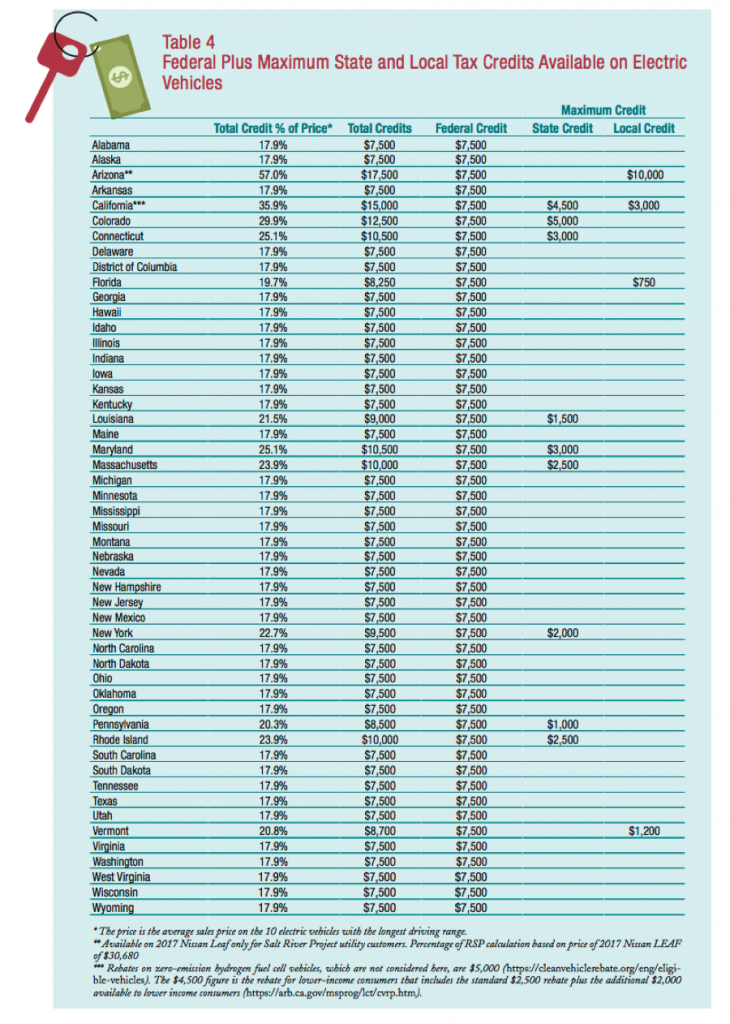
Source: Pacific Research Institute “Costly Subsidies for the Rich”

On top of all of this, some states like California, have zero emission vehicle (ZEV) mandates. These mandates set an arbitrary minimum market share for ZEVs within the state and represent an indirect subsidy to companies like Tesla that specialize in ZEV sales. 

As the Pacific Research Institute’s report explained, the vast majority of these benefits are going to the wealthy. In 2014, $263.3 million of EV tax credits went to consumers, 78.7 percent of which went to households with an adjusted gross income of $100,000 or higher. 

But apparently there’s no limit to the economic privileges EV manufacturers and owners demand from federal, state, and local governments. Khanna’s pending proposal will reportedly seek to remove the tax credit’s 200,000-vehicle cap and link it to companies producing vehicles in the United States. 

Politically speaking, this is a savvy move by Khanna, as it will probably appeal to two dangerous constituencies within the American electorate: elites who want to intervene in the American car market to favor EVs (and pass the costs along to everyone else), and people who favor government provided privileges for businesses that build things in America. However, the ability to potentially build a coalition around a proposal says nothing about whether or not it’s actually a good idea as there’s no shortage of economic illiteracy in Washington. 

Khanna’s attempt to use the EV tax credit to “create manufacturing jobs” is a fundamental misunderstanding of the point of economic activity. It’s remarkable that this would be lost on someone who studied economics at the University of Chicago, but the point of an economy isn’t to create jobs; it’s to produce things that people want. In 2017, SUVs and crossovers made up more than one in three cars sold globally last year—almost tripling their share from just a decade ago. Moreover, in 2018, pickup trucks and SUVs made up 68 percent of the new auto sales in the United States. This suggests people prefer larger vehicles that offer power and performance to range-limited battery powered cars that struggle in the cold

From a distributional perspective, the benefits of EV subsidies go almost entirely to high-income households. Some may find it remarkable that Khanna, the vice chairman of the Congressional Progressive Caucus, would support subsidies for the rich, but progressive ideology has been and always will be an ideology that favors the elite. This is because at its core, progressivism is a theory that justifies imposing costs on some in order to benefit others, but it pays little or no attention to whether or not the people imposing those costs are likely to do so in a manner that does not favor themselves. In that sense, Khanna’s plan is indeed a concrete example of the Green New Deal; it’s a handout to the wealthy and politically connected at the expense of everyone else.

Top 10 Questions for Governor Jay Inslee

This week, the Environment and Climate Change Subcommittee of the House Energy and Commerce Committee will convene to discuss what state and local leaders are up to on the issue of climate change. The Subcommittee leadership has summoned Washington Governor and Democratic presidential candidate Jay Inslee to appear as their star witness.

This hearing is a welcome opportunity for members of the Subcommittee to question Mr. Inslee on the implications of his policies and the actions he has taken both as Washington’s governor and as a candidate for the presidency of the United States.

We hope that members of the Subcommittee will ask Governor Inslee the following top ten questions from the American Energy Alliance:

  1. Given that under your leadership Washington State has failed not once, not twice, but 3 times to implement a carbon tax (once in the state legislature and twice at the ballot), what leads you to believe that the American people would support a national carbon tax?
  2. Given your expressed commitment to tackling climate change, if the entire U.S. stopped all of its carbon dioxide emissions under the Green New Deal, what would the temperature impact be in the year 2100?
  3. Washington State’s “Clean Energy Fund” has supported more than $100 million in taxpayer funds in clean energy and grid modernization projects. Have these taxpayer-funded programs had an impact on global mean temperature?  
  4. The U.S. contributes just 15 percent to global greenhouse gas emissions totals annually—and that number continues to fall. What percentage impact would a U.S. carbon tax have on global emissions totals?
  5. Converting the world’s largest economy to renewable energy by 2045 (the deadline you proposed in your state mandate) would vastly and rapidly increase demand for rare earth minerals mined almost exclusively in China. Why do you believe the U.S. should be dependent on China for the resources needed to meet our energy needs?
  6. The U.S. has reduced its greenhouse gas emissions by more than 10 percent since 2005, while global emissions have continued to climb. Why should the United States be bound by Paris Agreement emissions reduction commitments while large countries with growing economies, like China and India, continue to emit more each year?
  7. 2018 Capital Alpha Study found that a federal carbon tax would push static costs and revenue burdens onto the states and local government. How do you support a federal carbon tax in spite of the fact that it would force excess costs onto state governments that they can’t afford?
  8. Do you see it as an appropriate use of political office, or tax-exempt status, for politicians to arrange for off-book donor-funded staffing of advocacy campaigns or “profile-building” by non-profit groups? Should the National Rifle Association, American Petroleum Institute, et al., be available for donors to run an elected official’s advocacy? Or is there something unique about your relationship with the United Nations Foundation and Hewlett Foundation, the latter which paid for the former to hire ‘staff’ and run your “U.S. Climate Alliance” with donor funding?
  9. Similarly, given that activist donor groups directly provided six-figure report-writing services to your climate campaigning, along with the public relations services to promote it, do you see any campaign-finance-related or ethics issues with a public office-holder contracting out his office as a consultant? Can other groups hire, pay for and place advisors in the elected official’s office?
  10. What is the carbon footprint of your presidential campaign? What steps are you taking to reduce your dependence on commercial or private jets and SUVs for your transportation needs?

AEA Applauds Presidential Action on Keystone XL

WASHINGTON – This afternoon, President Trump issued a presidential permit authorizing the construction and operation of the Keystone XL pipeline at the international boundary between the U.S. and Canada. AEA President Thomas Pyle made the following statement: 

“We applaud President Trump taking action to expedite the path to construction of the much-needed and long-overdue Keystone XL pipeline. After years of senseless delays, we’re hopeful that this pipeline, which is an economic no-brainer, will finally be built. By issuing this permit, Trump is reaffirming that he will not play political games but will take decisive action to push forward this pipeline that will bring jobs and economic abundance to the region. The Keystone XL has gone through all the necessary environmental reviews, it is time for the delays to end and for the pipeline to be built.” 

Gaetz’s Green Deal-Lite: Still a Bad Deal for American Families

WASHINGTON – It has been reported that Representative Matt Gaetz (R-FL) is preparing to introduce a resolution in the House of Representatives dubbed the “Green Real Deal”. AEA President Thomas Pyle responded with the following statement: 

“Rep. Matt Gaetz’s so-called ‘Green Real Deal’ is nothing more than a Green New Deal-lite. While the resolution purports to affirm that the government should not pick winners and losers, it antithetically recommends taxpayer dollars be spent on preferred pet projects like nuclear modular reactors and carbon capture storage as opposed to what the green left would shower subsidies on. In other words, Gaetz’s Green Real Deal is just another big government scheme that would give handouts to corporations to achieve emissions reductions that the private sector has already proven they can achieve on their own. 

Responding to the Green New Deal with a slightly less big government style counter-offer is to give the original resolution too much credit. The U.S. already leads the world in gross emissions reductions. We don’t need a New Deal-style program to propel the U.S. into a strong energy and environmentally-friendly future, it’s already in our grasp. Conservatives must outright reject both the premise and the proposals of the Green New Deal and respond by getting the federal government out of energy markets, not entrenching it further.”

For more read AEA’s blog post: Rep. Gaetz’s Green New Deal Lite

Rep. Gaetz’s Green New Deal Lite

Last week, news outlets reported that Representative Matt Gaetz, a Republican from Florida, is drafting a proposal to counter the Democrats’ “Green New Deal”. Unfortunately, Rep. Gaetz’s “Green Real Deal” is a contradictory mishmash of government activism being touted by the media and faux conservative groups as a Republican response to the Green New Deal. In so doing, it betrays a fairly comprehensive misunderstanding of the current state of energy markets and bears no resemblance to free market policy. In fact, the “Green Real Deal” reveals just as much of a lack of understanding of markets as the government control fantasies of his fellow Climate Caucus members. As a purely economic matter, Rep. Gaetz’s government control resolution is perhaps even worse than a carbon tax, since recently introduced carbon tax bills at least pretend to be trying to limit government interference. Rep. Gaetz’s draft resolution is so gauzy and flexible that it is basically a license for the federal government to take over the energy sector and redirect it in whatever direction that unelected bureaucrats fancy.

Early in the leaked resolution draft, Gaetz oddly asserts that a “national commitment to innovation, competitive markets and the deployment of advanced energy technologies” has led since 2009 to energy efficiency improvements, increased natural gas production, and increased wind and solar installations.  This is jarring to anyone familiar with the energy industry because, though “national commitment” is a vague term, the ideas and data points collected in this clause are so in conflict with each other as to be nonsensical. Since this resolution refers to a duty of the federal government, we must presume that “national commitment” refers to a federal government commitment. But it is laughable to claim that the Obama administration led a national commitment to support natural gas production. To the contrary, the Obama administration limited gas development on federal land, slow-walked approvals for LNG export terminals, proposed numerous regulations crimping gas exploration and development, and its ideological allies aggressively opposed expanding the pipeline network which carries natural gas. The massive growth in natural gas production has been IN SPITE OF the prevailing “national commitment,” not because of it.  

The other two data points are similarly contradictory, particularly to the supposed national commitment to competitive markets. While some energy efficiency improvements have been undertaken for genuine economic reasons, the federal government since 2009 has layered on billions of dollars in costly mandates in the name of efficiency, everything from banning incandescent lightbulbs to wildly jacking up fuel efficiency standards for vehicles. And the increase in deployment of wind and solar generation since 2009 has next to nothing to do with competitive markets: tens of billions of dollars in subsidies, state renewables mandates, and legally mandated preferential access for renewable generation drove that growth. If that sort of government direction and interference counts as a “competitive market” then the term has lost all meaning.

The resolution, perhaps unwittingly, uses the language of the big government left, again betraying a lack of free market understanding. Government does not “empower individuals and businesses to come together in the marketplace,” people organize into markets themselves. Government interferes with those markets through regulation, mandates and subsidies. While some degree of regulation is appropriate, the idea that the government “empowers” is a deluded fantasy left over from the days of central planning. The resolution also talks repeatedly of “driving investment” to various industries and technologies selected by government. This term is a euphemism for government interference. The way government “drives investment” in a particular direction is by subsidizing it, mandating it, or regulating competitors. A genuine free market conservative should recoil at this language of “driving investment” because it raises the obvious question: who decides? Once the vague power of this resolution is granted to the federal government it is obvious that it will not be individual citizens or consumers deciding. Government “driving investment” means government control.

Moving into the action points section of the resolution, the total lack of understanding of the politics and policy of the energy sector is exposed most clearly. The “Green Real Deal” asserts that the government should “reduce and modernize regulations so that clean energy technologies can be deployed and compete,” but the reason that wind and solar are competitive today is precisely because of vast regulatory and subsidy assistance putting a thumb on the scale. It sees modernizing the grid as a priority, but modernizing the grid to achieve the lowest costs to consumers and redesigning the grid to maximize wind and solar are goals that are directly in conflict. It sees a modernization of the National Environmental Policy Act, but seems to ignore the fact that environmentalists oppose any changes to that law. It calls for increased subsidies for energy efficiency improvements, which companies and individuals already have an economic incentive to undertake, making those subsidies wastefully redundant. It also proposes a positively Orwellian carbon dioxide registry, allegedly voluntary, to better track the targets of environmentalist ire. This sort of tracking and surveillance of citizens engaging in lawful activity would not be tolerated by an ostensible conservative in other policy areas given the obvious potential for government abuse.

Despite how it is being characterized, this is not the “Republican” response to the Green New Deal, and it certainly isn’t a conservative or free market response. This is a Green New Deal-lite: all the license for government interference, just with less explicit language. The better to allow proponents to avoid accountability behind a cloud of obfuscation. Say what you will about the Green New Deal, but it is open about the intent to subject the energy sector to comprehensive, explicit government control. If Rep. Gaetz believes that government is the way forward, why not say so? At least have the courage of your big government convictions. 

Vogtle Loan Guarantees: How Much is Enough?

WASHINGTON – Today, Secretary Perry announced the Department of Energy is moving to finalize a $3.7 billion loan guarantee for the Plant Vogtle nuclear reactors. AEA President Thomas Pyle made the following statement in reaction to the announcement:  

“We oppose federal loan guarantees for any energy source, period. Nuclear power is an important part of our nation’s energy mix, but the federal government shouldn’t be in the business of providing loans for any energy source. Instead, it should stay out of energy markets and work to remove government subsidies and mandates to allow all energy sources to compete on a level playing field. 

The Trump administration has submitted a budget request that eliminates this loan program. We hope Secretary Perry will align the Department of Energy with the President’s priorities and fight for his budget on Capitol Hill.”

For media inquiries, please contact Erin Amsberry [email protected]

New Survey Finds Voters Skeptical of Government Action on Climate Change

WASHINGTON – Today, the American Energy Alliance has released the results of a nationwide survey of 1005 likely voters (margin of error = 3.1%) revealing Americans’ perspective on issues related to the Green New Deal, climate change, and the federal fuel economy mandate. The findings include: 

  • Consistent with previous polling, very few voters identify climate change as a priority issue. Only 3% identified “environment” in total as one of the most pressing issues facing the United States, and less than 1% specifically mentioned climate change.

  • With respect to solutions, respondents remain confident that solutions are likely to come from innovators (39%) and consumer demand (19%) than government action (25%). 

  • Voters’ willingness to pay for solutions also remains stable (and very modest). When asked how much they would be willing to pay annually to address global warming, the median response was $50 while 35% responded zero. 

  • When told the Green New Deal would cause the federal government to double in size by 2030, 61% of voters were totally opposed compared to 26% who were in favor. 

  • Throughout the poll, when more specifics were included in questioning, respondents became even more pro-free market in their answers. For example, when descriptions of capitalism and socialism were given (voluntary exchanges vs. mandated exchanges), capitalism was favored over socialism by 55 percentage points. 
  • When asked whether they trusted the federal government to decide what kind of cars or transportation technologies should be subsidized or mandated, 69% said they did not. 73% said the consumer should make decisions about what kind of cars to buy and what kinds of fuels to use, not the federal government or state governments. 

Topline results can be found here.

Read MWR Strategies’ analysis here.

AEA President Thomas Pyle made the following statement:

“No matter how much coastal elites belabor their talking points on climate change, across ideological and demographic groups, typical Americans are rightfully skeptical of government’s ability to find solutions. The so-called consensus that progressives reference on the ‘need to act’ is not there. Voters are divided, as they have been for years, on whether additional federal regulations or taxes are needed to address climate change. 

Before Democrats put forward more radical climate proposals like the Green New Deal, they must face reality and recognize the priorities and very real concerns of voters when it comes to government’s inability to implement meaningful solutions. Voters consistently prefer capitalism over socialism by a wide margin; our representatives in Congress should reflect those values and empower private sector innovation, not government coercion, to spur a cleaner environment as it has been doing for years.”

Mike McKenna of MWR Strategies, whose firm conducted the poll stated:

“After over a decade of polling on energy and environment issues, we’ve seen that voters’ views on climate change and their willingness to make sacrifices to address the issue remain unchanged. U.S. voters remain defensive against any attempts by government to reach deeper into their pockets. The Green New Deal may have some aspirational elements that poll favorably, but when specifics are brought into the equation, voters express very strong reservations about the potential effect on the size and spending of the federal government. Advocates for the Green New Deal know that, which is why they avoid specifics and focus on aspirations as much as possible.” 

When Will the Special Favors End?

WASHINGTON – Today, the Environmental Protection Agency and the Trump administration proposed regulatory changes to reform aspects of RIN markets and to allow gasoline blended with up to 15 percent ethanol to be sold during the summer months. AEA president Thomas Pyle made the following statement:

“We are deeply disappointed that the ethanol barons have convinced the Trump administration to waive seasonal restrictions for E15 fuel even though the EPA has historically admitted they lack congressional authority to do so. This poorly constructed rule will only further manipulate fuel markets to the detriment of consumers. The EPA’s reversal is further proof that the ethanol barons are too powerful even for President Trump take on. The renewable fuel mandate needs to be repealed, not enhanced.”

For media inquiries, please contact Erin Amsberry

[email protected]

Trump Budget Supports a Strong Energy Future

WASHINGTON – Today, the Trump administration delivered its proposed Fiscal Year 2020 budget to Congress. AEA President Thomas Pyle made the following statement in regards to the budget’s implications for American energy:

“The Trump administration’s proposed 2020 budget would modernize government spending in a manner consistent with the energy revolution taking place before our very eyes. The government should not be in the business of picking winners and losers in the economy. Trump’s DOE budget would rightsize the Office of Energy Efficiency and Renewable Energy and divert funds away from wasteful and duplicative government programs like the Advanced Research Projects Agency-Energy (ARPA-E) program. The Trump administration rightfully proposed to cut the Energy Department’s bloated budget by 11 percent and the Environmental Protection Agency’s inflated budget by 31 percent, refocusing taxpayer funds to high-priority, essential activities. 

Private sector innovation has led to a transformation in the way we produce and export our energy while protecting our environment at the same time. The Federal Government’s biggest contribution to this is not standing in the way. The private sector is much better equipped and incentivized to innovate in a way consistent with consumers’ best interest. We support the Trump administration’s proposed budget and ask Congress to swiftly put it into action.”

For media inquiries, please contact Erin Amsberry
[email protected]

Green New Deal: Unnecessary, Illogical, and Immoral

This week, I was able to represent the American Energy Alliance in testifying before the Western Caucus on the dangers presented by the Green New Deal. Conservatives must present a united front against this greenist manifesto and ensure that policymakers aren’t lured into accepting less draconian, but certainly damaging policies like a carbon tax or a cap-and-trade program as a “reasonable alternative”. 

I am grateful to the Western Caucus and Chairman Gosar for this opportunity. My spoken remarks are below. Written testimony can be found on the Western Caucus website: here.

__________________________________________________________________________________________

Thank you, Chairman Gosar, for your invitation and for your leadership of the Western Caucus. My name is Tom Pyle and I’m the president of the American Energy Alliance. We advocate for free markets and affordable energy for American consumers and businesses. 

And as a former staff director of the Caucus, I truly appreciate the active role the you are taking on this and a number of important issues.

For nearly a decade now, the United States — blessed with vast natural resources — has benefited from one of the greatest energy expansions in the history of the world. Our energy producers have delivered the low cost and reliable energy that has fueled economic growth and opportunity for all Americans. Contrary to the naysayers, we have drilled our way to prosperity here at home — and as this energy revolution continues — U.S. energy exports will help lift millions of people out of poverty around the globe.

The Green New Deal, on the other hand, would abruptly end this progress, devastate our economy, and disrupt our very way of life. 

As a political matter, the contents of the Green New Deal are not achievable to any substantial degree. The resolution conjures up false hopes and ignores several political realities. For example, it seems to completely ignore the current process for building out infrastructure. The resolution ignores the immense challenges that come with working through the NEPA process, which can delay projects for years and even decades. For the record, I’m completely in favor of NEPA reform, but refusing to even acknowledge these hurdles is to ignore reality and makes it impossible to take the Green New Deal’s policy proposals seriously. 

The Green New Deal takes a flight of fancy in the technical realm as well. The resolution asserts a series of end points for the electricity, transportation, and industrial sectors without any seeming awareness of the absence of known technologies to achieve them.

The resolution’s goal to quote “transform the transportation sector” illustrates this point. Replacing all vehicles in the U.S. with electric cars might theoretically be possible — assuming a willingness for the government to confiscate personal property — but it is certainly not possible in a 10-year time frame given the restraints of EV technology and scalability. 

Additionally — as if it needs to be said — there is no technology currently in existence to replace long distance travel by aircraft. The suggested alternative — high-speed rail — can never hope to match air speeds, even if the land for construction could be seized and the massive electricity demand of high-speed rail could be met. All one needs to point to is California’s high-speed train to nowhere to see the folly of this idea.

In short, we don’t have the technical capacity to do what the Green New Deal purports to mandate — certainly not in 10 years and most likely not in my lifetime. 

Grant it I am a little bit older than AOC.

Finally, and perhaps most importantly, the economic indignity of the proposal is so far-fetched that it won’t ever be achieved. Even the attempt to phase out natural gas, coal, and oil in the next decade would drastically increase gasoline and electricity prices. This obviously would hit the poor and those on fixed incomes the hardest, as energy constitutes a much higher percentage of their household budgets.

Some have estimated the cost of implementing the far-reaching proposals in the Green New Deal in the multi-trillions of dollars. Suffice it to say, there is simply no economic logic to this. The economic contradictions found within the Green New Deal further expose the whole proposal as nothing more than a green activist manifesto rather than a serious economic program. 

But there is nothing aspirational about making false promises to the very people the proponents of the Green New Deal claim to be trying to help. In fact, it is immoral.

In conclusion, the Green New Deal is unnecessary, illogical, and immoral. Thanks to innovation and technology, our domestic energy producers are delivering low cost energy to millions, increasing well-being and economic opportunity for all. At the same time, the U.S. has achieved emissions reductions unmatched by any other country in the world. 

The only thing the Green New Deal could possibly hope to achieve is to lull policymakers into accepting less draconian, but certainly damaging policies like a carbon tax or a cap-and-trade program as a “reasonable alternative”. 

Fortunately, as your leadership here today demonstrates, that will be as hard a sell as the Green New Deal itself.