Subsidies for Me, but Not for Thee

The Department of Energy’s proposed grid resiliency rulemaking was the wrong solution for a genuine problem. The Federal Energy Regulatory Commission rightly voted to terminate the rulemaking, instead requesting information from grid operators and the public about how to address the undervaluation of coal and nuclear power generation in electricity markets. But before we move forward with that discussion, something must be noted: the wind and solar companies and their lobbying arms that loudly opposed the proposal are rank hypocrites. The spectacle of two industries built on federal subsidies and state mandates feigning outrage at the mere suggestion that someone else might also get government favors cannot pass unremarked.

“We worry today’s proposal would upend competitive markets that save consumers billions of dollars a year. The best way to guarantee a resilient and reliable electric grid is through market-based compensation for performance, not guaranteed payments for some, based on a government-prescribed definition.”

The criticism above is quite correct. It sounds like it must have come from a free market think tank, right? Wrong. Those are the words of Amy Farrell of the American Wind Energy Association (AWEA), the trade association for the U.S. wind industry. No guaranteed payments for some based on a government-prescribed definition, huh? So exactly how does AWEA define the Production Tax Credit (PTC), a tax credit that goes to a government-prescribed list of favored generators (overwhelmingly wind)? The PTC provides a direct subsidy for every kilowatt-hour of electricity generation from those favored sources. Sounds like “guaranteed payments for some” to us.

AWEA’s position against the DOE proposal might give the impression that they have seen the light of competitive markets and don’t want their subsidies anymore. They might even tell you that they agreed to the deal to phase out the PTC, nevermind that they were forced into it by pressure and the “phase out” means they still will be getting subsidies for at least more than a decade. But their hysterical reaction to a Senate version of the tax bill that passed last year gives the lie to that. The renewables industry went DEFCON1 when they realized that a provision of the bill intended to prevent tax avoidance could reduce the value of their government subsidies. So, while simultaneously fighting the DOE resiliency rulemaking based on its potential to “upend competitive markets,” that same renewables lobby scrambled to protect their gravy train in the final version of the tax bill. It seems that what we have here from AWEA is an example of subsidies for me, but not for thee.

The coal and nuclear industries are right to feel aggrieved. Federal subsidies distort electricity markets. The renewables industry likes to talk about how much generation they have been installing in recent years, but those installations have not been additive economic contributions. U.S. electricity demand has been flat for a decade. New wind and solar generation is not meeting additional demand, but rather it is cannibalizing from existing generation, a parasite on the grid mainly harming coal and nuclear generators. In a normal market, no one would be investing billions in unneeded generation, but tax credits like the PTC and its solar cousin the Investment Tax Credit (ITC) make it profitable to throw up wind and solar generating facilities as rapidly as possible regardless of market conditions.

The coal and nuclear industries are right: the federal government skews markets against them and in favor of wind and solar. But the answer is not to expand subsidies to coal and nuclear, the answer is to remove the existing subsidies and favoritism that skew the markets. AWEA says they oppose “guaranteed payments for some.” As long as that “some” doesn’t include them.

Key Vote: Oppose Grassley Amendment #1835

The American Energy Alliance urges all Senators to oppose Grassley amendment #1835 to the Hatch substitute for HR 1 the Tax Cuts and Jobs Act. This amendment seeks to protect the users of complex international tax structures from being touched by reforms included in the Hatch Substitute, a provision known as the Base Erosion Anti-Abuse Tax (BEAT).

The BEAT provision targets asset stripping where large companies use international subsidiaries to game the system to reduce their tax liability. The BEAT provision seeks to crack down on this maneuver by imposing a minimum tax on entities employing these complex tax equity financing mechanisms. Senator Grassley’s amendment would protect these tax avoiding maneuvers and should be opposed.

Senator Grassley’s amendment to protect the large, sophisticated multinational companies that use these tax gimmicks would leave middle class taxpayers bearing more of the tax burden. The Senate should not be in the business of protecting these tax games just because it provides cheap financing for energy companies that Sen. Grassley happens to favor.

The AEA urges all members to support free markets and affordable energy by voting NO on Amendment #1835.  Should a vote on this amendment occur, AEA will include it in its American Energy Scorecard.

No Carve-Outs for Politically-Favored Industries

WASHINGTON – This afternoon Thomas J. Pyle, President of the American Energy Alliance, sent a letter to Senate Majority Leader Mitch McConnell expressing the organization’s
opposition to special tax treatment for the wind and solar industries vis-à-vis the Base Erosion Anti-Abuse Tax provision in the Senate tax reform bill.

The text of the letter can be read below:

Dear Majority Leader McConnell,

I am writing to urge you to oppose an unfair carve-out for the wind and solar industries in the tax reform bill. The Base Erosion Anti-Abuse Tax (BEAT) provision is intended to promote a level playing field for businesses by addressing tax equity investment. Businesses within the wind and solar industries in no way merit preferential consideration.

Wind and solar companies have exploited American taxpayers for decades and the costs must be reckoned with. The wind energy Production Tax Credit (PTC) alone is set to cost us over $25 billion, according to the Congressional Research Service, between 2016 and 2020. Enough is enough.

The House tax reform bill included the reasonable reduction of the wind PTC from $24 per megawatt hour to $15 per megawatt hour, which would save taxpayers billions. Unfortunately, such a reduction is absent from the Senate bill. Nevertheless, the BEAT provision can mitigate this cost by discouraging tax profiteering.

Twenty-five years of preferential tax treatment is more than any industry deserves. Saying “no” to the wind and solar lobbies’ demands for a carve-out gives Americans a fairer deal.

Sincerely,

Thomas J. Pyle
President, American Energy Alliance

AEA Endorses MINER Act

WASHINGTON – On Thursday, November 30, Thomas J. Pyle, President of the American Energy Alliance, sent a letter to Congressman Paul Gosar endorsing the Minnesota’s Economic Rights in the Superior National Forest Act (MINER Act). The MINER Act reflects AEA’s commitment to enabling the American people to access and develop all the natural resources at our disposal. Pyle’s letter can be read in full below:

Dear Chairman Gosar:

I write to you in support of H.R. 3905, the Minnesota’s Economic Rights in the Superior National Forest Act (MINER Act).

Put simply, the MINER Act would wrest power back from an overreaching executive branch and return it to the people. Proposals like the MINER Act are important for establishing a renewed respect for resource development across the country. As Congressman Emmer said earlier this month, “We can utilize the largest untapped copper-nickel deposit in the world for Americans, and in an environmentally sound way,”

The Obama administration’s midnight withdrawal application to restrict development within the Superior National Forest was an example of the federal government at its bureaucratic worst. Arbitrary withdrawals of this nature do nothing to provide us cleaner water or air, but have been shown time and again to harm local economies and put people out of work. Minnesotans deserve better and the MINER Act would move us in the right direction.


Sincerely,

Thomas J. Pyle

President, American Energy Alliance

Alexander Pillories Wind PTC

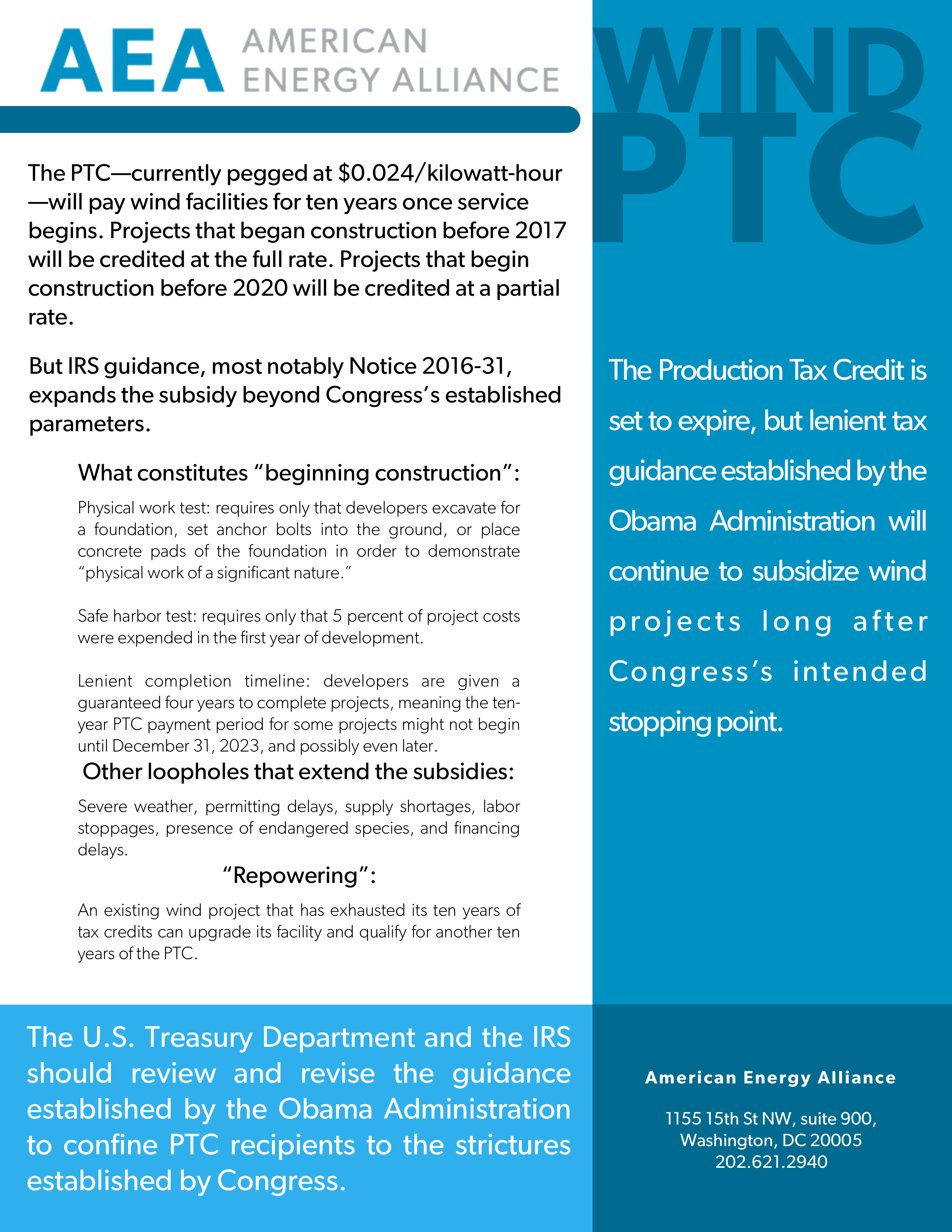
Congress is at long last coming to grips with the failure that is the wind production tax credit (PTC). The bill passed by the House Thursday will cut the rate at which wind production is subsidized by about one-third and will allow the quarter-century-old program to finally end as scheduled in 2020.

Hurdles still remain on the Senate side of things and the fight is far from over. At least one senator, however, isn’t afraid to call out the wind PTC as the costly, cronyistic subsidy that it is. That senator is Lamar Alexander (R-Tenn). Senator Alexander took to the floor on Tuesday to decry the wasteful history of the PTC and enjoin his colleague to discontinue it by year’s end.


Source: https://floor.senate.gov/MediaPlayer.php?view_id=2&clip_id=2656

Alexander described the wind PTC as “at the top of the list” of wasteful spending that should be addressed in the tax reform debate. By eliminating the subsidy on December 31, 2017, rather than phasing it out, taxpayers will be saved $4 billion according to figures cited by Alexander on the floor.

As he pointed out, wind PTC advocates can no longer claim this is a short-term support for an infant industry. The PTC has been extended seven times, has cost us tens of billions of dollars, and yet wind still produces just one-twentieth of our electricity.

We commend Senator Alexander on his continued realist stance on the wind PTC and echo his closing remark:

“I’m here to challenge my colleagues to be willing to consider all energy subsidies for mature technologies–wind, solar, oil, gas–as candidates for elimination in a tax reform bill. Those dollars could be better spent to lower rates for taxpayers.”

Senator Alexander’s comments can be viewed here in the recording of Tuesday’s proceedings by jumping to the 7 hour, 28 minute mark.

To read AEA President Tom Pyle’s comments on the passing of the House tax bill and its wind PTC reductions click here.

To read the Institute for Energy Research’s 2014 white paper on the wind PTC click here.

Abandon Free Market Principles to Save Competitive Energy Markets?

At the unveiling of the George W. Bush Presidential Center, former President Bush admitted to going against his “free market instincts” when he bailed out the banks following the financial crisis. “History shows that the greater threat to prosperity is not too little government involvement, but too much,” he added.

We couldn’t agree more.

Abundant, affordable energy is the foundation of modern prosperity. One of the most pernicious things that the Obama administration did was to interfere with the availability of affordable energy, lavishing subsidies and regulatory support on any trendy, inefficient and expensive technology or energy source that could be branded as “renewable.” The Obama administration’s government distortions raised costs for consumers and destroyed jobs in industries that did not gain government favor in an attempt to “finally make clean energy the profitable kind of energy.” This picking of winners and losers is no way to manage competitive energy markets in a free society.

The American Energy Alliance has not been alone in recognizing the baleful effects of government favoritism. Many clear-eyed politicians have also understood the negative impacts of excessive government intervention in energy markets.

In 2011, then Governor Perry exhorted voters to elect him president so that he could “level the playing field for all energy producers, removing Obama’s practice of picking winners and losers.”

In 2014, 55 House Republicans inveighed against a government subsidy which “has not only cost taxpayers billions, but has caused significant price distortions in wholesale electricity markets.”

In 2015, Rep. Alex Mooney spoke it plainly: “The government shouldn’t pick the winners and losers. What I object to is the government interfering in the market.”

In 2016, leaning on his experience as a state utility regulator, Rep. Kevin Cramer explained that “when ratepayers are subsidizing with an additional cost because of a mandate, that’s different. That’s punishing the ratepayer.”

This past summer, Rep. Keith Rothfus reminded us “the federal government’s role isn’t to pick winners and losers.”

Just a few weeks ago, Senator Shelley Moore Capito indicted the Obama administration for issuing “heavy-handed regulations to pick winners and losers among energy industries.”

Many of the companies that were targeted for harm by the Obama administration likewise stood with us and these political leaders against federal government distortions in energy markets.

FirstEnergy, one of the largest investor-owned utilities in the country, saw things clearly, noting “measures that restrict customer shopping or subsidize one electric generator over another are throw-backs to monopoly regulation. Such efforts that pick ‘winners’ and ‘losers’ in the energy market would create obstacles to private investment in generation and increase prices for customers.”

Earlier this year, the CEO of Murray Energy, correctly noted that under the Obama administration there was not a level playing field “the government has been picking winners and losers.”

Exelon, largest utility in the Fortune 500, has made clear its preference for outcomes based on free markets, “rather than through the government picking technology winners and losers,” and proudly declared itself “anti-subsidy.”

We couldn’t have said it better ourselves.

On September 29th, the Trump administration Department of Energy released a notice of proposed rulemaking proposing a rule for action by the Federal Energy Regulatory Commission (FERC). This proposed rulemaking called for FERC to intervene in electricity markets to guarantee cost recovery for certain classes of electricity generation units. As we have stated before, we agree that baseload power generation is not adequately valued. We also believe that FERC can play a limited role in addressing this legitimate concern. The Perry proposal, in contrast, would: pick winners and losers, cause significant price distortions in wholesale electricity markets, constitute government interference in markets, punish ratepayers, create obstacles to private investment in generation, and increase prices for customers.

Today, we implore the politicians and companies who fought against the reckless energy policies of the Obama administration not to go against their previously stated free market instincts. EPA Administrator Scott Pruitt is working to undo a slew of unnecessary and burdensome federal regulations like the Clean Power Plan, which would have led to the federal takeover of the electricity grid. The House of Representatives is taking steps to rein in distortive subsidies like the wind Production Tax Credit.

Our focus should be on helping to unwind these distortive and destructive policies, not adding to an already broken system. Let’s heed the advice of President Bush and be on the right side of history by sticking with our free market instincts. In the end, everybody will be better off.

AEA Responds to GOP Tax Plan

WASHINGTON – Thomas J. Pyle, President of the American Energy Alliance, has issued the following statement on today’s release of the Tax Cuts and Jobs Act:

“This pro-growth tax reform plan is a breath of fresh air for American businesses and the American people. The immediate lowering of the corporate tax rate to 20 percent will free up capital to boost investments, jobs, and incomes and the termination of distortionary practices like the $7,500 electric vehicle tax credit will help restore market signals and save taxpayers money. The 2016 elections gave the president and this Congress a mandate to chart a better path for our economy and this plan reflects that.”

“While we’re pleased with many provisions and the overall blueprint, we would prefer to see—and will continue to argue for—a more thorough elimination of federal energy subsidies. A termination of the Investment Tax Credit and the Production Tax Credit is of the highest order of importance. With that said, this plan takes us in the right direction by maintaining the scheduled expiration of the Production Tax Credit for wind energy and phasing out the temporary credits for wind and solar established by the 2015 PATH Act.

“The subsidies that have been dished out by the federal government to the wind industry in particular are staggering. Our 2015 study found that the cumulative magnitude of federal subsidy allocations from the PTC, the ITC, and Section 1603 grants to the wind industry from 2005 to 2014 was at least $18.6 billion. The wind industry’s continued dependence on the federal government is an injustice to the taxpayers forced to foot the bill. The phase-out of these subsidies cannot come a moment too soon.

“The bottom line, despite its flaws, is that this plan is a positive overhaul of a broken tax system. The sizable tax reduction for corporations will bring new jobs and stronger earnings for American families and help us move more into line with America’s historically strong rates of economic growth.”

Standing up to the Ethanol Mafia

Earlier this week a group of Senators from some of the states that are victims of the Renewable Fuel Standard (RFS) decided to fight back against the ethanol mafia. It’s about time. The spectacle last week of a few Midwestern Senators making threats and holding up nominations to protect a government handout that only benefits their wealthy backers in the ethanol industry was a new low even for Congress. Members of a party that ostensibly opposes regulation and federal mandates went full mafia-protection-racket to defend the federal government mandate that keeps Big Ethanol raking in the cash.

The RFS is the embodiment of government gone wild. It provides a federally guaranteed market for a product that no one needs and most people don’t want. Absent this government mandate, some ethanol would likely still be blended into gasoline to comply with environmental regulations, but nowhere near the levels that are mandated by the RFS. That is why Big Ethanol and their bought-and-paid-for Senators like Chuck Grassley and Deb Fischer went to the mat to stop even the minor, commonsense adjustments proposed by the EPA.

What was that proposal? What was it that sent Big Ethanol into a frenzy? The mere suggestion that perhaps the federal government should not be mandating imports of foreign fuels. Last year about 45% of biodiesel needed to meet the RFS was imported because the United States does not produce enough domestically. The EPA quite reasonably suggested that maybe the RFS should be adjusted slightly to better match actual domestic production. But the first rule of government handouts is no backsliding at any cost. Big Ethanol has decided that in order to protect their mandated market, the RFS must only ever go up. So instead of commonsense, we get a program that finances criminals, foreign producers and Big Ethanol. We are left with a situation where President Trump, who regularly rails against imports, is pressured into protecting a program that mandates those very imports at the expense of domestic petroleum fuels.

In their fulminations against the EPA, the subsidy Senators talked about the jobs that the RFS supports. Well what about the jobs it destroys? Hundreds of thousands of people work in the refining industry across the country, people whose jobs are at risk because of the escalating cost of complying with the RFS. East coast refiners are particularly damaged by being forced to buy compliance offsets, called RINs, to meet federal RFS mandates. That is money plucked from states like Pennsylvania and Texas to line the pockets of Iowa ethanol producers. In this situation it is perfectly appropriate for Senators like Ted Cruz and Pat Toomey to stand up to this extortion.

And it’s not just the refining industry that is harmed by the RFS. Every good that is transported by truck in the United States is more expensive because of the RFS. That is money taken from the pockets every single American to enrich, not the farmers in Iowa or Nebraska, but rather a few rich ethanol producers.

It’s long past time for our elected representatives in Washington to stand up to the ethanol mafia. President Trump should listen to these senators who are taking a stand; they are advocating for domestic jobs and domestic energy production, both of which are harmed by the RFS, and they are advocating for all Americans, who are forced to pay more for goods and gasoline because of the RFS.

Who Is Chuck Grassley’s Mafia Don?

Over the last few weeks and months, Senator Grassley and his paymasters in the biofuel industry created a lot of sound and fury about an eminently reasonable proposal from the Environmental Protection Agency (EPA). Namely, matching the biodiesel mandate in the Renewable Fuel Standard (RFS) more closely to the amount of biodiesel actually produced in the United States. This minor proposed adjustment to the federal biodiesel mandate prompted howls of anguish from Big Ethanol and their senators, who refuse to countenance any change to their special interest deal whereby the federal government requires consumers to purchase their product. The complaints escalated to threats from a few Midwestern senators to retaliate against the administration should any alteration be made to Big Ethanol’s government gravy train—U.S. senators effectively acting as the enforcers of the ethanol mafia.

The RFS mandates that certain levels of biofuels be mixed into the nation’s fuel supply. However, the mandate is expressed in volumes rather than percentages, with the mandated volumes ratcheting up every year. These volumes increase even if the United States does not actually produce enough of the products to meet the mandate. In the case of biodiesel, last year about 45% of the 2 billion gallons of mandated biodiesel had to be imported, mostly from Argentina. The resulting domestic shortfalls have created a situation that, according to the former head of the EPA Criminal Investigation Division, is ripe for fraud, particularly in the biodiesel market.

The key opening for this fraud is the compliance mechanism for the RFS, which is known as the Renewable Identification Number (RIN). A RIN is assigned to every unit of biofuel produced, but it can be detached from the physical fuel and traded and sold like a financial commodity. Refiners are required to accumulate enough RINs to meet their share of the RFS mandate, whether by purchasing biofuel with RINs attached or RINs traded in the opaque and poorly regulated secondary market.

The market for RINs has been fertile ground for fraudsters. The EPA keeps a running tally of the fraud that it has discovered. In the last three-plus years, the EPA has taken enforcement actions involving more than 429 million fake RINs with a market value of over $325 million. And keep in mind, that is just the ones they managed to catch and convict.

In one example of this massive fraud, extensively documented by Bloomberg last year, a con man named Philip Rivkin was indicted for selling more than 60 million fake RINs for at least $78 million, as well as illegally claiming another $21 million in biofuel tax credits. When an EPA inspector arrived at the site of his company, Green Diesel, he found a deserted facility with rusting equipment and disconnected pipes. Green Diesel never produced a single gallon of marketable biofuel.

The cost of this fraud is passed along directly to consumers in the form of higher fuel prices at the pump. According to the EPA, biodiesel costs between $1.36-$1.85 more for every gallon of petroleum diesel replaced. And don’t forget that much of that biodiesel is imported. Every good that is transported by truck in the United States is made more expensive by this biodiesel mandate, all for the sake of enriching criminals, foreign companies and Big Ethanol special interests.

In response to all this, the EPA proposed just a minor adjustment to the biodiesel mandate, no more than 15%, to closer align with actual domestic production. A common sense argument that the federal government should not be mandating imports of foreign goods. But Senator Grassley among others declared this a betrayal and threatened to hold up nominees to the EPA. Last week, Secretary Pruitt sent the complaining senators a letter attempting to allay their concerns that he sought to rationalize the boondoggle program they are so attached to. While this letter gave the subsidy senators most of what they want for now, they may have shot themselves in the foot by getting the president and EPA administrator to intervene in an active rulemaking, setting up possible litigation in the future.

The key fact remains, though, that Sen. Grassley and his fellow subsidy senators moved themselves to this level of outrage not to protect consumers, not to reduce transportation costs, not to reduce imports. No, their fury was unleashed in defense of a government mandate that lines the pockets of criminals, foreign producers, and their Big Ethanol political backers. Would that the average American consumer had these kind of enforcers in Washington, D.C.

Key Votes on Amendments to HR 3354

In considering HR 3354 Department of Interior, Environment, and Related Agencies Appropriations Act, 2018 [Make America Secure and Prosperous Appropriations Act, 2018], the American Energy Alliance has identified the below three amendments offered to Division A as key votes.

NO on Amendment #20 offered by Reps. LoBiondo and Beyer. This amendment seeks to prevent energy exploration activities along the entire Atlantic seaboard. This sweeping prohibition is unjustified and premature. The administration has just begun the process of creating a new five-year leasing plan. It is important that the offshore Atlantic remain a part of this review.

YES on Amendment #100 offered by Rep. Mullin. This amendment seeks to eliminate the use of the so-called social cost of carbon. The social cost of carbon calculation is entirely notional and cannot be justified on scientific or economic grounds. During the creation process, the social cost of carbon models and calculations were manipulated to reach a desired end goal. The social cost of carbon designed by the previous administration should be discarded.

YES on Amendment #101 offered by Reps. Mullin and Perry. This amendment seeks to prohibit the implementation of the previous administration’s methane rule. The methane rule was designed and intended as a tool to strangle energy production on federal lands. The rule is unnecessary, given that methane emissions have been falling in recent years even as natural gas production has increased rapidly. Oil and gas producers already have an economic incentive to capture methane as it is a versatile product in its own right. This unjustified rule should be stopped.

AEA urges all members to support free markets and affordable energy by voting NO on Amendment #20 and YES on Amendments #100 and #101.  Should votes on these amendments occur, AEA will include each in its American Energy Scorecard.