CBO Reports Higher Gasoline Prices if RFS Target is not Lowered

Last week the Congressional Budget Office (CBO) produced a report on the feasibility of complying with the Renewable Fuel Standard (RFS), a federal mandate that requires minimum volumes of renewable fuels to be blended into transportation fuels.  The original volume mandated by the Energy Independence and Security Act of 2007 (EISA) for 2014 is 18.15 billion gallons, which continues to increase annually.[i] However, after recognizing severe challenges in meeting the EISA target, primarily due to the lack of supply of cellulosic biofuels and the blend wall,[1] the EPA is proposing to lower the EISA 2014 mandate by 3 billion gallons to 15.21 billion gallons[ii].

CBO’s study evaluates both the extent to which an increase in the supply of renewable fuels would be necessary to comply with RFS standards and also how food prices, fuel prices, and emissions would vary in 2017 based on compliance with the original EISA mandates compared to EPA’s lowered targets. The report suggests that the most probable outcome is the success of EPA’s proposed lowering of the 2014 RFS target.[iii] CBO concludes that lobbying efforts by biofuel producers to increase the EPA’s lowered 2014 target are impractical and will cause a severe increase in gas prices, and that the EPA will likely continue to keep in place lower mandates than what were required under the 2007 EISA.[iv]

In defending the EPA’s lowered targets against the mandated EISA targets, CBO’s study found that if EISA targets are not lowered, the price of petroleum-based diesel would rise by between 30 cents and 51 cents per gallon (9-14 percent increase), and the price of E10 fuel (most of the gasoline in the country is now E10) would increase by between 13 cents and 26 cents per gallon (4-9 percent increase) by 2017.  The only fuel that would experience a decrease in price is E85, Flex Fuel, which would decline by between 91 cents and $1.27 per gallon.  However, not only is E85 limited to Flex Fuel vehicles, but currently fewer than 2 percent of filling stations in the United States sell E85.[v]

Additionally, CBO applauds EPA’s efforts to lower the 2014 RFS target by 3 billion gallons due to the 6% average increase in corn prices that would otherwise occur by 2017 if adhering to EISA volume requirements.  The report expects that the lowered 2014 target is set at roughly the same volume by which fuel suppliers would demand corn for ethanol even if they were not required to meet RFS standards.  Therefore, while upward pressure is put on price of corn due to the demand for biofuel, CBO suggests that such pressure would occur even without the RFS.[vi]  If fuel suppliers find it more cost effective to continue using corn ethanol to produce E10 even in the absence of the RFS, questions should be raised as to the effectiveness or necessity of the RFS, which is mandating the same demand levels that would otherwise be present in market conditions.

According to the CBO it is imperative that the RFS is either completely repealed or adjusted using EPA’s 2014 target of 15.21 billion gallons.  Not lowering the RFS targets would greatly increase the price of transportation fuels, and would force fuel refiners to exceed the 10 percent blend level, an unsafe level for older vehicles.  In addition, recent research suggests that greenhouse gas emissions from the use of renewable fuels is no different, and may be even worse, than emissions from gasoline.[vii]  While the federal government can be expected to support EPA’s lowering of the 2014 RFS targets, CBO also states that repealing the RFS should be a considered scenario, which is one that should be more seriously considered if the market will produce the same use of ethanol that is required under the RFS ethanol mandate, rendering the legislation unnecessary.

IER Summer Associate Sarah Pearce authored this post.


[1] Currently, most gasoline sold in the U.S. is a blend that includes up to 10 percent ethanol (E10), referred to as the “blend wall” because it is the maximum concentration of ethanol in gasoline that is feasible to avoid damage to the fuel systems of older vehicles.


[i]  Environmental Protection Agency, Federal Register Vol. 78, No. 230, November 29, 2013, http://www.gpo.gov/fdsys/pkg/FR-2013-11-29/pdf/2013-28155.pdf.

[ii] Ibid

[iii] Congressional Budget Office, The Renewable Fuel Standard: Issues for 2014 and Beyond, June 2014, http://www.cbo.gov/sites/default/files/cbofiles/attachments/45477-Biofuels2.pdf.

[iv] Edward Felker, CBO: Lower ethanol use likely for years to come, Energy Guardian, June 27, 2014, http://energyguardian.net/cbo-lower-ethanol-use-likely-years-come.

[v] Congressional Budget Office, The Renewable Fuel Standard: Issues for 2014 and Beyond, June 26, 2014, http://www.cbo.gov/publication/45477.

[vi] Ibid

[vii] Environmental Working Group, Ethanol’s Broken Promise, May 29, 2014, http://static.ewg.org/reports/2014/ethanol_broken_promise/pdf/ethanol_broken_promise_ewg_2014.pdf.


Uncertainty Surrounds Ethanol’s Impact on GHG Emissions

The EPA is proposing to lower the 2014 RFS biofuel blending mandate by 1.4 billion gallons, from the statutory mandate of 18.21 billion gallons to 15.21 billion gallons.  While a study by the Environmental Working Group (EWG) concluded that reducing the biofuel target would reduce emissions by the equivalent of taking 580,000 cars off the road,[i] a study conducted by Biotechnology Industry Corporation found that reducing the target would add greenhouse gas emissions equivalent to placing 5.9 million more cars on the road.[ii] So which is it? Does ethanol reduce or increase carbon dioxide emissions? After years of research, the answer is still not clear.

This latest research suggests that the impact on carbon dioxide emissions of using biofuels over petroleum-based fuel is unclear, primarily due to uncertainties in modeling biofuel emissions associated with life cycle production and land use changes.[iii]

Four years ago, when the EPA wrote its final rule on the RFS and released its Regulatory Impact Assessment in 2010, there was little doubt that biofuels produced lower greenhouse gas emissions than gasoline.  The Impact Assessment predicted that corn ethanol’s emissions would be 17 percent lower than gasoline’s by 2022.  By setting thresholds that require a certain amount of biofuels to be blended into transportation fuel each year, the EPA sought to cut emissions by 20 percent using corn ethanol and 50 percent using advanced biofuels.[iv]

However, studies today have resulted in a variety of conclusions that both question and confirm the original belief that the RFS would help reduce greenhouse gas emissions.  The EWG report produced this past May concluded that the EPA proposal to cut the 2014 RFS target by 1.4 billion gallons would actually lower U.S. greenhouse gas emissions by 3 million tons of carbon dioxide.  EWG concluded that previous estimates and models dramatically underestimated carbon emissions associated with land changes—plowing grasslands and wetlands to turn into corn fields for biofuel production—which release carbon locked up in trees and soil into the atmosphere.  Therefore, EWG suggests that by taking the full life cycle of biofuel production, transmission, and tailpipe emission into account, biofuels release more carbon dioxide into the air than gasoline.[v]

In response to EWG’s study, a group of seven scientists conducted their own research, and came to similar conclusions as the ones produced by the Biotechnology Industry Corporation.  The reports suggested that EWG’s models both exaggerate the total amount of land that has been converted into corn ethanol production and overestimate the carbon released from such land changes.[vi]  They therefore concluded that reducing the 2014 RFS biofuel mandate would increase greenhouse gas emissions, because even after accounting for the life cycle of biofuel production corn ethanol still reduces emissions by about 30 percent compared to petroleum-based fuel.[vii]

When the RFS was created, there was great confidence that domestic oil production would continue to fall, that cellulosic ethanol would quickly become cost competitive, and that using more ethanol would reduce greenhouse gas emissions. Today, domestic oil production is booming, cellulosic ethanol production is almost non-existent, and it now isn’t clear whether ethanol reduces carbon dioxide emissions.  Questions surrounding biofuel life cycle emissions and the impact of land changes make it difficult to definitively conclude whether biofuel or petroleum-based fuel produces less carbon dioxide emissions. This is a good reminder of the folly of mandates—politicians understand far less of the world than they think they do.

IER Summer Associate Sarah Pearce authored this post.


[i] Environmental Working Group, Ethanol’s Broken Promise, May 29, 2014, http://www.ewg.org/research/ethanols-broken-promise.

[ii] Amanda Peterka, RFS proposal would reduce greenhouse gas emissions- enviro report, Greenwire, May 29, 2014, http://www.eenews.net/greenwire/stories/1060000375/.

[iii] Amanda Peterka, DOE-backed study questions life-cycle analyses of carbon footprint, Greenwire, http://www.eenews.net/greenwire/stories/1059987911/.

[iv] Environmental Working Group, Ethanol’s Broken Promise, May 2014, http://static.ewg.org/reports/2014/ethanol_broken_promise/pdf/ethanol_broken_promise_ewg_2014.pdf.

[v] ibid

[vi] Michael Wang, Jennifer B. Dunn, Steffen Mueller, Zhangcia Qin, Wally Tyner, Barry Goodwin, Comments on Ethanol’s Broken Promise by the Environmental Working Group (May 2014), June 11, 2014, http://ethanolrfa.3cdn.net/c9820f88366b2d2b3f_ykm6bnsvc.pdf.

[vii] Amanda Peterka, Industry Group says EPA proposal will increase GHG emissions, Greenwire, March 26, http://www.eenews.net/greenwire/stories/1059996767/.

Disaster

Ethanol-590-AEA-1

EPA Should Rethink Unrealistic 2014 Biofuel Standards

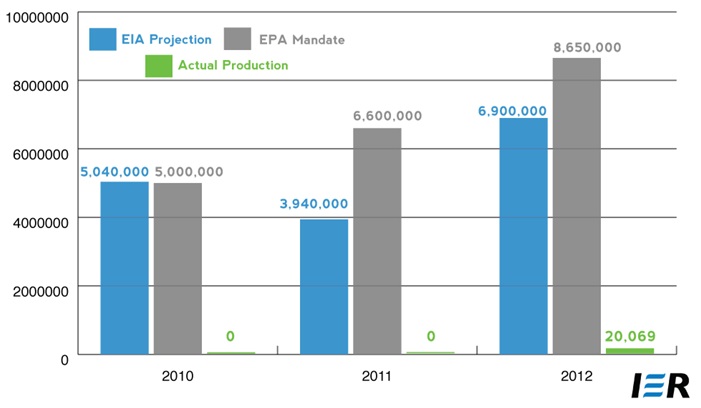
The EPA is planning to set an unrealistic target for cellulosic biofuel production for the 5th year in a row, although the final rule will be postponed until late summer due to an extension of the 2013 deadline for refiners to meet renewable fuel blending requirements from June 30 to September 30. Last year, EPA proposed adjusting the 2014 Renewable Fuel Standard (RFS) cellulosic target to 17 million gallons (15.21 billion gallons of total renewable), down from the original 1.75 billion gallon (18.15 billion gallon total renewable) statutory target set by the Energy Independence and Security Act of 2007. [i]

The EPA has regularly adjusted RFS targets, as the original EISA mandated unreachable levels of 9 billion gallons of total renewable fuel by 2009 and 36 billion gallons by 2022.[ii]  However, the EPA’s 2014 target for cellulosic biofuels jumped 11 million gallons from its 2013 target of 6 million gallons, which is both concerning and unrealistic.

With only 72,111 gallons of cellulosic biofuel production in the first quarter of 2014, it is unlikely that even the level that EPA mandated for 2013, 6 million gallons, will be reached, let alone the proposed 17 million gallon target for 2014.[iii]  EPA’s targets are therefore still greatly out of touch with reality, and should take into account actual production levels rather than projected production targets.

Source: EPA 2014 RFS Data, http://www.epa.gov/otaq/fuels/rfsdata/2014emts.htm.

The chart above suggests that such a difference between EPA targets and actual cellulosic biofuel production in 2014 should not come as a surprise, as the EPA has consistently chosen targets that are greatly above actual cellulosic biofuel production.  Rather than assessing actual production from 2013, the EPA instead increased the unmet target from last year by 11 million gallons.[iv]

In EPA’s proposed rule for 2014, the EPA based its adjustments for the cellulosic target on simulations and assessments of projected production volumes instead of considering the fact that EPA’s estimates have overestimated actual production 4 years running by at least 5 million gallons a year. EPA’s simulations for 2014 predicted a range of production from 8 million to 30 million gallons. In the first quarter, only 72,111 gallons of cellulosic biofuel were produced—far less than EPA’s simulation. Despite being wrong 4 years in a row, EPA’s simulation obviously failed to quantify important uncertainties, showing that EPA’s target of 17 million gallons is both arbitrary and ambitious.[v] For example, EPA models suggest that new facilities projected to be brought online in the United States in 2014 will increase the production capacity of the cellulosic industry by 600 percent, seemingly ignoring the reality that sheer capacity is much different than actual production.[vi]

Even one of the leading companies of cellulosic biofuel production cannot meet EPA’s projected production rates. KiOR, the nation’s first commercial-sale cellulosic biofuel plant and one of the most significant actors in the EPA’s calculation of cellulosic fuel volumes for the RFS program, has grossly and consistently underperformed EPA’s expected production.  While the company produced a record 385,000 gallons of total fuel in the fourth quarter of 2013 (which was still way below EPA projection), high production costs and insubstantial profits forced the company to freeze its production in the first quarter of 2014.[vii] If the U.S.’s largest cellulosic ethanol provider is considering bankruptcy, defaulting on its loans, and delisting from Nasdaq,[viii] it is an illusion to think that another 16.9 million gallons can be produced by the end of this year.  The EPA should seriously reconsider raising the RFS target from 6 million in 2013 to 17 million in 2014, because the target is likely unattainable.

Setting unrealistic targets has led the often referred-to “phantom fuel” situation to persist, in which petroleum refiners are mandated to include renewable fuels that do not exist.  Because there is not enough actual production of cellulosic biofuel to meet the RFS target, refiners are required to purchase credits that cost the industry more than $2.2 million in fees last year.[ix]  Refiners are not only mandated to blend biofuels that do not exist, but are also forced to purchase credits that may push costs onto consumers. This unnecessary financial drain is the product of unrealistic EPA targets and should be seriously reconsidered in the final decision on the 2014 RFS adjustments taking place at end of this summer.

IER Summer Associate Sarah Pearce authored this post.


[i] Environmental Protection Agency, Federal Register, Vol. 78, No. 230, November 29, 2013, http://www.gpo.gov/fdsys/pkg/FR-2013-11-29/pdf/2013-28155.pdf.

[ii] Environmental Protection Agency, Renewable Fuel Standard (RFS), June 6, 2014, http://www.epa.gov/otaq/fuels/renewablefuels/.

[iii] Environmental Protection Agency, 2014 RFS Data, May 7, 2014, http://www.epa.gov/otaq/fuels/rfsdata/2014emts.htm.

[iv] ibid

[v] See footnote i

[vi] See footnote i

[vii] Amanda Peterka, First U.S. cellulosic plant goes idle as EPA weighs production targets, Governors’ Biofuels Coalition, January 16, 2014, http://www.governorsbiofuelscoalition.org/?p=8108.

[viii] Amanda Peterka, Bankruptcy worries loom as funding dries up at cellulosic plant, Governors’ Biofuels Coalition, March 19, 2014, http://www.governorsbiofuelscoalition.org/?p=8722.

[ix] Reuters, UPDATE 2-U.S. may lower 2013 target for cellulosic ethanol, January 23, 2014, http://www.reuters.com/article/2014/01/23/usa-ethanol-cellulosic-idUSL2N0KX1IS20140123.

AEA Enlists New House Leaders to End Wind Welfare

WASHINGTON – American Energy Alliance President Thomas Pyle sent a letter today to House Leadership congratulating the newly elected Majority Leader Kevin McCarthy and Majority Whip Steve Scalise. The letter also urges them to remain opposed to an extension of the recently expired Wind Production Tax Credit (PTC). AEA also ran a full page ad in today’s edition of Politico as part of a broader paid initiative that includes digital and social media.

Excerpts from the letter:

The PTC expired as of January 1, 2014. However, green pressure groups and the wind lobby are working to revive this costly policy as part of a tax extenders package and also have it be retroactively reinstated. We urge you to oppose such an action.

We agree with Majority Leader McCarthy that subsidies for wind have “had their time”. Majority Whip Scalise, you have similarly condemned the PTC. In late 2012, you joined with 44 fellow Representatives in a letter stating, “Twenty years of subsidizing wind is more than enough.” This decades old subsidy has far outlived its usefulness. The wind industry should be left to compete in the free market based on its own merits, not rely on taxpayer dollars. We ask that you stand by your previous positions and remain in opposition to an extension of this wasteful subsidy.

The effect of providing a subsidy worth half or more of the wholesale price of electricity has already negatively impacted electricity reliability, because the artificial price structure created by the PTC encourages the development of uneconomic wind while undermining the economics of reliable full-time generation such as coal, natural gas, and nuclear. Investor Warren Buffett made this fact very clear when her recently said, “…On wind energy, we get a tax credit if we build a lot of wind farms. That’s the only reason to build them. They don’t make sense without the tax credit.”

To read the full letter, click here.
###

The National Interest

National-Interest-590-AEA

U.S. Energy Boom Helping Refiners and Manufacturers

The U.S. oil boom is helping U.S. manufacturers, including refiners, by producing low-cost energy to help American companies compete in a global economy. The latest example of this is a recent report by the Energy Information Administration (EIA) that compares the profitability of American and European refiners over the past 10 years. EIA’s analysis shows that over the last three years American refiners have reported considerably higher profits than their European counterparts due to lower input costs. This is because of benefits of increased domestic natural gas and oil production.

The recent influx of oil obtained through the use of hydraulic fracturing and directional drilling has widened the spread between the price of WTI (domestic) and Brent (European) crude oil prices. This has resulted in lower input costs for U.S. refiners that acquire their oil domestically. After the first quarter of 2014, the EIA reports American refiners earned around $6 more per barrel processed than refiners operating in the European markets—all because of an increase in U.S. natural gas and oil production.

This increase in supply of oil for U.S. refiners comes in the wake of a large build-out of transportation and storage infrastructure over the past several years. Firms spent billions to complete projects that move oil and gas across the United States from operating wells to refiners, and ultimately to consumers.

This increase in available oil is leading refiners to actually increase refining capacity in the U.S. A Wall Street Journal article from March 2014 reports an estimated increase in oil-refining capacity of 400,000 barrels per day to existing plants by 2018 – the equivalent of constructing a new, large-scale refinery – the last of which was built over three decades ago.

One town reaping the benefits of the refining boom is Nixon, Texas, profiled in a New York Times article earlier this year. The town is home to a refining plant owned by Blue Dolphin Energy, which resumed operations 2 years ago. The opening of the refinery resulted in the direct employment of 50 individuals, has packed the town’s diners and stores, quadrupled home values and allowed the town to improve infrastructure like roads and water systems.

The re-opening of the refinery in Nixon, Texas and the proposed capacity additions highlight the beneficial impact increased energy production, and the resulting lower energy prices, can have on individuals, small businesses, and towns alike.

IER summer associate Justin Bohlen authored this post

Mission Accomplished

Coal Killer

Coal-Killer-AEA-590

Rahall is Not Doing Enough

“President Obama’s war on coal is really a war on West Virginia families and Nick Rahall simply has not done enough to protect West Virginia from Washington’s anti-coal regulations.” -AEA President Thomas Pyle
WASHINGTON – The American Energy Alliance continued today its energy accountability initiative with another round of television and online ads in West Virginia. These ads come on the heels of the EPA’s recently proposed rules for existing power plants—one of the costliest regulations in history. The ads hold Congressman Nick Rahall accountable for shielding this and several other of President Obama’s anti-coal regulations from facing an up or down vote in Congress. The total ad buy is for $140,000 and the ads will air for three weeks.
Thomas Pyle, president of the American Energy Alliance, released the following statement:

“When coal takes a hit, so do West Virginia families, and the EPA’s anti-coal policies are having very real and devastating impacts on the state, including higher energy costs and lost jobs. But instead of protecting West Virginians from these threats, Congressman Rahall voted to shield the Obama Administration’s radical anti-coal agenda from the scrutiny of Congress. Rahall’s vote against reining in EPA’s regulatory power and his support for budgets that advance the carbon tax agenda prove that when push comes to shove, Nick Rahall stands with President Obama instead of standing up to him.

“President Obama’s war on coal is really a war on West Virginia families and Nick Rahall simply has not done enough to protect West Virginia from Washington’s anti-coal regulations.”

To view the ad, click here.

To read the fact sheet for the ad, click here.

###