
Where Does the GOP Field Stand on Obama’s Carbon Regulations?

This Wednesday, fourteen of the Republican candidates will face off in a third presidential debate hosted by CNBC in Boulder, Colorado. During the debate, CNBC plans to ask questions about key issues like taxes, job growth, and the overall health of our national economy.

While all these issues warrant discussion, let us not forget about one of the largest threats facing our economic future: President Obama’s so-called “Clean Power Plan.”

Every way you look at it, Obama’s new carbon regulations are a looming disaster for our economy, especially the poor and middle class. To start, they’re some of the costliest regulations in U.S. history. With a total price tag of $366 billion (for the proposed rule), and an annual cost of $41 billion, these regulations are among the costliest in U.S. history.

These increased costs will leave few unscathed. Hardworking families and businesses across the United States suffer because the price of energy affects the cost of everything else.

Who will suffer the most under Obama’s Climate Rule?

Low-income and minority families will be the hardest hit. A recent study from the National Black Chamber of Commerce estimates that the regulations will increase poverty for African-American households by 23 percent and Hispanic households by 26 percent. The potential jobs lost are unacceptable: energy policies that could cost 7 million jobs for African Americans and 12 million for Hispanics simply aren’t fair.

For all this economic pain, you’d think there was some method to the madness, but there isn’t. The EPA’s own climate models show the climate benefit of the regulations is practically nonexistent—a 0.018 degrees slowing in global temperature rise by 2100.

So how should candidates respond if they’re asked about these devastating regulations? Ideally, they would join leaders like Senator McConnell in his call for states to stand together and agree not to implement Obama’s carbon regulations.

In short, Americans deserve to hear each candidate say something like this:

“As a candidate, I urge states to stand together and protect their citizens from Obama’s devastating carbon regulations. States have a right to not implement these regulations until courts decide the issue and they should exercise that right. 

As President, I would do everything in my power to undo these regulations and prevent the harm they would cause. We all want a clean environment and a healthy planet for future generations. But the fact is that these regulations go about it in the wrong way. Not only would they cost hundreds of billions of dollars, but they would bring great harm to the hardworking families that need the most help. And for what? Even the EPA’s own model shows that they won’t make a real difference in global temperature.

That’s not smart energy policy. That’s asking Americans to endure a lot of pain for basically no gain. Americans deserve better than that.”

The simple fact is that the American people oppose Obama’s radical climate agenda. After being told that the carbon regulations would result in hundreds of thousands of lost jobs, a majority of voters in key battleground states opposed the regulation, according to a July survey released by AEA. Moreover, a survey conducted by MWR Strategies on behalf of AEA finds that 60 percent of likely voters believe that it is “mostly a bad thing” to “require States to impose mandates on their citizens to buy certain amounts of renewable energy, whether or not it is cost-effective,” as Obama’s carbon regulations would. We hope the candidates listen to the American people and recognize that affordable, abundant, and dependable energy is key to a vibrant economy.

AEA Urges Congress to End Wind Welfare

WASHINGTON — Today, the American Energy Alliance launched a six-figure advocacy initiative urging Congress to eliminate the wind Production Tax Credit (PTC). This targeted digital and grassroots initiative follows AEA’s recently launched PTC Action Hub, and continues a sustained effort to drive House Members to support H.R. 1901, the PTC Elimination Act. Fifty House Members currently support this legislation, while 86 have publicly opposed the PTC.

“Congress has an opportunity to step up and end a handout that has bilked American taxpayers for decades,” said AEA President Thomas Pyle.

“We applaud Congressmen Marchant and Pompeo for introducing legislation to eliminate the PTC and encourage other members to support their efforts. The PTC benefits large wind corporations and bankrolls President Obama’s federal takeover of the electric grid—leaving the American people with the bill. Congress can protect their constituents from wasteful handouts and the Obama administration’s climate agenda by opposing the PTC.”

The targeted digital effort will focus on the following 23 districts:

Rep. Young (IN-9th)
Rep. Buchanan (FL-16th)
Rep. Adrian Smith (NE-3rd)
Rep. Boustany (LA-3rd)
Rep. Renacci (OH-16th)
Rep. Smith (MO-8th)
Rep. Ellmers (NC-2nd)
Rep. Brooks (IN-5th)
Rep. Johnson (OH-6th)
Rep. Latta (OH-5th)
Rep. Long (MO-7th)
Rep. Roby (AL-2nd)
Rep. Rogers (AL-3rd)
Rep. Womack (AR-3rd)
Rep. Crawford (AR-1st)
Rep. Jolly (FL-13th)
Rep. Wagner (MO-2nd)
Rep. Rice (SC-7th)
Rep. Hurt (VA-5th)
Rep. Abraham (LA-5th)
Rep. Murphy (FL-18th)
Rep. Ashford (NE-2nd)
Rep. Kirkpatrick (AZ-1st)

Click here to visit EndWindWelfare.org

Click here to see which representatives are taking a stand to end corporate welfare.

Click here for more information on H.R. 1901, The PTC Elimination Act.

###

EPA Messes With Texas Scientist; EPA Fails Miserably

Recently, the Environmental Protection Agency (EPA) received a gentle reminder not to mess with Texas, when Texas Commission on Environmental Quality (TCEQ) Chairman Bryan Shaw once more drew attention to EPA’s dubious health claims associated with President Obama’s so-called “Clean Power Plan.”

In a letter addressed to Rep. Eddie Bernice Johnson, Shaw explains that, contrary to assertions made by EPA officials, carbon dioxide does not threaten respiratory health at existing or anticipated levels. To support this claim, Shaw cites an EPA document, which states, “Greenhouse gases (GHGs), at both current and projected atmospheric concentrations, are not expected to pose exposure risks on human respiratory systems…”

However, EPA has managed to use anticipated respiratory health benefits as justification for their costly carbon regulation. The health benefits cited in the regulatory impact analysis (RIA) of the regulation are derived not from a reduction in GHGs, but rather from other pollutants that are “scientifically and legally distinct from GHGs and are not even the subject of the CPP.”

In addition, by relying on these “co-benefits,” EPA is claiming benefits from reducing pollutants that, in some cases, EPA admits are not causing any harm. Shaw cites PM2.5 as an example, stating, “Texas does not have a single county in non-attainment for PM2.5, meaning the EPA has concluded that PM2.5 is not impairing health anywhere in Texas. Yet at the same time, this RIA postulates that reducing PM2.5 levels…will provide some health benefit to Texans.”

This is not the first time that EPA has used “co-benefits” as justification for a costly regulation. Earlier this year, EPA’s Mercury and Air Toxics Standards was reviewed and remanded by the Supreme Court for failing to consider costs. During this process, Chief Justice Roberts suggested that EPA’s “co-benefits” analysis could be “an illegitimate way of avoiding the different…quite different limitations on EPA that apply in the [NAAQS] program…” The Supreme Court’s ruling on the mercury rule was a step in the right direction, but now EPA is repeating its misleading behavior in emphasizing the “co-benefits” of Obama’s carbon rule.

As Dr. Shaw and others have pointed out, EPA is overstepping its authority to impose a rule that, even according to EPA Administrator Gina McCarthy, will have no meaningful, direct impact on respiratory health, atmospheric temperatures, or sea level rise. To avoid an outcome like that with the mercury rule, where costly and irreversible changes had already been made before legal resolution, state policymakers should follow Texas’ lead and reject the president’s costly and overreaching regulation. Blocking EPA’s federal overreach on the new carbon regulation is a small but necessary move towards the broader regulatory reform needed to check EPA’s authority and stop the trend of federal overreach.

EPA Playing Politics With Carbon Regulation

WASHINGTON — American Energy Alliance President Thomas Pyle issued the following statement after EPA published its carbon regulation for existing power plants in the Federal Register:

“EPA once again reveals that its motives are purely political. The agency delayed publication of its carbon regulation for nearly three months to stall the legal process and avoid any embarrassing PR before the UN Climate Conference. The president’s climate regulation has never been about protecting the environment. It’s about fulfilling his promise to fundamentally transform America at the expense of poor and middle class families who will be hit with higher energy costs and lower living standards.

“Administrator McCarthy’s claim that EPA is giving states options, time, and flexibility to handle this regulation is a farce. In reality, EPA is trying to bully states into doing their dirty work for them. State leaders have an obligation to protect their citizens and should do so by refusing to implement Obama’s unlawful carbon regulation before the courts weigh in.”

Click here to visit SmartPowerPlan.org

###

Key Vote: No on House Ex-Im Bank Reauthorization

On Monday, the House will vote to reauthorize the Export-Import Bank. Having expired this summer, a band of Representatives summoned a seldom-used parliamentary procedure known as a discharge petition to skirt the usual legislative process and force a vote on the House floor for H.R. 3611, the Export-Import Bank Reform and Reauthorization Act of 2015. The Ex-Im Bank is the poster-child for corporate welfare and a hallmark of cronyism. Further, the Export-Import bank is used to provide hundreds of millions of dollars a year for unnecessary energy subsidies that distort the market and hurt consumers. The American Energy Alliance urges all Members to oppose reauthorization of the Export-Import Bank and vote against H.R. 3611.

Obama Offers Grim Solace To Coal Communities

WASHINGTON — American Energy Alliance President Thomas Pyle issued the following statement on the Obama administration’s announcement of $14.5 million in grants as part of the president’s “Partnership for Opportunity and Workforce and Economic Revitalization Initiative”:

“The Obama administration’s ‘Partnership for Opportunity and Workforce and Economic Revitalization Initiative’ offers grim solace to America’s coal families. After years of working to fulfill his campaign promise to bankrupt the coal industry, the president has the audacity to claim he is ‘revitalizing’ these communities. President Obama’s destructive agenda has robbed coal communities of their jobs and their livelihood. Now he wants to be commended for throwing taxpayer money at a problem he created.”

###

AEA Launches Wind PTC Action Hub

New Initiative Encourages Lawmakers to Eliminate Handouts for Big Wind

WASHINGTON — Today, the American Energy Alliance launched www.EndWindWelfare.org—a resource and activist hub aimed at eliminating the wind Production Tax Credit (PTC). With this new tool, which includes a legislative tracker and an action center, AEA will encourage lawmakers to support efforts to end this taxpayer-funded handout.

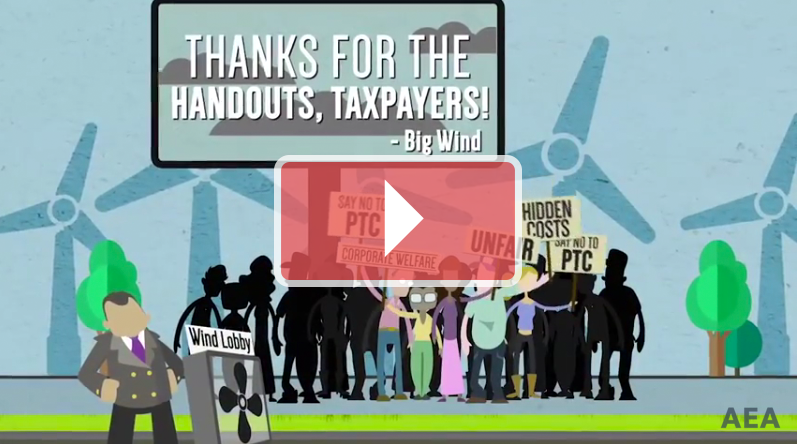
One feature of the hub is a video illustrating how the PTC is tied to President Obama’s new carbon dioxide regulation. The goal of this regulation is to shift electricity generation from affordable and dependable sources like coal toward expensive and unreliable sources like wind. Obama’s plan will unavoidably raise electricity rates—hurting poor and middle class families the most. But without the PTC, mandating industrial wind power is a much more difficult task, as wind power needs handouts to survive. Thus, Congress can take meaningful action against the Obama administration’s anti-energy agenda by eliminating the PTC. Watch the video below:

End-Wind-Welfare-video-still
The hub’s legislative tracker shows which representatives have publicly taken a stand against the PTC, allowing Americans to thank their elected leaders for opposing this handout, or hold them accountable for supporting wind welfare. Our action center will also serve as a resource for policymakers and activists by providing recent reports, blog posts and ongoing advocacy efforts on the PTC.

Click here to visit the hub.

###

Let States Manage Their Own Land; Don’t Reauthorize LWCF

A debate in Washington over the reauthorization of the Land & Water Conservation Fund (LWCF) has brought up the often overlooked topic of federal land management. Many Americans may not know just how much land the US government owns. The federal government owns roughly 643 million acres of surface lands, tens of millions acres more of subsurface lands and 1.76 billion acres in the outer continental shelf (OCS) off our coast. The combined roughly 2.46 billion acres is larger, by comparison, than the entire landmass of the United States. Despite these holdings, the LWCF has been a major program for the federal government to continue to buy private lands in the United States.

Created in 1964, the LWCF is a fund that empowers the federal government to purchase private lands to be annexed into growing federal land holdings. This is funded through offshore drilling fees and royalties, which then go into an account that is appropriated to various land programs every year. On October 1, 2015, the LWCF charter expired–and will remain expired unless Congress acts to reauthorize the LWCF.

The question is whether Congress should look to immediately reauthorize this program, or whether this program can stand to have some changes made to it–considering it’s 50 years old. One thing is very clear–there is no emergency facing the program. Currently the LWCF has over $20 billion in unappropriated funds, enough to last at least 60 years if the trend of $300 million in annual appropriations (the minimum amount) continues. Even though the charter has expired, the LWCF can continue to operate on annual appropriations. Thus, claims that the fund is in a crisis are simply untrue. The LWCF should not be reauthorized, at least until serious reforms regarding federal land acquisition are addressed.

At issue is the growing abuse of federal power used to annex state, local, and private land under the auspice of ‘conservation’ or ‘stewardship.’ Between the four major land owning agencies–the BLM, Forest Service, Fish and Wildlife Service, and the National Park Service–the federal government controls 643 million acres of land, roughly 29 percent of all acreage in the US. In a state like Utah, over 60 percent of the land is controlled by the federal government.

Screen Shot 2015-10-06 at 4.53.36 PM

Since the federal government owns so much land that–unlike private lands–produces so little economic enterprise, states and localities are forced to rely on the federal government for revenues, called Payment in Lieu of Taxes (PILT). In 2015, Congress appropriated $405 million for PILT on over 607 million acres of land, the highest it has been in six years, and by a good margin: the next highest total year PILT was $360 million in 2010. A reauthorization of the LWCF could lead to even higher federal spending for PILT in the years to come, and thus greater state dependence on the federal government.

Further, the federal government does a poor job of administering land as opposed to states and localities. For example, over the past 5 fiscal years, oil production is up 89 percent in the U.S. on non-federal lands, while oil production is down 10 percent on federal lands. As explained by the Property and Environment Research Center, “States have clearly demonstrated their ability to generate greater returns from land management than the federal government.” According to their study, from 2009-2013 state lands totaled over $223 million in net revenue, while federal lands lost nearly $2 billion. If we care about land management, a reauthorization of LWCF in its current state is not the best remedy. States must have a greater role in land administration.

At the very least, the LWCF should be reformed prior to any talk of reauthorization being acted upon by Congress. Reform should include measures to give power back to states over lands within their own borders and allowing them to be stewards of their own land. After all, who knows better about the needs of local people and environments than those who live and work closest to them.

Some in Congress want to permanently reauthorize this program, but permanent reauthorization of programs sets a bad precedent. It also seems to indicate that there is something wrong with private land ownership, and that the federal government needs to buy more and more and more private land. Taxpayers are better served if programs are continually reviewed, evaluated, and then reauthorized–with appropriate changes in policy, if deemed prudent. This also forces Congress to prioritize in a way that they rarely do.

The LWCF, initially a bipartisan endeavor, strayed far from its initial goals and now serves as a tool for the federal government to pay for or seize land from states and individuals. States and localities are the best stewards of the beautiful land that we Americans call home, not the federal government. Congress should look to give states greater authority and power over their own lands and should not reauthorize the LWCF without first initiating substantial reforms.

Americans Deserve a Committee Focused on Real Energy Reform

As with any suggestion of a change in the status quo in Washington, my call for the establishment of an Energy & Natural Resources Committee in the U.S. House of Representatives (a position which I have held for over five years) has been met with some reservation. I am happy to continue the dialogue about why this is long overdue and welcome others to join the conversation.

Representative Ed Whitfield recently announced plans to retire from Congress at the end of this term. Whitfield, who chairs the Energy and Commerce Subcommittee on Energy and Power, said one of the issues a future Congress could take on would be to “revisit the Clean Air Act.”

Revisiting the Clean Air Act would be a worthy endeavor. The Obama administration has misused the statute by pursuing the regulation of carbon dioxide to grab more power and exert more control over Americans’ daily lives. Energy policy generally under President Obama has become subservient to carbon dioxide policy through the hijacking of the Clean Air Act by anti-energy groups and their allies in Washington. Just this week, this fact was evidenced by the swift Democratic opposition to the very modest energy bill advanced by Commerce Committee Republicans after a year of “bipartisan” negotiations.

Amending the Clean Air Act currently falls under the jurisdiction of the Energy and Commerce Committee. In fact, the committee wrote the laws that the Obama administration is now abusing. Even the committee’s longest serving former Chairman, John Dingell, never intended the Clean Air Act to control carbon dioxide.

To its credit, the Energy and Commerce Committee has held dozens of hearings on the havoc caused by the Administration’s misuse of the Clean Air Act. Unfortunately, they have never mustered the political will to amend the Act’s language to reflect its original intent.

Instead, they have spent the past year advancing a piece of legislation not designed to take on the Administration’s regulatory onslaught, but rather to garner bipartisan support in the hopes that somehow it will make it to the President’s desk. Now, instead of a bipartisan “Architecture of Abundance” they are advancing a partisan energy bill that fails to accomplish meaningful reform.

The fact that the Energy and Commerce Committee has such vast jurisdiction means that the committee has borne the brunt of Obama’s abuse of executive authority. Given the circumstances, they have done as good of a job as one can expect fighting back. However, the fight against national environmental organizations, which are dedicating millions of dollars lobbying to keep our energy resources in the ground, is too important to be relegated to one of many challenges a committee must tackle.

A House Energy and Natural Resources Committee would be able to focus on building a strong case for updating the Clean Air Act. Doing so would go a long way to creating the long-term, structural changes necessary to promote America’s abundant natural resources, lower energy costs, create jobs, and enhance our energy security.

The House Republicans should use the opportunity of a change in leadership to shift the Energy and Commerce Committee’s energy jurisdiction to the House Committee on Natural Resources, which already has jurisdiction over many energy issues and shares jurisdiction with Commerce in several areas. This would allow the Commerce Committee to devote more attention to its other areas of jurisdiction, including healthcare and telecommunications.

A new House Energy and Natural Resources Committee would focus the House Republican effort on advancing real energy reform. As energy issues rise to the forefront of the policy agenda, the American people deserve a concentrated focus on this crucial set of issues.

Key Vote: Yes on Lifting Oil Export Ban

Congress will soon vote on H.R. 702, a bill to lift the ban on oil exports. The American Energy Alliance supports ending the oil export ban and urges all Members of Congress vote in favor for H.R. 702.

The oil export ban is an outdated and economically damaging policy. The statute is a relic from the 1970s. Technological advances, specifically in hydraulic fracturing and horizontal drilling, have given way to a domestic oil boom. Since 2008, U.S. oil production has increased more than 80 percent and will almost certainly continue to increase. Today, the U.S. is the largest combined oil and natural gas producer in the world. But banning oil exports puts a damper on future domestic oil expansion. This means greater uncertainty and fewer jobs for U.S. oil workers.

One of the biggest concerns about allowing oil exports it that it seems like it could increase gasoline prices here at home. In fact, studies show the opposite would occur because allowing U.S. oil exports would increase the overall supply of oil in the world. The Brookings Institution found a potential 9 cents per gallon drop in gas prices. IHS estimates lifting the ban could lower gas prices by 8 cents per gallon, and an industry study estimates removing the export ban could result in up to $5.8 billion in reduced consumer fuel costs from 2015-2035.

Even though there is substantial evidence supporting an end to the oil exports ban, some lawmakers are attempting to use the issue as a bargaining chip to pass other initiatives. Unfortunately, some of these policies, such as renewing or extending thewind Production Tax Credit and the solar Investment Tax Credit, are harmful for Americans. Studies have demonstrated that wind power is an expensive energy source and undermines the reliability of the electricity grid. Congress should consider the merits of oil exports and realize that removing the ban is positive in and of itself.

The American Energy Alliance urges Congress to vote in favor of H.R. 702 so long as it is not tied to the extension of renewable energy subsidies or partial repeal of the renewable fuel standard. If lifting the oil export ban is considered on its own merits, the American Energy Alliance will include it in our American Energy Scorecard. YES is the pro-consumer, pro-energy, and pro-free market vote.