Groups to Congress: Don’t Use Military to Subsidize Pet Energy Projects

AEA & CVA Send Letter Supporting Rep. Fleming’s Amendment to NDAA

WASHINGTON — Today the American Energy Alliance and Concerned Veterans for America sent a letter to Congress in support of Rep. John Fleming’s proposed amendment to the National Defense Authorization Act for FY 2017. To protect our national interest and ensure the military remains as effective and efficient as possible, Congress should reject the Obama Administration’s attempt to promote its green energy agenda on the backs of our armed forces. Below is an excerpt from the letter:

We join together in voicing our strong support for Congressman John Fleming’s proposed amendment to the National Defense Authorization Act for FY 2017 (NDAA). Our military should be focused on protecting our national security, not subsidizing pet energy projects.

Congressman Fleming’s amendment prohibits funds from being used to carry out parts of Executive Orders 13653 and 13693. These executive orders direct agencies to implement a host of policies under the guise of preventing climate change. For the Department of Defense (DoD), this means increased costs, further complication of the acquisition process, and additional burdens in logistics, planning, and execution of critical missions. Ultimately, these executive orders detract from the DoD’s ability to protect our country by introducing even more unnecessary bureaucracy to the Pentagon.

By restricting funds from being used to carry out these executive orders, Congressman Fleming’s amendment accomplishes several goals. It allows DoD to continue to protect Americans by using the most efficient and capable means necessary. This means allowing our military to use the most reliable and cost effective energy resources—a priority for the world’s largest single energy consumer.

The NDAA should authorize taxpayer dollars to be spent on defense activities in the interest of promoting national security. Implementing these executive orders requires additional funds, whether it is for acquiring more expensive fuel sources, such as biofuels or solar panels, or committing more resources to the already bloated Pentagon bureaucracy to oversee the implementation of these executive orders. Forcing the DoD to rely on more expensive energy sources for no actual tactical or strategic advantage is unnecessary, especially given the abundance of domestic energy supplies. The funds authorized in the NDAA should be spent in areas directly related to DoD’s mission – not to implement President Obama’s green energy agenda.

Click here to read the full coalition letter.

###
States Continue to Stop Work on Carbon Rule, But Utilities See “Investment Opportunity”

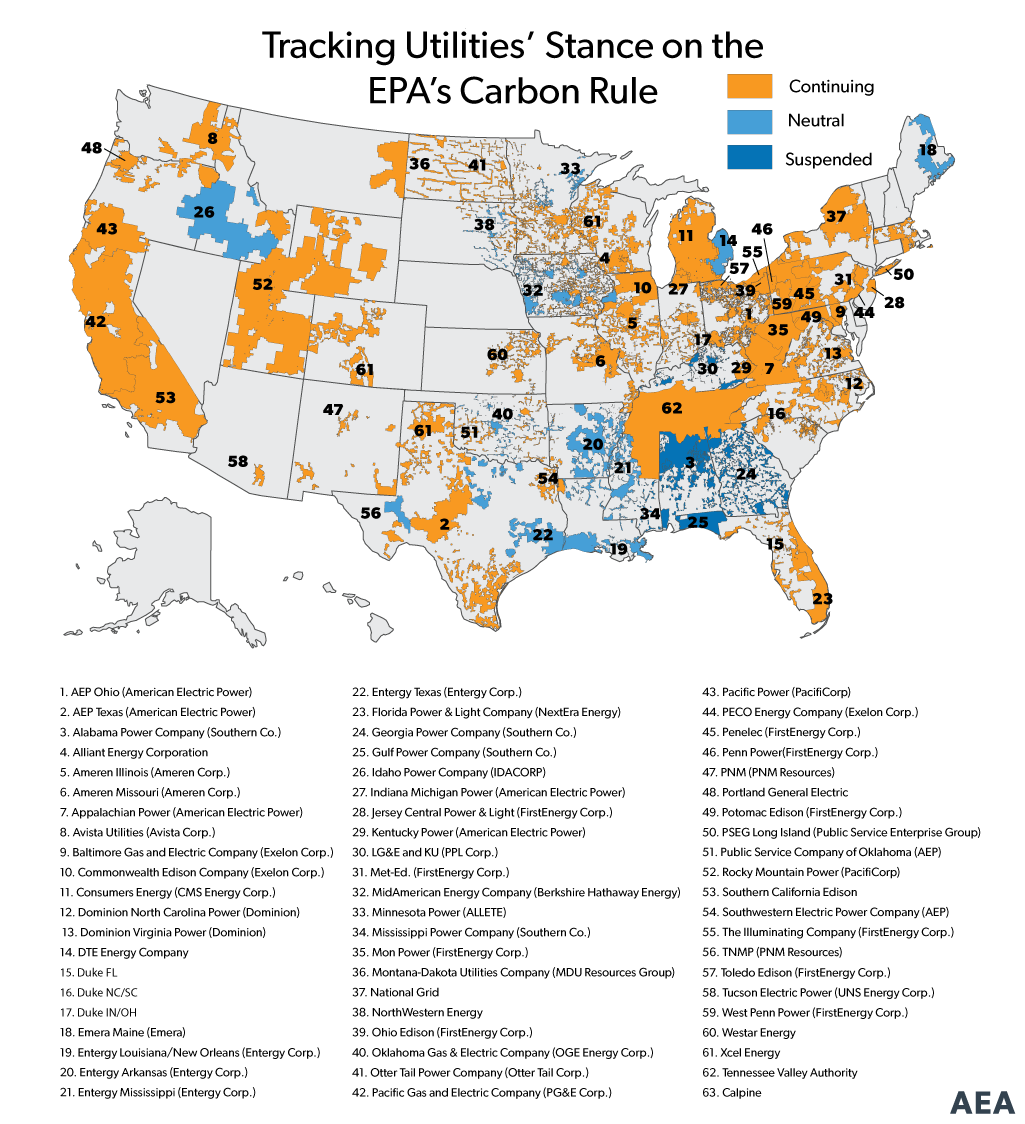
Litigation over the EPA’s carbon rule for power plants is continuing with oral arguments set for early June. In the meantime, several states have sought to codify the Supreme Court’s stay with a “stop work order” inserted into state appropriations bills. Last Friday, Kansas became the latest state to protect their residents. These bills are critical to protecting scarce state resources while legal uncertainty remains. Where possible, they should also be extended to cover utility regulators.

One of the most important reasons for states to pass these kinds of bills is to protect electricity ratepayers from premature rate hikes as a result of these regulations. Utilities have every incentive to quickly comply with future regulations and pass on the costs of compliance to ratepayers.

To prepare for the future, including compliance with possible regulations, utilities prepare plans known as Integrated Resource Plans (IRPs). These are long, dense documents that detail the many investments the utilities currently have or would like to make to ensure affordable, reliable power is available to their customers. IRPs also must take into account existing laws such as Renewable Portfolio Standards or other mandates that require energy to be bought and sold from specific sources that may not otherwise be economical or beneficial to the grid. Accounting for these mandates can be fairly straightforward, as the laws are established by the state legislatures.

These IRPs get much more complicated, however, when utilities attempt to anticipate future regulatory burdens imposed by the EPA (or other federal agencies) before the regulations are finalized or withstand legal scrutiny (e.g., MATS, carbon rule). Miscalculation on what the rule might require or whether it passes legal muster can result in costly increases for consumers and premature closures of power plants. This was a main reason 28 states sought a stay of the carbon rule and arguably one of the reasons the Supreme Court granted the request. The goal is to prevent unnecessary and irreparable harm before EPA successfully defends the rule in court. Fortunately, many state agencies have “put their pencils down”, as West Virginia Attorney General Patrick Morrisey and Texas Attorney General Ken Paxton recommended.

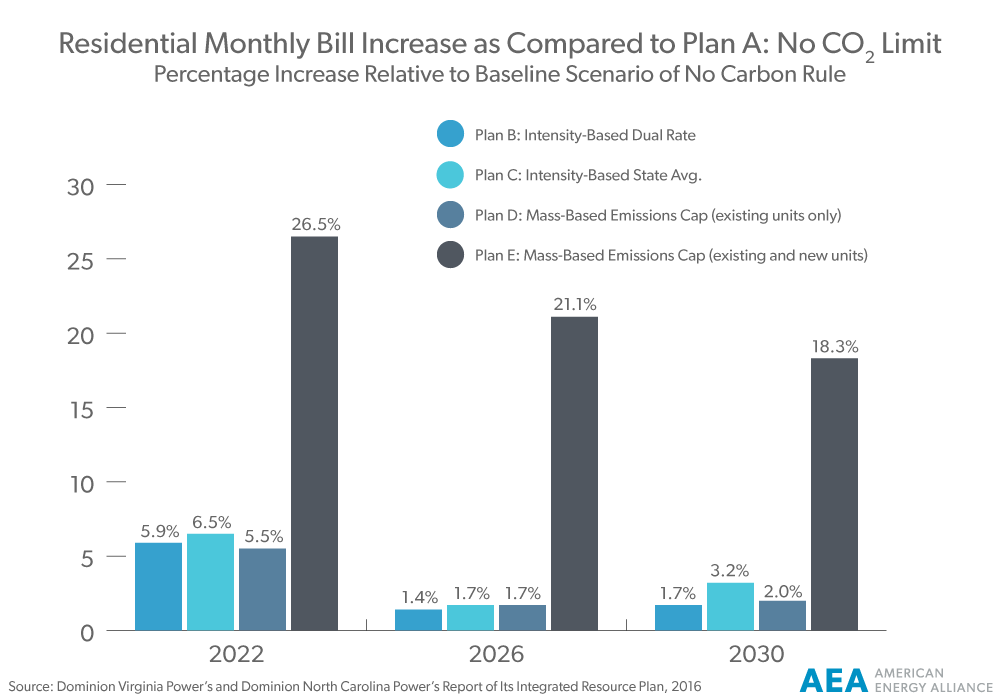
Unfortunately, this is not the case with many utilities, who see the carbon rule as an “investment opportunity…[that they] plan to take full advantage of”. A recent IRP submitted by Dominion Resources covering North Carolina and Virginia demonstrates this point in two ways. First, Dominion betrays its preference for the CPP by presenting five scenarios with different policies in place and investments made – four of which assume the carbon rule is in place.  Second, their models project electricity rate increases in every scenario when compared to the baseline of no carbon rule.

Res-Monthly-Bill-Increase-Compared-to-No-Carbon-Rule

Simply put, the carbon rule will raise electricity rates, whatever way you slice it. Even worse, the most expensive scenario for consumers – a mass-based approach covering existing and new units (e.g., cap and trade) – is the one most often recommended by carbon rule proponents as the most cost effective method of compliance! In reality, this scenario likely allows the greatest “investment” to occur.

grid-map-full-legend

Yet many utilities see profit to be made and have aligned with environmental pressure groups in ignoring the stay for planning purposes. State policymakers and utility regulators should beware the consequences of costly, premature action, and deny any attempt to prematurely force this rule on their constituents.

House Bill Signals New Life for Nuclear Energy

Nuclear energy has provided Americans with safe, reliable power for decades. In recent years, new technologies have opened the door to more advanced reactors. However, the current licensing process for nuclear facilities remains burdensome and lengthy, and there is currently no path for advanced nuclear technologies to gain approval at the Nuclear Regulatory Commission.

Fortunately, Congress is taking steps to address this impasse for advanced nuclear technology. Reps. Latta and McNearny introduced H.R. 4979, the Advanced Nuclear Technology Development Act, to reform policies surrounding the licensing process by asking the Department of Energy and the Nuclear Regulatory Commission to coordinate efforts and map out a path forward for advanced nuclear technology. This bill provides a good first step in improving the regulatory framework for nuclear power and improving access to reliable, low-emission power for decades to come.

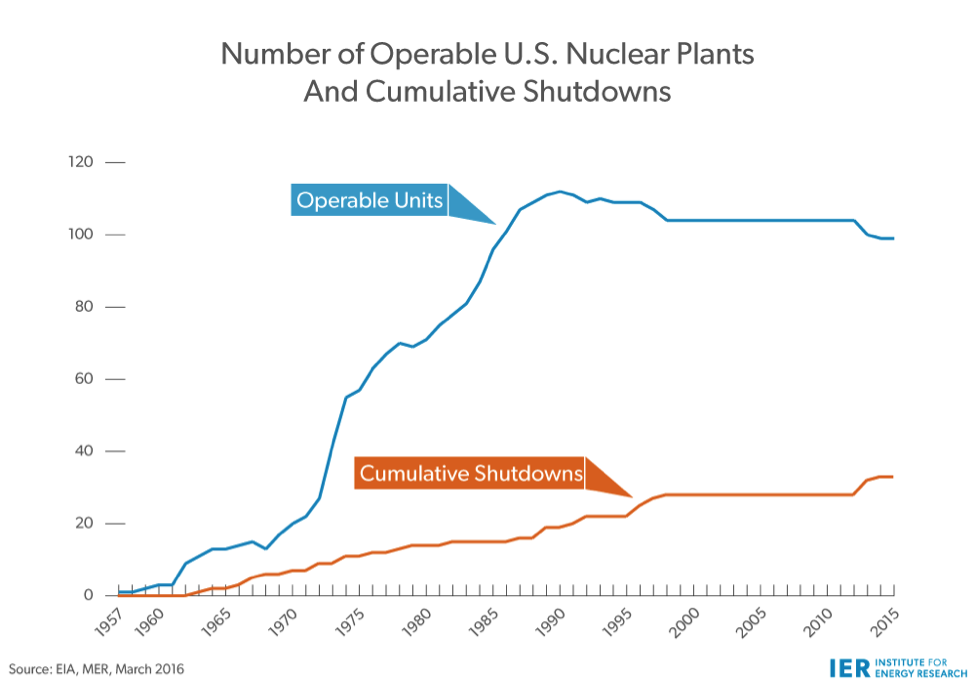
Nuclear power has long supplied the U.S. with dependable baseload electricity. However, the current fleet is aging and facing a number of retirements due to license expiration. Currently, 99 units operate in 31 states across the country. These reactors provide 20 percent of the nation’s electricity and 8.5 percent of our total energy. Yet nearly one third of the fleet could be retired in the next 15-20 years.

nuke

There is no question that the future is darker without nuclear energy. Nuclear energy is distinctly advantageous due to its dispatchability, reliability, safety, and lack of emissions. New reactor designs not only provide baseload power, as current designs do, but may also be able to follow load and actively balance power demand and supply. Yet building a new plant requires extensive licensing and regulatory approval, often making such endeavors uncertain and cost-prohibitive. Thus, as the nation requires more and more reliable power–especially to replace the dozens of gigawatts of coal-fired capacity that have retired in recent years–nuclear energy faces the dim prospect of being left out of the generation mix.

H.R. 4979 recognizes the benefits of nuclear power in America’s energy future and seeks to ensure that it is not left behind due to regulatory inefficiencies. First, the bill notes the importance of nuclear energy, including advanced reactors, to America’s power mix. This affirmation by Congress is important, given the recent mischaracterization of nuclear energy by some in the energy sector. Take the case of the Vermont Yankee nuclear plant, which closed in 2014. The plant provided New England with reliable, emissions-free energy for over four decades. Attempting to replace the 604 megawatts of energy lost from Vermont Yankee with new wind and solar will be impossible, as nuclear energy is fully dispatchable: wind and solar are not. Congress understands this reality and says as much in the bill.

Most importantly, the bill begins the process of reworking the framework for advanced nuclear reactor licensing. It requires the Nuclear Regulatory Commission to formulate a plan for “developing an efficient, risk-informed, technology-neutral framework for advanced reactor licensing.” This would set the U.S. on a path of regulatory reform that should result in streamlined and more efficient licensing for advanced nuclear reactors. Further, the bill will allow for increased cooperation between the nuclear energy industry and regulators, thus increasing stakeholder input in the hopes of establishing a coherent and agreeable licensing framework for the next generation of nuclear power.

There is still a long road ahead for nuclear regulatory reform. While H.R. 4979 does not immediately remedy issues in the current licensing and approval process, the bill is an important step forward and gets the ball rolling towards much needed regulatory reform in nuclear energy.

Earth Day: Continuing a Storied Tradition of Misleading Claims and Outrageous Predictions

Today, millions of people around the world are celebrating Earth Day. Since its inception in 1970, Earth Day, and the environmental movement in general, has been plagued by incorrect predictions and factually wrong claims.

Earth Day’s Legacy of Inaccuracy

In their 1970 Earth Day edition, Life Magazine stated, “Scientists have solid experimental and theoretical evidence to support…the following predictions: In a decade, urban dwellers will have to wear gas masks to survive air pollution…by 1985 air pollution will have reduced the amount of sunlight reaching earth by one half….”.

The reality is that air quality was already improving in major cities around the United States and air quality continued to improve after 1970 through today.

Similarly, in the 1970 Earth Day issue of The Progressive, Harvard biologist and alarmist Paul Ehrlich laid out a doomsday scenario where between 1980 and 1989, 4 billion people, including 65 million Americans, would perish in what he termed the “Great Die-Off.” Instead, global population grew by over 800 million during the 1980s.

And let’s not forget failed presidential candidate turned millionaire environmental activist Al Gore, who in January of 2006 claimed that if we didn’t take “drastic measures” to reduce greenhouse gas emissions, that we would reach a “point of no return” in ten years. For those keeping track, this June marks the ten-year anniversary of Gore’s climate alarmist documentary “An Inconvenient Truth,” whose dire predictions look flimsier and more absurd every year.

As time has passed, we’ve seen just how absurd these predictions really were. However, the environmental movement and Earth Day activists continue to make misleading claims about the environment and particularly our use of natural gas, oil and coal. For a group that celebrates “consensus science” at every opportunity, the environmentalist movement’s predictions seem closer to science fiction than reality.

A Model for Our Kids?

On Earth Day 2015, in a conversation with mechanical engineer and children’s entertainer Bill Nye, President Obama stated, “I have the capacity to look at facts and base my conclusions on evidence… Part of shifting our political culture, I think, is we’ve got to model for our kids that facts matter.”

We agree with the president: facts matter. That’s why this Earth Day, we should pay attention to the facts about energy and the environment, instead of the alarmist rhetoric of the environmental movement.

Here are some of the top myths we continue to hear from the environmental movement:

MYTH: The environment is getting worse.

If you listen to the rhetoric from the national environmental movement, you would think the quality of our air and the environment was in pretty poor shape and only getting worse. The American Lung Association, one of the biggest advocates for overreaching EPA regulations like the so-called “Clean Power Plan,” tells us that over half of Americans are breathing in polluted air. Groups like the Sierra Club say we have to move beyond resources like natural gas, oil, and coal because they pollute our air.

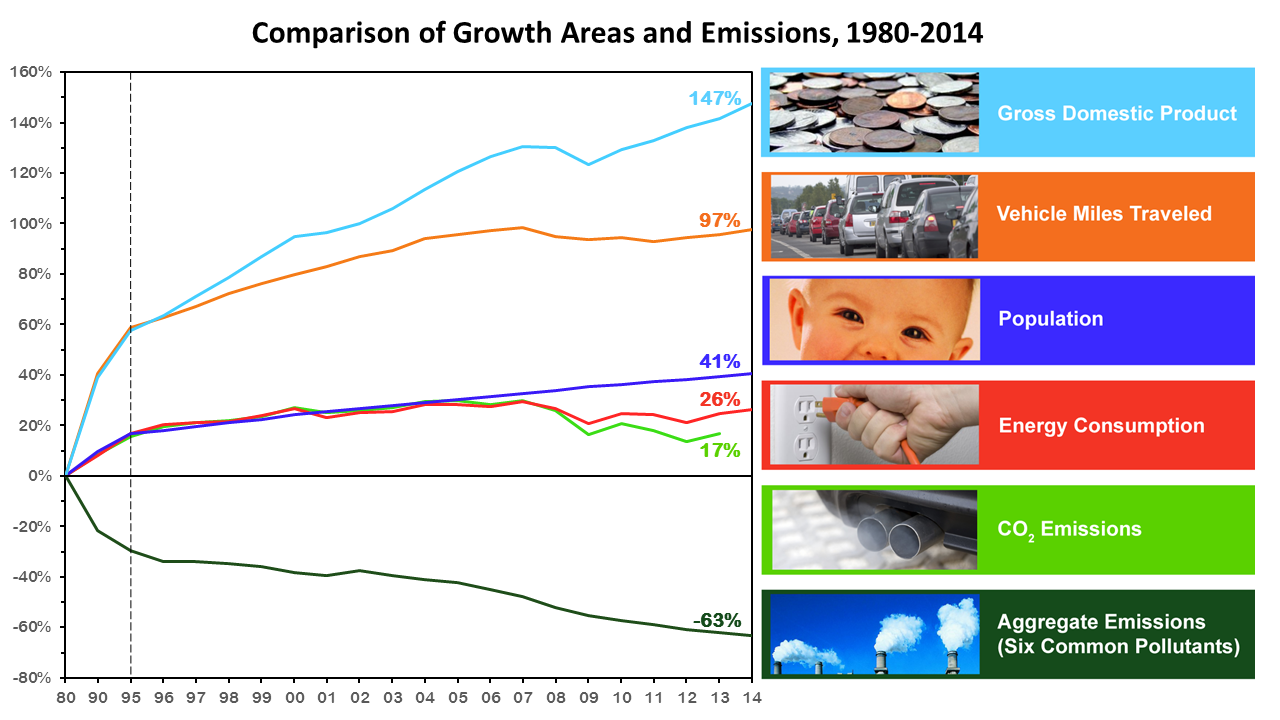
But the data tell us that air quality in the United States is actually improving. According to the following chart from the EPA, emissions from the six criteria pollutants declined by 70 percent since the 1970’s even as we’ve consumed more energy, increased our population, and driven more miles in our vehicles:

y80_14

But it’s not just air quality that has improved. America’s water is also cleaner. As Strata Policy points out:

“Water quality today is far better than it was a century ago…In 1900, 35 Americans per 100,000 died of typhoid and paratyphoid, 8 per 100,000 died of malaria, and 12 per 100,000 died of dysentery. By 1970, four years before the passage of the Safe Drinking Water Act, all those death rates had fallen virtually to zero.”

The 2007 Cato Institute publication The Improving State of the World, written by Indur Goklany, chronicled the myriad ways in which human beings are thriving today beyond what was even imaginable for previous generations. As the press release states, “Goklany confronts foes of globalization and demonstrates that economic growth, technological change and free trade helped power a ‘cycle of progress’ that in the last two centuries enabled unprecedented improvements in every objective measurement of human well-being.”

For the environmentalist movement, the obvious progress of modern civilization–including cleaner and safer air and water than ever before–falls on deaf ears.

MYTH: CO2 is dirty and bad for your health.

Faced with the reality that the air is actually getting cleaner, the environmental movement has shifted their focus to what they call “carbon pollution.” In reality, what they’re referring to is the emission of carbon dioxide or the emissions of greenhouse gases.

Al Gore has referred to carbon dioxide as sewage. In an interview with Ezra Klein, Gore said, “[I]n spite of the continued released [sic] of 90 million tons of global warming pollution every day into the atmosphere, as if it’s an open sewer, we are now seeing the approach of a global political tipping point.”

Environmental groups like the Sierra Club claim that carbon dioxide is “linked to life-threatening air pollution—such as the smog that can trigger asthma attacks,” and that establishing regulations for carbon dioxide will “ensure that our kids, our communities and America’s workforce are healthier…”

But when asked by FactCheck.org back in 2011 about connections between carbon dioxide and asthma, Dr. David Bernstein, professor of medicine at the University of Cincinnati stated:

“To my knowledge, there is no convincing evidence in the medical literature indicating that CO2 and methane directly affect asthma symptoms, asthma morbidity or asthma mortality. This would be considered misinformation. We’re more concerned about ozone, particulate matter, nitrogen dioxide and sulphur dioxide.”

Carbon dioxide is not dirty, and is not poisonous to humans in concentrations we observe in the atmosphere. In fact, carbon dioxide is the natural product of combustion–whether that combustion occurs within our cells (which is why humans exhale carbon dioxide), or whether carbon dioxide results from the combustion of natural gas. Carbon dioxide is essential to life on Earth because vegetation requires carbon dioxide to survive and thrive.

However, the point about asthma and respiratory illnesses remains. It’s true that cases of asthma have increased in recent years, but with emissions of the six criteria pollutants decreasing and CO2 not linked to respiratory problems, what’s to blame?

A study from Johns Hopkins University found that asthma was more closely linked to poverty; and specifically, indoor air pollution linked to poverty. The policies that environmental activists advocate for, such as shutting down our nation’s affordable and reliable coal power plants, will make energy more expensive. And as we have seen in countries that have made electricity a luxury good through ill-advised energy policy–like Germany–higher energy costs exacerbate poverty and the negative health impacts associated with it.

MYTH: We must use less natural gas, oil, and coal.

Environmental campaigners tells us that we must move away from the use of natural gas, oil, and coal to avoid environmental disaster and climate change. This sentiment–that we need to “break up” with fossil fuels–is embodied in the keep it in the ground campaign, which is an effort to stop all production of natural gas, oil, and coal. As Greenpeace claims on its website, “To avoid the worst impacts of climate change, we need to keep the world’s remaining fossil fuels in the ground. That means moving away from coal, oil, and natural gas, and towards a renewable energy future.”

First of all, it’s important to note that even if we were to completely eliminate carbon dioxide emissions here in the U.S., such a dramatic move would only reduce average global temperatures by 0.17 degrees Celsius by 2100.

Second of all, using affordable, reliable energy improves our lives. Some of the most affordable and reliable energy is natural gas, oil, and coal. These three sources make up over 80 percent of the energy Americans use because they are abundant, affordable, and reliable. They’re the sources that keep our lights on – no matter the weather – and our vehicles moving forward.

Not only are these important energy sources, but natural gas, oil, and coal are essential building blocks to many of the products that we use every day. For example, oil is used to create everything from plastics used in life-saving equipment at hospitals to the Kevlar that keeps our police officers and military personnel safe. Simply put, the use of natural gas, oil, and coal makes modern life possible.

MYTH: We can and should transition to 100 percent renewables (and it’s easy).

Environmental campaigners claims that we can transition to 100 percent renewable energy by using politically correct technologies such as wind and solar. In fact, it’s in vogue right now for companies like Apple, Google, and Procter & Gamble to claim they’re transitioning toward powering their operations with 100 percent renewable energy. These claims range from completely misleading to downright lying, as IER explains:

“…members of the “100 percent renewable” club are, in reality, not powered exclusively by renewables. Rather, they are connected to the power grid, which is nowhere near 100 percent renewable. In fact, it’s 86 percent powered by coal, natural gas, and nuclear power. And there’s good reason for that—these technologies offer low-cost, reliable power when and where it is needed. By contrast, wind and solar power combined to produce between only 5 and 6 percent of the electricity in the U.S., and their supply is intermittent and often too far away from population centers to be economic.”

So how do these companies claim to be powered by 100 percent renewables? By purchasing Renewable Energy Credits (RECs). As IER goes on to explain:

“RECs amount to a piece of paper saying the company has ‘offset’ some of the electricity the company buys from conventional sources on the grid—the credits themselves can be bought and sold independent of the renewable energy itself.”

In reality, these companies are playing a paper-trading game for PR purposes. Moving toward 100 percent renewable energy is neither feasible nor desirable. Wind and solar power are expensive and unreliable sources of electricity. In fact, electricity from new wind resources is about three times as expensive as electricity from existing coal and nuclear sources.

Additionally, wind and solar are unreliable sources of energy, which means cost comparisons between reliable sources and wind or solar power are intrinsically misleading. They only operate when the sun is shining or the wind is blowing. You can’t reliably run a power grid when the sources are intermittent, which–combined with the overwhelming cost effectiveness of reliable sources over wind and solar power–is why we get most of our electricity from sources like natural gas, nuclear, and coal.

Conclusion

Over the years, Earth Day and the broader environmental movement have produced many outlandish predictions that have been proven false. And while some of the arguments have changed in recent years, the strategy of spreading false and misleading information has not. Today, the environmental movement warns us of the impending disaster that awaits us if we do not stop using energy from natural gas, oil, and coal. However, the evidence simply does not support their claims. In fact, using abundant, reliable energy resources greatly improves life on Earth.

Key Vote: Energy Appropriations Amendments

The Senate is set to vote on several amendments to the FY2017 Energy & Water Development Appropriations bill. Two amendments look to rein in federal overreach and spending. Sen. Hoeven is offering an amendment blocking funds from being used to implement the administration’s Waters of the United States (WOTUS) rule. Another amendment, offered by Sen. Coats, would look to rein in federal spending in the Advanced Technology Vehicles Manufacturing (ATVM) loan program. The American Energy Alliance urges all Senators to vote YES on the Hoeven WOTUS amendment and the Coats ATVM amendment.

The Two Faces of Coal Opposition

Candidate Obama promised that his policies would bankrupt the coal industry. Fast-forward eight years, and that is exactly what has happened. This week’s news about Peabody Energy becoming the latest and final publicly-traded coal company to declare bankruptcy put an exclamation point on this devastating era for the coal industry. The industry’s losses are quite staggering – losing a combined $30 billion in stock-market value since 2010 and shedding 31,000 jobs since 2009, according to the Mine Safety and Health Administration.

Of course, like any sector’s demise, there are several contributing factors. The rise of natural gas as a cheap alternative is clearly one of them. A decline in steel production is cited as another. Yet, even some of natural gas’ success is due to the political and regulatory assault on coal being orchestrated by the Obama Administration and its allies. This has not stopped opponents of coal from trying to have it both ways.

Senator Inhofe’s heated Environment and Public Works Committee hearing, held this week, showcased one aspect. Senator Markey (D-MA) appeared gleeful as he spoke of Peabody’s bankruptcy saying, “we’ve finally begun to win,” completely failing to acknowledge the human toll associated with job losses caused by the company’s dramatic fall.

Thankfully, this terribly inappropriate response by a U.S. Senator was not lost on some of the members of the committee, namely Senator Capito (R-WV), who gave a reminder about the impact of the Administration’s policies:

“This isn’t something to cheer about. This is a human tragedy that I’m living in my state of West Virginia. And they may get tired of hearing about the ten thousand jobs that we’ve lost in WV. The county school systems that are now cutting 30 and 40 and 50 teachers because of the loss of population. The pessimistic downtrodden pockets of poverty that have been created in certain areas of our country … because of these policies. You can say free market all you want. This is the policies that have been promulgated by this Administration … one of the major causes of poverty creation in our country. And I can’t even talk about it hardly without expressing the disdain for the glee that I hear when poverty is being created, people are losing their jobs, and families are being devastated.”

The other face of the anti-coal movement was also on full display this week at the state environmental regulators semi-annual conference (Environmental Council of the States). EPA Administrator Gina McCarthy declared that there was “not one single bit of evidence that [the EPA has] destroyed an industry or significantly impacted jobs other than in a positive way.”

This statement is clearly contradicted by reality and credible studies. For example, the economic consulting firm NERA found that the cost of EPA’s so-called “Clean Power Plan” could total nearly $300 billion.[1] Nearly $300 billion in compliance costs will significantly impact jobs.

The retreat by EPA to the argument that its actions are merely complementary to a market-driven shift has become a regular refrain as job losses pile up in coal country. But this argument ignores the massive compliance costs – not only of EPA’s regulation of carbon dioxide from power plants, but an additional tens of billions of dollars in compliance costs from MATS.[2]

McCarthy’s “market forces” misdirection is of course belied by her boss’ promise in 2007 to put the coal industry out of business. While McCarthy and her colleagues in the Obama Administration have so effectively made good on this promise, her attempt to shift in blame to the market has often carried the day when reported by the media. This argument should be consistently rebutted and exposed for the lie that it is. For every now and again, our opponents such as Senator Markey show their true happiness in the face of America’s misery. We can only hope the devastating nature of their policies is not lost on the American people.


[1] NERA, Energy and Consumer Impacts of EPA’s Clean Power Plan, Nov. 7, 2015, http://www.americaspower.org/wp-content/uploads/2015/11/NERA-CPP-Final-Nov-7.pdf.

[2] NERA, An Economic Impact Analysis of EPA’s Mercury and Air Toxics Standards Rule, http://www.rff.org/files/sharepoint/Documents/Events/Workshops%20and%20Conferences/120719_Regulatory_Impacts_Electricity_Sector/NERA_Presentation.pdf

Ozone Bill Grants Much Needed Relief from Regulation

In 2015, the Environmental Protection Agency finalized new National Ambient Air Quality Standards (NAAQS) for ground level ozone. This regulation is slated to be one of the most expensive in history, affecting nearly all aspects of the economy. However, the potential benefits come nowhere close to justifying the astronomical costs. Fortunately, H.R. 4775, the Ozone Standards Implementation Act of 2015, seeks to mitigate the damage done by the EPA’s ozone regulations. This legislation offers a sensible path towards protecting Americans from excessive red tape.

In 2014, EPA proposed new regulatory standards for ground level ozone. This proposal looked to lower what were then the current standards from 75 parts per billion (ppb) to as low as 60 ppb. NERA Economic Consulting estimated that a 65 ppb standard could cost more than $1 trillion. Ultimately, the EPA set the new level at 70 ppb, estimating an annual cost of between $1.4 billion and $3.9 billion per year, per the regulatory impact analyses for the final and proposed rule.

Why EPA chose to ratchet down the ozone standard now remains unclear. EPA itself recognizes that ozone levels have dramatically declined since the 1980’s. In fact, national levels fell 33 percent from 1980 to 2014, and fell 18 percent since 2000 alone. On top of this, many areas are still implementing the previous round of ozone regulations.

Further complicating the situation is that much of the “low hanging fruit” — reductions in ozone from sources such as power plants — has already been picked. This means that plans to reduce ozone levels must include other “unknown controls,” according to the EPA. Ultimately, the new 70 ppb standard has left many questions unanswered and a looming threat of massive compliance costs.

H.R. 4775 would offer relief to American communities from these ozone regulations. Sponsored by Reps. Olson, Flores, Scalise, Latta, McCarthy, and Curbelo, the legislation takes several steps to ease the pain of EPA’s ozone standards. First, the bill extends implementation deadlines for the 2015 ozone standards until 2025, giving states more time to work with stakeholders to reach attainment. Allowing more time for states is not only reasonable, but critical if they hope to come anywhere close to complying with the regulation.

Second, the legislation amends the Clean Air Act by changing the timeline for review of air pollutants under NAAQS from five to 10 years. Requiring a review of all air pollutants every five years is a waste of resources. A 10-year review cycle allows ample opportunity for oversight and promotes clean air while ensuring states are not strained by continuous, entirely unnecessary and frequent reviews.

Finally, this bill further amends the Clean Air Act by directing the EPA Administrator to consider technological feasibility when reviewing and revising NAAQS. This provides a key check on the process, helping to prevent arbitrary rule-making that cannot possibly be met.

Overall, H.R. 4775 takes a step in the right direction. The legislation improves flexibility, enacts much needed reforms, and helps states in their efforts, all while still working to promote clean air.

Bloomberg Article Hypes Renewable Investment – Ignores Actual Energy Production

America is in the midst of an energy revolution. While coal use has fallen, natural gas and oil production have increased dramatically over the last four years. Conversely, despite massive amounts of subsidies, mandates, and media hype, renewable energy production has hardly budged. Glowing words for renewable energy investment shouldn’t outshine the real story about the market-driven boom in oil and gas production.

Data vs. Hype

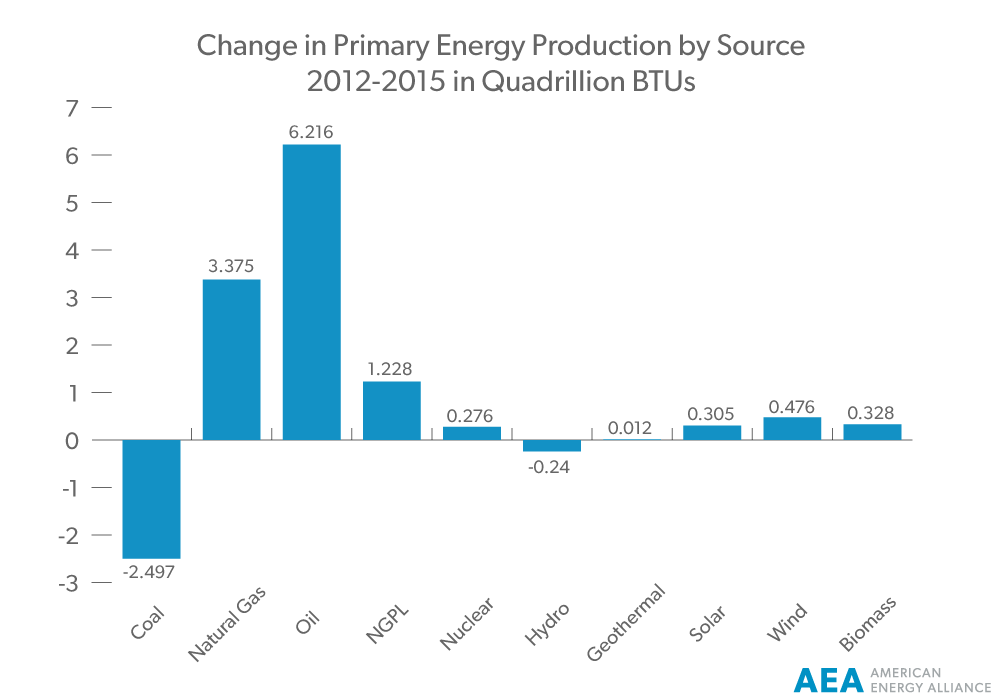
The chart below shows the change in U.S. energy production (in quadrillion BTUs) over the last four years, according to data from the U.S. Energy Information Administration (EIA).

Change-in-Primary-Energy-Production-by-Source,-2012-2015-in-Quadrillion-BTUs

Source: IER calculations of data from EIA’s Monthly Energy Review March 2016

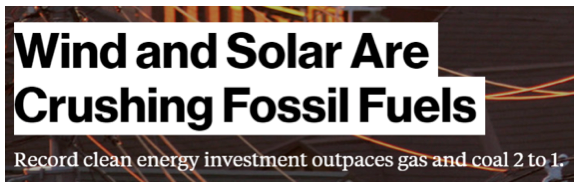
But one Bloomberg article had a different take on the recent trends in the energy sector:

Screen Shot 2016-04-12 at 1.56.16 PM

Source: Bloomberg

Are wind and solar actually “crushing fossil fuels?” Hardly. Natural gas and oil production in the U.S. has increased 10 times more than solar and wind production between 2012 and 2015, even as wind and solar producers received billions of dollars more in subsidies.[1]

To be fair, Bloomberg’s article is about global spending on energy, but the headline and some of the rhetoric in the article belies reality. Higher spending can lead to more production, but articles like this miss the biggest energy-related story of the past 20 years: market forces are spurring massive amounts of new energy production (primarily through greater implementation of advanced techniques such as hydraulic fracturing and horizontal drilling). Moreover, the piece is misleading because it downplays wind and solar power’s reliance on government subsidies. Ultimately, real-world production matters more than mere investment.

Government or Markets?

Bloomberg acknowledges that government subsidies have helped wind and solar but argues that government funding isn’t very important anymore:

Government subsidies have helped wind and solar get a foothold in global power markets, but economies of scale are the true driver of falling prices: The cost of solar power has fallen to 1/150th of its level in the 1970s, while the total amount of installed solar has soared 115,000-fold.

However, claiming that subsidies are no longer the key driver for solar and wind overlooks one of the biggest energy developments from 2015: the extension of the wind Production Tax Credit (PTC) and solar Investment Tax Credit (ITC). The same Bloomberg author even previously argued that those tax credit extensions from last year “will give an unprecedented boost to the industry and change the course of deployment in the U.S.” The wind and solar industries still claim that subsidies are critical to renewable energy growth.

In addition, an analysis from Deloitte found that, without subsidies, wind and solar wouldn’t reach cost-competitiveness with electricity from other sources in the near future “except in certain markets possessing the most robust renewable resources and having relatively high wholesale power market prices.”

Furthermore, traditional ideas about economies of scale don’t necessarily fit with solar energy’s unique characteristics. Solar power will encounter significant challenges as more and more capacity is added to the grid. As MIT Technology Review notes, “solar reaches peak generation during sunny afternoons, but there’s a limited demand for such additional power during those times.” Because solar doesn’t fulfill peak demand, its value will actually decrease as installations increase.[2]

Bloomberg also argues against the continuing importance of fossil fuels around the world:

Meanwhile, fossil fuels have been getting killed by falling prices and, more recently, declining investment. It started with coal—it used to be that lower prices increased demand for fossil fuels, but coal prices apparently can’t fall fast enough. Richer OECD (Organisation for Economic Co-operation and Development) countries have been reducing demand for almost a decade.

Declining investment in coal isn’t happening merely due to market factors. Certainly, cheaper natural gas prices (driven primarily by technological innovation) are playing a role. Nevertheless, political actions, including onerous federal regulations in the U.S., are largely responsible for shuttering huge swaths of coal-fired generation capacity.[3] The Environmental Protection Agency’s (EPA) mercury rule is a major reason for the retirement of 40 GW of coal plants, and EPA’s carbon rule could push another 50 GW out of operation.[4] Similarly, in 2015, the United Kingdom announced a “new direction” for its energy policy, which would close all operating coal plants by 2025. Commentators have noted that the country’s meddling in energy markets has destroyed effective price signals.

In other words, Bloomberg completely misses the only market-driven trend that represents a real threat to coal-fired power plants: low-cost natural gas from new drilling and hydraulic fracturing. By lumping all “fossil fuels” together, the piece misses a crucial electricity market trend—specifically, that electricity production from natural gas-fired power plants eclipsed production from coal-fired plants for seven months in 2015.[5]

More Wind and Solar at What Cost?

In the past, a Bloomberg article correctly explained how increasing solar and wind generation erodes the economics of fossil-fuel generation (by lowering capacity factors and making it harder for sellers to recoup costs). As the Institute for Energy Research has previously articulated, what solar and wind are really doing is placing “imposed costs” on reliable power plants.[6]

Even if wind or solar could provide low-cost electricity at especially sunny or windy times, we will always need reliable power plants to match demand on a second-by-second basis. Hence, wind and solar production is really a nuisance to the grid, because it disrupts the economics of much-needed dispatchable power plants without obviating the need for them.

The piece also ignores the escalating cost of electricity across the country. Bloomberg is right that the current trend is toward more intermittent generation from wind and solar facilities and less from coal. However, this trend is terrible for American families’ power bills, because the existing coal resources that are prematurely retiring are some of the lowest cost sources on the grid. In other words, the government is picking winners and losers on the power grid and doing a lousy job on the economics—new wind and solar facilities are three to four times more expensive than existing coal resources.[7] Once subsidies are taken out of the mix and the full costs of intermittency are factored in, renewables are much less attractive options.

Coal, natural gas, and oil are far from being “crushed” by wind and solar. As the chart above shows, natural gas and oil are crushing wind and solar in terms of actual energy production, even though wind and solar benefit from energy mandates and receive billions more in government subsidies.

The long-term trend still looks favorable for reliable sources, too. EIA’s 2015 assessment predicted that reliable electricity sources like coal, natural gas, and nuclear power will continue to provide the vast majority of the electricity in the U.S. Furthermore, despite Bloomberg’s claims that coal power in China has “flattened,” recent evidence indicates that the country is focusing less on wind power and instead building coal plants at a rate of about one every two days.

Conclusion

Reliable energy sources remain essential for electricity generation in the U.S. and around the world. Despite the media hype surrounding wind and solar power, these intermittent sources of energy still heavily rely on government handouts and won’t overtake energy production from coal or natural gas anytime soon—if ever. A consumer-friendly approach where government doesn’t pick winners and losers is the best way for energy sources to prove their own value. Under the current framework of heavy subsidies for high-cost power, the only ones getting crushed are American families, who are ultimately paying for uneconomic wind and solar facilities.


[1] Although EIA’s analysis calculates subsidies for FY 2010–2013, the trend is still the same: renewable energy resources receive significantly more subsidies than oil and natural gas producers on a yearly basis. See, http://www.eia.gov/analysis/requests/subsidy/.

[2] See, Travis Fisher, Assessing Emerging Policy Threats to the U.S. Power Grid, Institute for Energy Research, p. 21, http://instituteforenergyresearch.org/wp-content/uploads/2015/02/Threats-to-U.S.-Power-Grid.compressed.pdf.

[3] See AEA, State Strategy for Responding to President Obama’s Carbon Rule, November 2015, pp. 8–9, https://www.americanenergyalliance.org/wp-content/uploads/2016/01/State-Strategy-for-Responding-to-President-Obamas-Carbon-Rule.pdf.

[4] See U.S. Energy Information Administration, Analysis of the Impacts of the

Clean Power Plan, May 2015, pp. 16–17, http://www.eia.gov/analysis/requests/powerplants/cleanplan/pdf/powerplant.pdf.

[5] See, EIA, Net Generation data from Electric Power Monthly, Table 1.1 http://www.eia.gov/electricity/monthly/epm_table_grapher.cfm?t=epmt_1_01.

[6] Thomas F. Stacy and George S. Taylor, Ph.D., The Levelized Cost of Electricity from Existing Generation Resources, Institute for Energy Research, June 2015, p. 9, http://instituteforenergyresearch.org/wp-content/uploads/2015/06/ier_lcoe_2015.pdf.

[7] The estimate for the levelized cost of electricity for solar energy is from a forthcoming update to the Institute for Energy Research’s report, The Levelized Cost of Electricity from Existing Generation Resources.

Bureau of Land Management Spins a Terrible Record on Oil and Gas

The Bureau of Land Management (BLM) of the Department of Interior tried this week to put a positive spin on their anemic onshore oil and gas leasing program. Even worse, it took them nearly six months to do it, since the fiscal year 2015 ended at the beginning of last October. Of course, it takes a while to craft a message by massaging numbers and cherry picking data points.

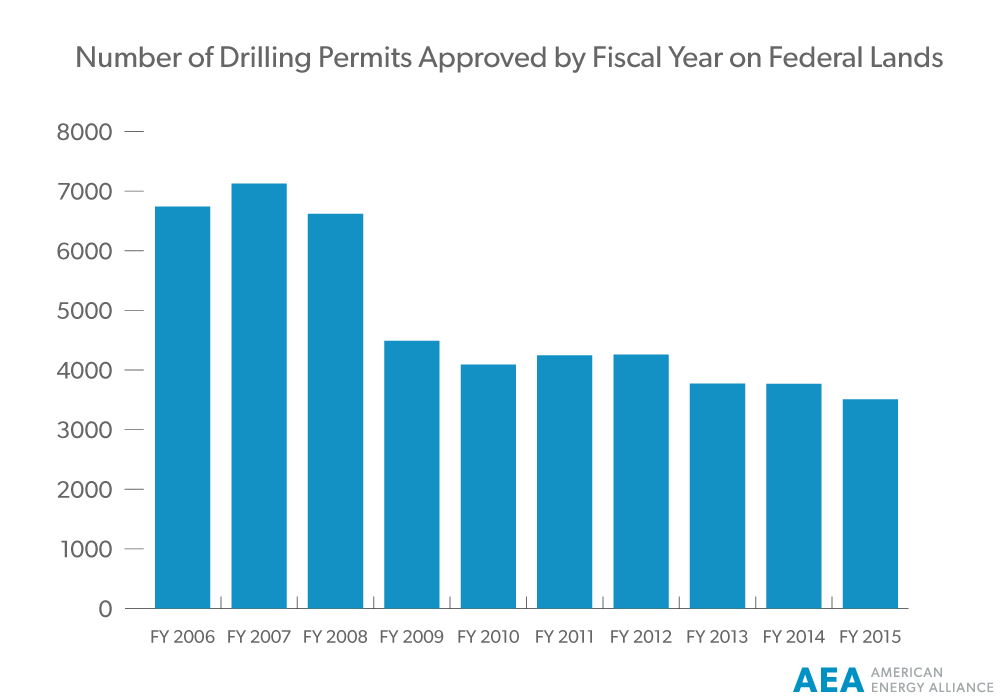
In their release, the BLM cites a 10 percent increase in oil production on federal and Indian lands from 2014 to 2015. What they don’t tell us, but the Congressional Research Service thankfully does, is that under the Obama Administration, the “federal share of total U.S. crude oil production fell from its peak at 36.4 percent in FY2010 to 21 percent in FY2015.” The BLM also does not say that Applications for Permit to Drill on federal lands have fallen by 46 percent since FY2008.[1]

Number-of-Drilling-Permits-Approved-by-Fiscal-Year-on-Federal-Landsrev

The Bureau of Land Management manages 700 million acres of federal mineral subsurface in the United States, equal to over a third of the landmass. BLM’s sister Department of Interior offshore management agency, the Bureau of Ocean Energy Management, manages some 1.7 billion acres of lands offshore, for a combined total of over 2.4 billion acres. Total oil and gas federal leasing acreage is a minute fraction of the total federal acreage, and has direct consequences upon the amount of oil and gas produced from the federal estate as a percentage of the national total.

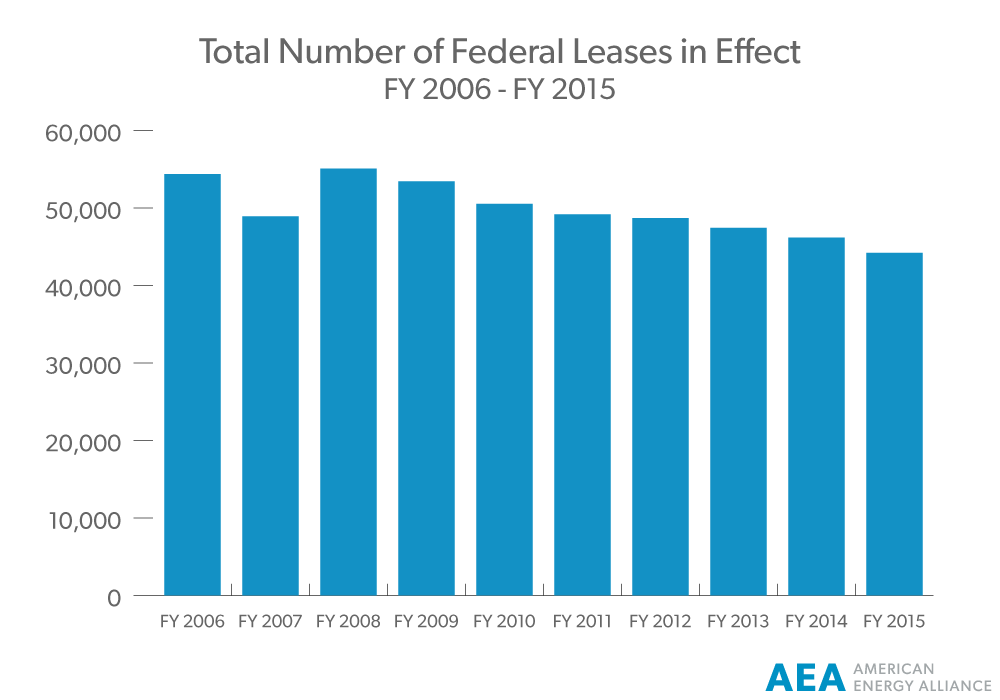
In addition, leasing on federal lands dropped significantly in the last year, as more and more federal regulations mean less and less interest from businesses interested in pursuing energy exploration and development.[2] It is well understood by businesses that federal lands are the last place they wish to go, given increasing red tape, paperwork, and delays due to an anti-energy executive branch of the government.

Total-Number-of-Federal-Leases-in-Effect

The BLM also stopped leasing coal from federal lands last year, in order to “study” the entire coal leasing program. Federal lands, especially in the Western public land states, hold huge reserves of coal which will be needed in the future to keep the lights on in America. The Obama Administration’s “keep it in the ground” policies will impact oil, gas and coal production on federal lands for years to come.

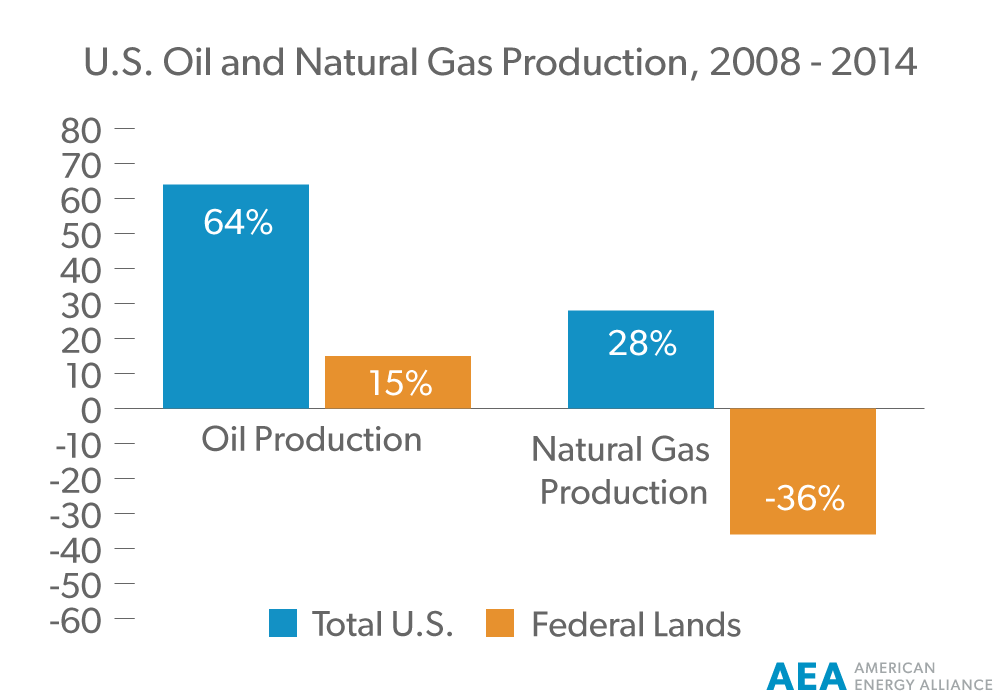
Throughout his time in office, President Obama has actively blocked energy production on public lands and waters and has worked to make energy production on private lands more expensive.[3] Despite the boom in oil and natural gas on private lands, production on public lands is struggling. Total U.S. oil production increased by 64 percent from 2008 to 2014,[4] but only 15 percent on federal lands. Federal lands contain vast conventional oil and gas resources. When oil prices are high, as they have been for almost the entire period of 2008 through 2014, there is no reason that federal production should lag behind production on private and state lands – unless the federal government is antagonistic to energy production. We see more of this with natural gas production. Natural gas production on federal lands[5] fell by 36 percent over the same time period, while increasing by 28 percent overall.

U.S.-Oil-and-Natural-Gas-Production---2008-to-2014rev

The facts are, despite the BLM’s spin, that the agency is simply following orders from the top, with President Obama’s war on affordable, reliable energy paying dividends to those who would rather keep it in the ground than develop our nation’s enormous resources. All the spin in the world can’t change the fact that businesses would rather not do business with their federal government, and will do whatever they can to avoid leasing federal lands, and producing oil and gas from those lands.


[1] Bureau of Land Management, Oil & Gas Statistics, Table 8, http://www.blm.gov/style/medialib/blm/wo/MINERALS__REALTY__AND_RESOURCE_PROTECTION_/energy/oil___gas_statistics/data_sets.Par.36062.File.dat/number%20of%20APDs%20approved%20Federal.xlsx

[2] Bureau of Land Management, Oil & Gas Statistics, Table 2, http://www.blm.gov/style/medialib/blm/wo/MINERALS__REALTY__AND_RESOURCE_PROTECTION_/energy/oil___gas_statistics/data_sets.Par.11329.File.dat/number%20of%20leases%20in%20effect.xlsx

[3] Institute for Energy Research, Obama’s Roadmap for Expensive Energy, Sept. 10, 2014, http://instituteforenergyresearch.org/analysis/obamas-roadmap-expensive-energy/

[4] Energy Information Administration, International Energy Statistics, Petroleum Production, https://www.eia.gov/cfapps/ipdbproject/iedindex3.cfm?tid=5&pid=53&aid=1&cid=regions&syid=2008&eyid=2015&unit=TBPD

[5] Energy Information Administration, Sales of Fossil Fuels Produced from Federal and Indian Lands, FY 2003 through FY 2014, July 2015, http://www.eia.gov/analysis/requests/federallands/pdf/eia-federallandsales.pdf

In Another Backroom Deal, Congress Looks to Tack Energy Handouts Onto FAA Bill

In December 2015, Congress passed a massive omnibus spending bill, which included a $23.8 billion, five-year extension of the wind Production Tax Credit (PTC) and the solar Investment Tax Credit (ITC). This extension marked a big win for wealthy industrial wind developers and solar investors—all at the expense of American taxpayers.

Now, some in Congress—both Democrats and Republicans—have proposed extending several other energy subsidies that were not included in the year-end omnibus and tax extenders deal. Democratic Senators Harry Reid and Ron Wyden are leading the charge to extend tax credits for small wind power facilities, combined heat and power, fuel cell facilities, and geothermal heat pumps as part of the Federal Aviation Administration (FAA) reauthorization bill. Extending these subsidies will cost taxpayers an estimated $1.4 billion.

Loath to be left off the gravy train, the biofuels lobby is also pushing for a multi-year extension of five subsidies that already received a two-year extension just last year. These include the Second Generation Biofuel Producer Tax Credit, the Special Depreciation Allowance for Second Generation Biofuel Plant Property, the Biodiesel and Renewable Diesel Fuels Credit, the Alternative Fuel and Alternative Fuel Mixture Excise Tax Credit, and the Alternative Fuel Vehicle Refueling Property.

Subsidies for green energy aren’t the only energy related handouts in the mix. Several Republicans including Sens. Roy Blunt, Shelley Capito, John Barrasso, and Mike Enzi are pushing to include language that would extend subsidies for carbon capture and sequestration (CCS) technology, which are set to expire at the end of this year. The length and cost of this extension is unknown, because these discussions are taking place behind closed doors.

When asked about extending the subsidies for green energy, Minority Leader Harry Reid stated, “We have businesses run by Democrats and Republicans … whose actual life depends on this money. It needs to be there.”

Reid’s statement makes it clear that he is more interested in rewarding lobbyists and corporations than protecting American taxpayers. This isn’t surprising, as the Senator has a well-documented history of securing subsidies for his allies in the industry.

Senator Heidi Heitkamp, who is pushing for an extension of CCS subsidies, stated, “There are going to be things in there for renewables and things in there for fossils… Anything that we pass out of a divided Congress is going to have to be balanced.”

Balanced for whom? Certainly not for American taxpayers, who are forced to foot the bill for these subsidies. Two wrongs don’t make a right, and it is wrong to spend taxpayer dollars on energy giveaways, regardless of the source or technology.

Extending these subsidies is not about promoting viable energy sources. It is about perpetuating a cycle of dependency where politicians feed money to industries that then instruct their lobbyists to support those same politicians.

If these energy sources and technologies are viable, then there’s no reason to subsidize them. Further, if they still aren’t viable after years of handouts, then why should the American people continue to subsidize them?

To make matters worse, the process by which these handouts are being considered – behind closed doors and free from the scrutiny of the American public – has become so commonplace, lawmakers now seem to be bragging about it. When asked about the specifics on certain credits, Senator Ron Wyden responded,  “We’re not going to negotiate in public.” We deserve far better from our elected representatives.

It remains unclear how these subsidies would be attached to the FAA reauthorization bill, which, it should be noted, has nothing to do with energy. These extenders could either be voted on as standalone amendments or included in the underlying legislation. This second option is possible because Sen. McConnell and Reid have reportedly agreed to allow a tax title in this legislation, thereby opening the door for pork barrel tax subsidies to be tied directly to the bill. Unfortunately, this strategy of tying special interest handouts to unrelated “must-pass” legislation has become the new normal in Washington. This process bars the American public from having a voice in the debate. Again, because much of the deal making is happening behind closed doors, it is still uncertain how many of these subsidies will find their way into the bill.

It is time for both political parties to recognize the high cost that energy subsidies inflict on the American people. Just a few short months ago, Congress wasted billions of dollars on similar subsidies that were shoveled into the omnibus spending bill. Congress should not go back to the well to add a second wave of subsidies. It’s time to end the cycle of dependency for wealthy energy speculators and their lobbyists. Enough is enough.