
The Unregulated Podcast #46 Part 1: Tom and Mike Discuss New CDC Guidelines and The Gavin Newsom Recall Election

On this episode of The Unregulated Podcast Tom Pyle and Mike McKenna discuss new CDC guidelines published in the wake of the Delta Variant and the Gavin Newsom recall election taking place in California.

Links:

Key Vote NO on Cloture to Proceed to Infrastructure Vehicle

The American Energy Alliance urges all Senators to oppose cloture on proceeding to the vehicle for the proposed bipartisan infrastructure bill.

This announced deal is poor policy and a bad use of taxpayer resources. The subsidies for electric vehicles and charging are not the responsibility of the federal government. The tens of billions of dollars for unneeded and impractical passenger rail will only fuel more wasteful white elephants to accompany California’s ongoing high-speed rail fiasco. The tens of billions of dollars more to mass transit systems whose ridership have collapsed is yet more waste. The tens of billions in subsidies for electricity transmission is simply not needed.

On top of all this unneeded spending, the infrastructure bill does not address the biggest problems we have building infrastructure in this country — the permitting and regulatory processes that slow projects to a crawl and make American infrastructure projects far more expensive than in other countries. 

But beyond the bad policy in the infrastructure proposal itself, the legislation is inextricably linked to the multi-trillion dollar inflationary budget that the administration hopes to see passed through reconciliation. While the contents of the reconciliation bill are still vague, the energy taxes and tariffs reported to be included would be a disaster for the American economy. Its provisions will drive up the cost of energy and goods throughout the country, turbo-charging already persistently high inflation and exacerbating the challenges posed by federal deficits. Because of the linkage of the two pieces of legislation, a vote for the bipartisan infrastructure bill makes passage of the inflation bill more likely. AEA therefore urges the Senate not to collude in raising energy prices for Americans.

The AEA urges all members to support free markets and affordable energy by voting NO on cloture on the MTP to the infrastructure vehicle.  AEA will include this vote in its American Energy Scorecard.

The Unregulated Podcast #45: Tom and Mike Discuss The Battle Over Infrastructure

On this episode of The Unregulated Podcast Tom Pyle and Mike McKenna discuss the brewing Congressional battle surrounding the Democrat’s “infrastructure” package and related legislation.

Links:

Biden Lied To Energy Workers

Workers are finding out that the solar and wind jobs that President Biden proclaimed would be high-paying union jobs are not living up to the sales pitch. Traditional energy industry jobs need skilled labor.  For example, building an electric plant powered by fossil fuels usually requires hundreds of electricians, pipefitters, millwrights, and boilermakers who typically earn more than $100,000 a year in wages and benefits when they are unionized. According to the New York Times, Biden’s jobs are more “akin to an Amazon warehouse or a fleet of Uber drivers: grueling work schedules, few unions, middling wages and limited benefits.” On solar farms, workers are often nonunion construction laborers who earn an hourly wage in the upper teens with modest benefits. According to Jim Harrison, the director of renewable energy for the Utility Workers Union of America, “The cleantech industry is incredibly anti-union. It’s a lot of transient work, work that is marginal, precarious and very difficult to be able to organize.”

To deal with the job situation, Mr. Biden has proposed federal subsidies to plug abandoned oil and natural gas wells, build electric vehicles and charging stations and speed the transition to renewable energy. For example, the White House wants Americans to believe that vastly increasing the number of wind and solar farms could produce over half a million jobs a year over the next decade — primarily in construction and manufacturing. The irony of the situation is that solar panels and wind turbines are mainly manufactured outside of the United States (think China), whose prices are less than those for U.S.-manufactured panels and turbines. Europe has 3 wind turbine manufacturers in the top ten while the United States has only one company in the list of the top ten wind turbine and solar panel manufacturers in the world.

Included in the table below are the solar panel manufacturers with the largest global market share in 2020, based on sales in 2019.

Further, it takes far more people to operate a coal, natural gas- or nuclear-powered electric plant than it takes to operate a wind farm, and many solar farms often can operate without a single worker on site.

Comparison of a Traditional Plant Closing and a New Renewable Plant

In 2023, a coal- and natural gas-powered plant (D.E. Karn) is scheduled to shut down. The plant’s 130 maintenance and operations workers, who are represented by the Utility Workers Union of America and whose wages begin around $40 an hour plus benefits, are supposedly guaranteed jobs at the same wage within 60 miles at the Assembly Solar site in Michigan. But the union, which has lost nearly 15 percent of the 50,000 national members that it had five years ago, indicates that many will have to take less appealing jobs because the utility, Consumers Energy, does not have nearly enough renewable energy jobs to absorb all the workers.

According to the head of the carpenters union in Michigan, the construction of a new fossil fuel plant in the state employs hundreds of skilled tradespeople who typically make at least $60 an hour in wages and benefits. About two-thirds of the roughly 250 workers employed on a typical utility-scale solar project, however, are lower-skilled, and get paid “around $20” per hour, depending on the market, and those jobs are generally nonunion. Solar construction is like a moving assembly line. But, instead of the product moving down the line, the people move, replicating the process over and over again across 1,000 or 2,000 acres. Some might equate it to manual harvesting in agriculture.

Another Reason for Lower Wages in Wind and Solar Projects 

While utilities have traditionally built their own coal- and natural gas-powered plants, they usually purchase wind and solar energy from other companies through power purchase agreements. When utilities build their own plants, their labor costs get embedded in their rate of return, which is set by regulators — around 10 percent of their initial investment a year, according to securities filings. However, when a solar farm is built and owned by another company, that company needs to keep costs down because a lower price helps secure the purchase agreement, on which the company’s revenue is based.

Conclusion

Utility jobs are more likely to be unionized than green energy jobs, and union representation is correlated with higher wages and benefits. Utility jobs are associated with traditional technologies—coal, natural gas, hydroelectricity, and nuclear. Solar and wind jobs are usually procured by companies that are not utilities and that rely on purchase power agreements for their revenue. President Biden’s belief that there will be many renewable jobs and that they will be unionized does not comport with recent data. In fact, most of the top manufacturing firms of solar panels and wind turbines are outside of the United States, mainly in China. Americans need to realize that under Biden’s plan of moving away from conventional sources of energy to so-called “green energy,” we will end up outsourcing our good American jobs and benefitting China in the process.


*This article was adapted from content originally published by the Institute for Energy Research.
Democrats Reveal Plan To Intentionally Raise The Price Of Everything

Democratic lawmakers have devised a plan to impose a border tax on imported goods that is based on the exporting countries’ greenhouse gas emissions. Although details are scarce, the New York Times ran an article Monday which provides a broad outline of the border tax explaining that it would “require companies that want to sell steel, iron, and other goods to the United States to pay a price for every ton of carbon dioxide that is emitted during their manufacturing processes. If countries can’t or won’t do that, the United States could impose its own price.”

This proposal follows a similar plan that came out of the European Union last week. As the Wall Street Journal’s editorial board explained, under that plan, “foreign firms would have to undertake detailed carbon audits to report emissions to EU regulators, and then would have to work out what proportion of the emissions attributable to goods shipped to the EU already were covered by carbon taxes elsewhere. If a company isn’t able to complete such complex and expensive calculations, its carbon tariff will be estimated on the basis of the emissions of the dirtiest 10% of European producers for the same good.”

Over at Reason Magazine, Eric Boehm has a good summary of why carbon border taxes aren’t a good idea. In short, these taxes would raise prices on imported goods, hurting low-income and middle-class consumers of those products. As my colleague Jordan McGillis explains at the American Spectator:

Democrats will try to sell this new tax as a way to save American jobs, but as has long been understood, tariffs deliver concentrated economic benefits to the powerful incumbents who lobby for them while spreading new costs across the wider population. Far from being an economically just approach, the carbon border tax would further enrich existing companies while taxing American households.

Furthermore, these taxes will expand the federal bureaucracy to a point where the whole project is likely to devolve into cronyism. As economist Dan Mitchell explains:

It’s always a bad idea to give politicians a new source of revenue. But it’s a worse idea to give them a new source of revenue that will require bureaucrats to measure the amount of carbon produced by every imported good. As I pointed out a few days ago when discussing the European Union’s version of this protectionist scheme, that’s a huge recipe for cronyism and favoritism.

And as the WSJ’s editorial page pointed out when discussing the EU’s plan for carbon border taxes, these taxes are likely to lead to retaliation from trade partners and pushback at the World Trade Organization.

To those points I would add that if this proposal exempts the poorest countries from being taxed, then the whole rationale for the policy is greatly undermined as those countries are likely to emit more carbon dioxide in the future as they develop. On the other hand, if the proposal does include carbon border taxes on the poorest countries, then people who claim to care about the world’s poor cannot support this proposal because penalizing carbon emissions from developing countries deprives them of a path out of poverty by denying them access to affordable and reliable energy.  And at the political level, taxing your own citizens to try to influence environmental policy in other parts of the world feels like the type of thing that is likely to create some sort of political backlash.

One final point that needs to be made is that these proposals for carbon border taxes are problematic for carbon tax advocates writ large who frequently ignore public choice objections to their ideal proposals. Carbon border taxes are usually proposed by carbon tax advocates as an additional element to correct for problems with domestic carbon tax policies. One of the many problems with carbon taxes is that by only raising taxes on domestic emitters of carbon dioxide, policymakers simply shift that economic activity to other parts of the world where those policies don’t exist, thereby thwarting the stated goal of reducing carbon emissions. This shift is also known as carbon leakage. Proponents of carbon taxes argue that carbon border taxes are also needed to correct for the problem of carbon leakage by bringing foreign production costs in line with domestic carbon tax policies.

All of that sounds great in theory but look at what climate policy is actually producing in practice: carbon cronyism and protectionism in the form of carbon border taxes rather than your perfectly formulated carbon tax. Perhaps that’s because the only way to make climate policy palatable amongst Republicans in the real world is by formulating it in a way where politicians can sell these costly policies as attempts to punish foreign competition.

In the end, carbon border taxes are another way for politically connected companies to protect themselves from foreign competition while the government increases its revenue by claiming to save American jobs and the environment. All of that comes with a cost to the everyday consumer in the form of higher prices.


*This article was adapted from content originally published by the Institute for Energy Research.

AEA Opposes Hidden Energy Taxes Within Yet-To-Be-Seen Infrastructure Bill, Issues Vote Alert

With no legislative text or details, Democrats and 5 misguided Republicans lay a path for a vote on carbon tariffs.


WASHINGTON, D.C. (July 19, 2021) – Today, the American Energy Alliance (AEA), the country’s premier pro-consumer, pro-taxpayer, and free-market energy organization, voiced opposition to efforts by the White House, Democratic leaders, and a handful of Republican senators, to advance a $1.2 trillion infrastructure measure that is also linked to a $3.5 trillion budget reconciliation package. Procedural votes on the $1.2 trillion package could begin as early as today despite the fact that nobody has seen any language. Allegedly, the companion reconciliation package contains a massive new energy tax in the form of a carbon tariff and a federal renewable energy mandate.

The American Energy Alliance opposes the so-called “bipartisan infrastructure framework” and will score against the procedural motion and subsequent votes on it and other related measures.

AEA President Thomas Pyle issued the following statement:

“The so-called ‘bipartisan infrastructure package’ is a wasteful and unnecessary exercise that will make the nation $1.2 trillion poorer. Consequently, AEA opposes and will score votes with respect to this legislation and the linked budget reconciliation package, which reportedly contains massive new taxes on energy along with a pointless, yet costly national renewable electricity mandate.

“Perhaps most ridiculous part of the measure being considered is the $15 billion in subsidies for electric vehicles and charging facilities, but the package also includes tens of billions of dollars of wasted funding on passenger rail and mass transit.

“Proponents also seek to spend tens of billions of dollars subsidizing an electricity transmission build-out. We already have a grid that is robust and well-suited for reliable, baseload electricity generation. What the grid struggles to handle is the wild swings of generation from unreliable renewables like wind and solar. These sources are at the heart of the grid issues we have seen recently in California and Texas.

“The only reason there is any need at all to build long-distance transmission is because of federal and state subsidies and mandates forcing unreliable wind and solar into the electricity system. We should end these taxpayer giveaways immediately, not pile on even more of them.

“On top of all this unneeded spending, the infrastructure bill does nothing to address the biggest problems we have building infrastructure in this country — the permitting and regulatory processes that slow projects to a crawl and make American infrastructure projects far more expensive than in other countries.

“Finally, make no mistake: passing the infrastructure package makes the subsequent and far worse reconciliation package more likely to succeed. The Senate should not go along with this farce. The votes cannot be separated as a practical matter; a vote for the infrastructure package is as good as a vote for the reconciliation package, and all the energy taxes and inflation that come with it.”


Additional Resources:


For media inquiries please contact:
[email protected]

Don’t Collude In Raising Energy Prices

After many months of discussion, votes are expected in the next few weeks on some sort of infrastructure package as well as the first votes on the Democratic Party’s go-it-alone additional spending bill (beyond the regular budget), which they want to pass through reconciliation.  While the administration’s preposterous attempt to define every progressive spending priority as “infrastructure” was correctly laughed at, the infrastructure package that is currently under negotiation is still a bad deal. Even worse, by giving some bipartisan cover to some of the administration’s spending, a bipartisan infrastructure deal makes the passage of a blowout multi-trillion-dollar left-wing reconciliation package more likely.

Infrastructure Package

While the bipartisan infrastructure package has yet to be written, we do have an outline of what it contains. While more focused on actual infrastructure, the package is still a wasteful and unnecessary $1.2 trillion. Perhaps most ridiculous is the $15 billion in subsidies for electric vehicles and charging facilities. Why exactly federal taxpayers should be paying for this, rather than EV owners themselves, is not explained. 

The package also includes tens of billions of dollars for passenger rail and mass transit. While at least meeting the definition of physical infrastructure, these subsidies for unused services should be cut off. Passenger rail simply does not make sense in a country as large and spread out as the U.S.

The California high-speed rail fiasco of the last decade should have put to rest the passenger rail fantasy, but this package looks to shovel even more good money after bad. Mass transit ridership cratered during the pandemic and has not recovered, and it may never recover.

It is not smart to spend tens of billions more on something no one wants to use.  Even if ridership recovers at some point, why should federal taxpayers be subsidizing the mass transit systems of large, wealthy cities? New York and Washington, DC should pay for their own excessively expensive systems.

The package also seeks to spend tens of billions of dollars subsidizing electricity transmission build-out.  Stripped of context, this might sound like a reasonable idea, why not have “more resilient” transmission? But the context is that we already have a grid that is robust and well-suited for reliable, baseload electricity generation (which comes from nuclear, hydro, natural gas or coal).  What the grid struggles to handle is the wild swings of generation from unreliable renewables like wind and solar. These sources are at the heart of the grid issues we have seen recently in California and Texas.

The only reason there is any need to build long-distance transmission is because of federal and state subsidies and mandates forcing unreliable wind and solar into the electricity system. Taxpayers are being told to pony up tens of billions of dollars in this infrastructure package (which is only a down payment, far more will be needed) in order to “solve” the transmission problems created by government in the first place.

On top of all this unneeded spending, the infrastructure bill does nothing to address the biggest problems we have building infrastructure in this country — the permitting and regulatory processes that slow projects to a crawl and make American infrastructure projects far more expensive than in other countries.

The Reconciliation Package

While the bipartisan infrastructure package contains plenty of bad policy on its own, the deal looks even worse in the context of the reconciliation package that both President Biden and House Speaker Nancy Pelosi have insisted must pass with the infrastructure bill. The reconciliation bill, while its contents are still vague, would be a disaster for the American economy. Its provisions will drive up the cost of energy and goods throughout the country, turbo-charging already high and growing inflation and exacerbating the challenges posed by monstrous federal deficits.

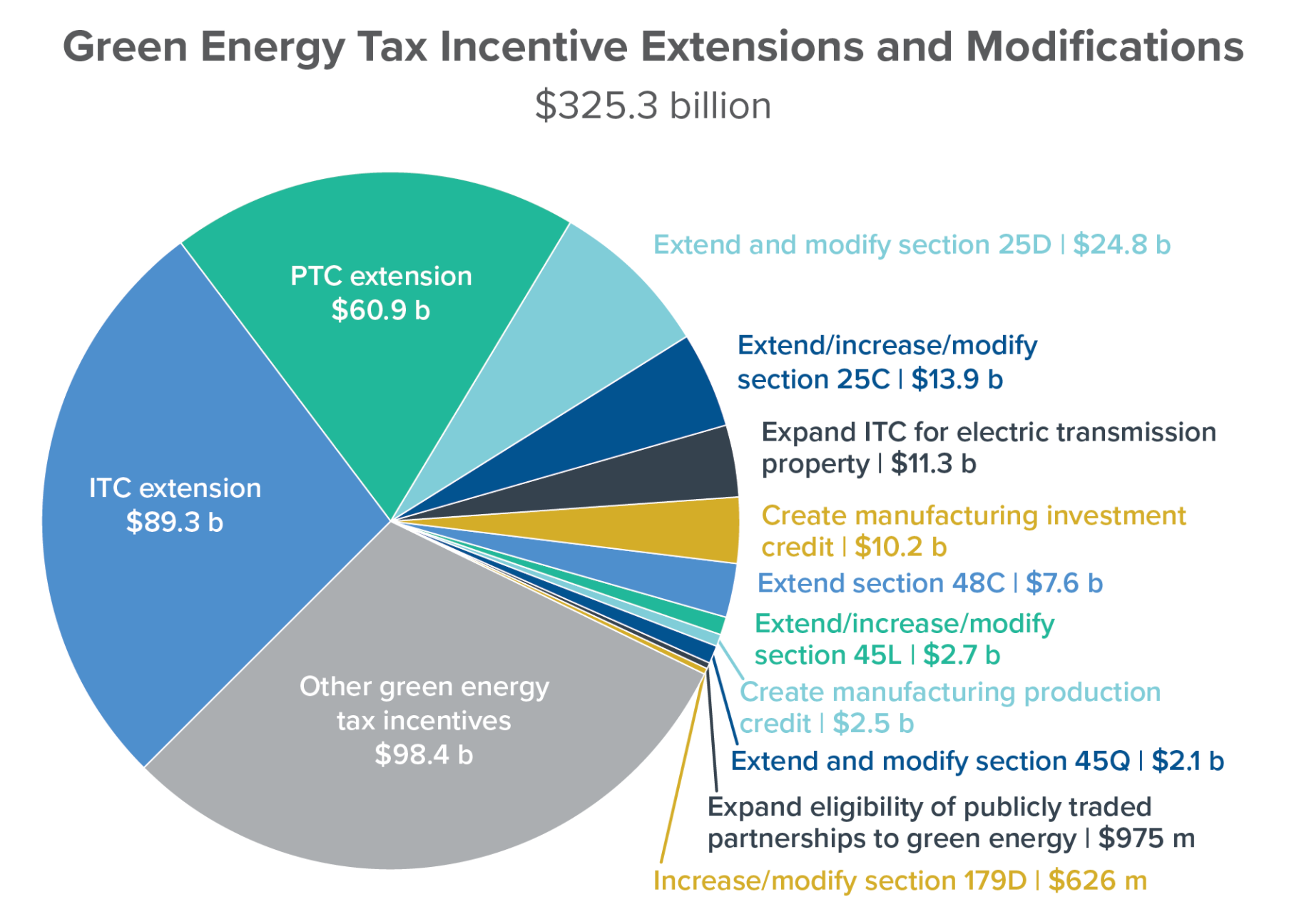
According to reporting, the reconciliation bill is set to contain a Civilian Climate Corps, a “clean electricity” mandate, subsidies for electric vehicles and renewable electricity, a tax on methane (natural gas) emissions, subsidies for weatherization, and most damagingly a border carbon tax.  Most of these energy-related inclusions are designed to do one thing:  increase the cost of energy.

A “clean electricity” mandate, however defined, will increase the cost of electricity. A tax on methane emissions will increase the cost of natural gas and thus everything that natural gas is used for, like home heating. A border carbon tax would increase the cost of every good coming into the country. This tax would fall on food, clothing, construction materials like steel and wood, cars, electronics, anything and everything imported.  All of these taxes would be paid by consumers, and would damage the poor, those on fixed incomes, and local institutions like schools and hospitals the most.

The Senate Should Not Collude

Even those components of the reconciliation package that don’t directly raise energy costs are expensive or harmful as a policy matter. There is a reason that the administration is trying to jam all these provisions through in a reconciliation package.  The contents are harmful and unpopular, catering to the left-wing of the Democratic Party, not to America as a whole. These extreme policies cannot pass Congress through the regular legislative process or as stand-alone legislation, so the administration is playing this two-track game: a bipartisan infrastructure package for political cover, paired with a blowout $3.5 trillion collection of damaging left-wing policy. 

Make no mistake: passing the infrastructure package makes the reconciliation package more likely to succeed. The Senate should not go along with this farce. The votes cannot be separated as a practical matter; a vote for the infrastructure package is as good as a vote for the reconciliation package, and all the energy taxes and inflation that come with it.

Biden Calls For More Foreign Oil While Attacking Domestic Producers

Last week OPEC+ talks on oil production quotas for member nations stalled and, as a result, oil prices rose. The Biden administration is somewhat concerned about the increase in oil prices and in response to the OPEC+ stalemate, a Biden administration spokesperson stated, “Administration officials have been engaged with relevant capitals to urge a compromise solution that will allow proposed production increases to move forward.” Instead of calling on countries like Russia and Saudi Arabia to increase their oil production through investment and hiring more people, the Biden administration could reverse its anti-energy prices in the United States and oil prices would likely decrease. Our economy might also receive a shot in the from increased production. After all, the U.S. has been the biggest contributor to the decrease in global oil prices over the past 10 years by supplying the oil market with the majority of new oil over the past decade.

From 2010-2019, 81 Percent of the Global Increase in Oil Production Came From the United States

For decades, people have not thought of the United States as an energy superpower. Too many people were stuck in the mindset that the United States could not do anything about oil prices—that we had too little oil reserves to meaningfully impact global prices. This worldview was perfectly encapsulated by President Obama, when he stated in 2012, “we can’t just drill our way to lower gas prices.” But the United States did exactly that.

From 2010 through 2019, global total petroleum (and other liquids) production increased by 12.1 million barrels a day. For the same time period, U.S. total petroleum (and other liquids) production increased by 9.77 million barrels a day. In other words, the United States alone covered 81 percent of the total increase in global oil production over the past 10 years. More supply meant lower energy prices throughout the world, and American households gave a collective sigh of relief from lower gas prices.

In fact, if you include the COVID-19-altered 2020, the increase in U.S. oil production exceeded the global increase from 2010-2020.

It is very likely that Russia and OPEC could have increased their oil production over the past 10 years and further reduced prices, but Russia and OPEC were more interested in maximizing their revenues instead of supplying the market with more oil.

U.S. Oil Production Has Helped Keep Oil Prices in Check

The impact of all of this oil production from the United States led to downward pressure on oil prices over the past 10 years. In the oil price chart below you can see what looked to be a long-term run-up in the price of oil after the 1990s stalled in the early 2010s and then decreased by more than 50 percent. A greater supply of oil, the majority of which came from the United States, is a key reason for this price decrease.

IER has as long noted how U.S. oil production has helped keep oil prices in check. For example, in 2014 we explained how U.S. oil production growth more than offset unplanned disruptions to the world’s oil supply and in 2008, we explained how ending bans on offshore drilling led to immediate price relief.  Market signals about probable government actions also drive prices sooner than the actions’ actual effect.

The United States is playing a larger role in global oil production as a result of the increase in production. This chart shows the percentage of global oil production that is produced by the United States. In 2020, the United States produced almost 25 percent of the global total.

President Biden Could Reduce Oil Prices by Ending His Anti-Energy Policies

As has been amply demonstrated over the past decade, we can drill our way to lower gas prices. We did it. But while the Biden Administration would like to see oil production increase in OPEC+ countries, they are taking action after action to hamstring domestic (and Canadian) oil production. As a result of policies such as canceling President Biden is signaling to oil markets that it will be harder for the U.S. to produce oil in the future. It’s no wonder oil prices recently hit the highest level in nearly 7 years.

If President Biden wanted to see lower oil prices, he would reverse course on his anti-energy policies. But the reality is that high oil prices would help the electric vehicle market and “nudging” more drivers into EVs is a key policy objective of the Administration.

We can expect to see additional policies from the Administration that will drive up prices at the pump while at the same time the Administration asks other countries like Russia and Saudi Arabia to produce more oil. After all, President Biden promised it during the campaign.


*This article was adapted from content originally published by the Institute for Energy Research.

The Unregulated Podcast #44: Tom and Mike Discuss Gas Prices, Bipartisan Infrastructure, and Election Reform

On this episode of The Unregulated Podcast, Tom Pyle and Mike McKenna talk about rising gas prices, the prospects of a bipartisan “infrastructure” bill, and election reform efforts from around the country.

Links: