New Studies Pile Up Against Ethanol

The new year has not been kind to ethanol lobbyists. A pair of new reports released in the last month undercut some of the key arguments the ethanol industry uses to support its favorite biofuel mandates, the federal Renewable Fuel Standard (RFS) and California’s Low Carbon Fuel Standard (LCFS).

The first, a new working paper from the World Resources Institute (WRI), examined the issue of using food for fuel, which the UN has described as a “crime against humanity.” The researchers conclude: “bioenergy that entails the dedicated use of land to grow the energy feedstock will undercut efforts to combat climate change and to achieve a sustainable food future.”

Indeed, the WRI report reiterates what we have long known—that biofuels make food more expensive, hurt the environment, and decrease the amount of arable land available for food production. Key findings include:

  • “Use of bioenergy at a globally meaningful level will push up costs of food, timber, and land.”
  • “In fact, burning biomass directly emits at least a little more carbon dioxide than fossil fuels for the same amount of generated energy.”
  • “A growing quest for bioenergy exacerbates this competition for land” that would otherwise be used for food production.

WRI recommends that lawmakers repeal mandates like the RFS and LCFS. As the researchers put it: “Governments should phase out the varied subsidies and regulatory requirements for transportation biofuels made from crops or from sources that make dedicated use of land.”

The second study, from the University of Michigan, reviewed more than 100 papers on the environmental impacts of biofuels. As the study’s author, Professor John DeCicco, explains, much of the existing literature underestimates the amount of carbon dioxide generated from ethanol:

The main problem with existing studies is that they fail to correctly account for the carbon dioxide absorbed from the atmosphere when corn, soybeans and sugarcane are grown to make biofuels, said John DeCicco, a research professor at U-M’s Energy Institute.

“Almost all of the fields used to produce biofuels were already being used to produce crops for food, so there is no significant increase in the amount of carbon dioxide being removed from the atmosphere. Therefore, there’s no climate benefit,” said DeCicco, the author of an advanced review of the topic in the current issue of Wiley Interdisciplinary Reviews: Energy and Environment. [Emphasis mine]

The study finds that “policies used to promote biofuels—such as the U.S. [RFS] and California’s [LCFS]—actually make matters worse when it comes to limiting net emissions of climate-warming carbon dioxide gas.” These findings build on numerous other studies demonstrating the negative environmental consequences of biofuels. Read more about that here.

Click here to learn more about the RFS and here to learn more about California’s LCFS.

Everson: ‘Free market fills your tank; government empties it’

In a recent column for the Las Vegas Review-Journal, Patrick Everson juxtaposes the wonders of free markets against the folly of government intervention in energy markets. As Everson puts it:

Plunging gas prices have provided millions of Americans with something they haven’t had in years: an effective pay raise. The average number of cars per household is around two, and the average American buys about 12 gallons of gas a week per vehicle. A $1 drop in the price of a gallon of gas saves that typical household $100 a month. Here in Las Vegas, the savings have been far greater. Gas averaged $3.85 a gallon in early July, and it’s now down to $2.20, a difference of $1.65. A two-car family with average fuel consumption in January saved $160.

And the left doesn’t want low gas prices, which is why the Obama administration consistently opposes drilling on federal land — including the 84 percent of Nevada the federal government owns. [Emphasis mine]

Everson is spot on. Gas prices have fallen by almost 50 percent in many areas thanks to America’s domestic energy producers, who are thriving despite a federal government that consistently tries to obstruct energy development. While oil production is up almost 80 percent since 2008, that is occurring only on state and private lands outside of federal control. On lands operated by the feds, energy production is actually down amid America’s record energy boom on private lands.

Click here to read Patrick Everson’s entire column for The Las Vegas Review-Journal.

Coal: Bedrock of Modern Life

Coal is one of the most versatile and useful natural resources. The energy from coal powered the Industrial Revolution, pulling millions of Americans out of poverty. Even today, developing countries are using coal to pull billions more people out of poverty with reliable, affordable energy. For many developed countries like the U.S., energy from coal remains the single largest source of the electricity that powers our 21st-Century lives.

But electricity generation is just one of many uses for coal. Many of the products that are critical to today’s civilization rely on coal, such as steel, plastics, and a number of other products that we use every day. Unfortunately, fossil fuel divestment activists want coal—the affordable, reliable energy it provides, and the products such as steel that we make from coal—to go away.

America’s Vast Coal Resources

  • The United States has 483 billion tons of coal in its demonstrated reserve base, enough domestic coal to use for over 500 years at current rates of consumption. These estimates do not include Alaska’s coal resources, which, according to government estimates, are even larger than those in the lower 48 states.
  • Another way to look at our coal resources is to consider in-place coal resources (the entire estimated volume within the Earth). By that measure, the United States has an estimated 10 trillion short tons of coal, over 11,000 years worth at today’s consumption levels.
  • The United States produces about 900 million short tons of coal per year, making it the world’s second largest coal producer behind only China.

Coal Solved the First Energy Crisis

In the late 1500s and early 1600s, the English faced what was possibly the world’s first energy crisis—they were running out of wood.[1] They used wood for almost all of their energy needs—to heat their homes, cook their food, and for industry. But the supply of easily-accessible wood was rapidly decreasing. This was occurring because their economy and their population were growing, but wood—a renewable resource—could not keep up. Between 1500 and 1800, the population of the British Isles more than tripled from 5 million to around 16 million.[2]

Economic growth and population growth drove up the price of wood. Between 1500 and 1630, the price of wood increased 700 percent[3] as the trees near cities were cut down. Luckily for the English, they had an abundance of easily-accessible coal.[4]

The British gradually switched from using wood to using coal. Even before the steam engine created even greater demand for coal, coal was the primary energy source in England.[5] The steam engine increased the demand for coal even more rapidly, and coal has dominated ever since.[6]

Coal for Electricity

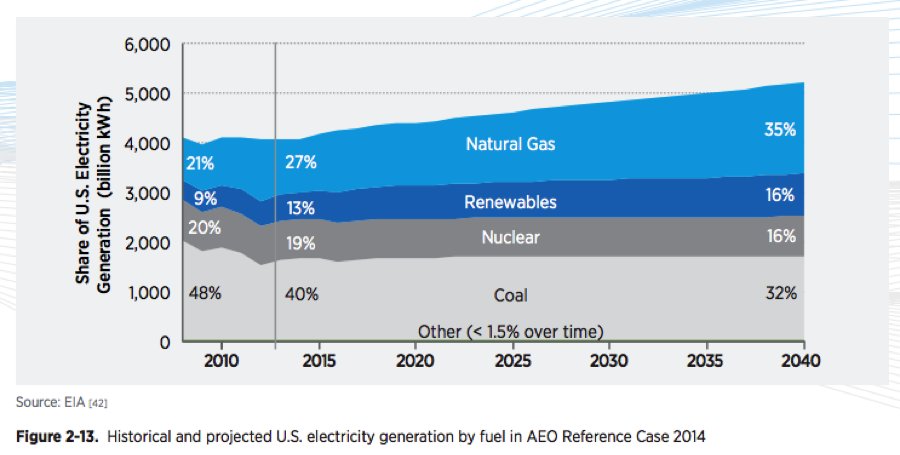
Coal was used in the first central power plants, such as Thomas Edison’s Pearl Street Station in New York City. For the last 130 years, it has held the lion’s share of electricity generation. In recent decades, we have seen other sources compete for second place: first hydroelectricity, then natural gas, nuclear power, and natural gas again. The following chart shows U.S. electricity generation by source since 1950.

EIA coal for electricity

The trend has continued over time, with coal still the dominant source of electricity in the U.S. today, accounting for 39 percent of total generation in 2013. After coal, natural gas, nuclear power, and hydropower make up the leading sources of electricity generation.

us elec gen

Source: EIA

The reason why coal dominates other fuel sources for the purposes of electricity generation is simple—it is highly reliable and inexpensive. Unlike wind and solar power, which depend on the weather in order to operate, coal serves as a reliable “baseload” source of power which can operate around-the-clock. Coal is also less subject to price volatility than natural gas, as tight gas supplies and fluctuating prices demonstrated during the “Polar Vortex” of 2014.

The U.S. is the world’s second largest coal producer after China, producing 892.6 million tonnes out of the world’s 7,896.4 million tonnes produced in total. That is about 11 percent of the world’s total.

Coal for Life

But coal is not simply used for electricity generation. It is also used to make a number of other products that serve as the backbone of modern life—steel, plastics, fertilizers, and medicines included. According to the U.S. Energy Information Administration:

Many industries use coal and coal byproducts. Methanol and ethylene can be produced from coal and can be used to make plastics, tar, synthetic fibers, fertilizers, and medicines. Coal is used indirectly to make steel. First, coal is baked in hot furnaces to make coke, and then coke is used to smelt iron ore into iron to make steel. The high temperatures created by burning coke give steel the strength and flexibility needed for bridges, buildings, and automobiles. The concrete and paper industries also use large amounts of coal for heat. [Emphasis added]

Below is a partial list of products made from coal. As you can see, many products we use every day come from coal, including steel to make bridges, concrete for buildings, and life-saving kidney dialysis machines.

  • Steel
  • Cement
  • Concrete
  • Kidney dialysis machines (activated carbon)
  • Water and air purification systems (activated carbon)
  • Tennis racquets (carbon fiber)
  • Mountain bikes (carbon fiber)
  • Fertilizer
  • Soaps
  • Aspirins
  • Plastics
  • Blackboard chalk
  • Cosmetics
  • Shampoo
  • Toothpaste

Imagining life without plastics, fertilizers, medicines, steel, bridges, buildings, automobiles, concrete or paper is nearly impossible—and for good reason. These are the things that underpin modern life, and divesting from coal means divesting from all of these products that sustain the way we live.

Divesting Coal is Divesting Modern Life

Asking people to divest from a material that sustains our lives every day is not only irresponsible, but also immoral. We have a moral imperative to make sure that people can refrigerate their food and medicines, grow crops and plants with fertilizer, and keep their homes lit at night and warm during winter. All of this is what divestment activists are asking us to divest from—the bedrock of modern life.

AEA Analysts Travis Fisher and Alex Fitzsimmons authored this post

[1] “Between the accession of Elisabeth and the civil war, England, Wales , and Scotland faced an acute shortage or wood, which was common to most parts of the island rather than limited to special areas, and which we may describe as a national crisis without laying ourselves open to a charge of exaggeration.” John U. Nef, The Rise of the British coal Industry 161 (1932) quoted in B. Thomas, “Was There an energy Crisis in Great Britain in the Seventeenth Century?”

[2] John F. Richards, The Unending Frontier: An Environmental History of the early Modern World 193 (2003)

[3] Kenneth Pomeranz, The Great Divergence: China, Europe and the Making of the Modern World Economy 220 (2000) citing John U. Nef .

[4] Kenneth Pomeranz, The Great Divergence: China, Europe and the Making of the Modern World Economy 220 (2000).

[5] John F. Richards, The Unending Frontier: An Environmental History of the early Modern World 194 (2003)

[6] Rudolph L. Daniels, Trains Across the Continent: North American Railroad History 3 (2000).

div-button-revised

Congressman Bishop: Obama’s ANWR Plan Shows Lack of Leadership

In a recent op-ed for the Washington Times, Congressman Rob Bishop slams the Obama administration for moving to block energy development in the Arctic National Wildlife Refuge (ANWR). As Rep. Bishop puts it:

Last week, the Obama administration issued two edicts that could leave much of our strategic energy resources untapped for decades. Mr. Obama announced a plan on Sunday to lock up 12 million acres of Alaska’s Arctic National Wildlife Refuge (ANWR) and on Tuesday, his administration offered the most restrictive offshore oil and gas leasing plan in the history of the program. This is the latest move in a broader regulatory expansion that has drastically driven down production on federal lands during his tenure.

By tightening his grasp on these resources, the president has revealed another lack of leadership on the global stage. This time, it’s America’s future leverage in world affairs and our nation’s path to energy security that’s at stake.

As IER explains here, the President’s plan would designate 12.28 million acres of ANWR as wilderness, thus putting much of Alaska’s vast energy resources under lock and key. This land grab is designed to starve the Trans-Alaskan Pipeline System, which is currently operating at just one-quarter of its total capacity. If production continues to fall, operators would be forced to dismantle the pipeline, effectively marking the end of oil production in Alaska’s Artic region. For a state that relies on the oil industry for approximately 80% of its revenue, this is a veritable death knell being handed down by the Obama administration.

Click here to read IER’s ANWR fact sheet.

Click here to learn more about the Obama administration’s attempt to starve the Alaska pipeline.

Divestment? How About Hydrocarbon Appreciation Day!

This article was originally posted on Master Resource. It is authored by Roger Bezdek and Paul Driessen.

“To colleges, universities and pension funds, we say: Please demand and ensure open, robust debate on all these issues, before you vote on divestment. Allow no noisy disruption, walk-outs or false claims of consensus. Compel divestment advocates to defend their position, factually and respectfully. Protect the rights and aspirations of people everywhere to reliable, affordable electricity, better living standards and, improved health.”

“Social responsibility” activists have designated February 13/14 as Global Divestment Day. They want universities and other institutions to eliminate fossil fuel companies from their investment holdings. Their demand is not just unrealistic and misguided. It is irresponsible and immoral, potentially lethal–and racist in result.

Having grown up in developed countries, these activists seem to have forgotten how nasty and short life was throughout human history, until quite recently. Even a mere 200 years ago, the vast majority of people in every nation were poor, sick, and malnourished. Life expectancy in 1810 was less than 40 years, and even royal families lived under sanitation, disease and housing standards vastly inferior to what American welfare families enjoy today. Then a veritable revolution occurred in the human condition.

The world began to enjoy a bonanza in wealth, technology, living standards, and life spans. In just 200 years, world population increased eight-fold, incomes rose eleven-fold, disease rates plummeted, and life expectancy more than doubled. Unfortunately, not everyone benefitted equally, and even today billions of people still live under conditions little better than what dominated two centuries ago. Bringing them from squalor, disease and early death to modernity is perhaps the most important challenge we face today.

Many factors played important roles in this phenomenal advancement, but underlying nearly all of them were fossil fuels that provided the energy for this industrial, transportation, housing and healthcare revolution. Modern civilization is undeniably high energy – and based largely on coal, oil and natural gas.

Indeed, hydrocarbons provide over 85% of the world’s energy, supporting $70 trillion per year in global gross domestic product. Fossil fuels are energy, and energy is modern life.

Without Fossil Fuels: Brutal, Short Living

As Julian Simon, Indur Goklany, Alex Epstein and the authors of this article have documented, the relationship between fossil fuels and human betterment is positive, strong and undeniable. Hydrocarbons have driven dramatic improvements in all human and environmental indicators worldwide, including a huge decline in climate-related deaths due to storms, droughts, heat and cold.

The divestment movement’s demand – that institutions divest from and society stop using fossil fuels – would reverse this progress and jeopardize people’s health and living standards. The fossil fuel industry produces almost all of the energy we use for virtually everything we make, grow, ship, drive, eat and do. Hydrocarbon divestment and elimination would destroy the quality of life Americans take for granted.

Trains and automobiles would not run. Planes would not fly. Refrigeration, indoor plumbing, safe food and water, central heating and air conditioning, plastics and pharmaceuticals would disappear or become luxuries for wealthy elites. We would swelter in summer and freeze in winter.

We would have to get used to having electricity when it’s available, not when we need it – to operate assembly lines, conduct classes or research, and perform life-saving surgeries. Many jobs would disappear, and our living standards, health and welfare would regress toward Third World or Eighteenth Century conditions.

In what some might call poetic justice, college students, professors, administrators and divestment activists would also feel this pain – and lose their computers, the Internet, Google, smart phones, tablets, PowerPoints, iPads, and “essential” social media of email, Facebook, Snapchat, Skype and Twitter.

Divestment: Financially Imprudent

Divesting a fossil fuels portfolio is also financially imprudent. Fossil-fuel stocks have provided good returns in institutional and university investment portfolios; they are among the best for solid, risk-adjusted returns. One analysis found that a 2.1% share in fossil fuel companies in 2010–2011 by colleges and universities generated 5.7% of all endowment gains, to fund scholarship, building and other programs.

School teacher, public safety worker and other retirement funds have experienced similar results. In the top five state pension funds operating in 17 states, fossil company shares significantly outperformed other investments. Tufts University determined that divesting its endowment of fossil fuel companies would result in a loss of at least $75 million over the next five years.

Perhaps that is why these institutions often choose to divest slowly, over five or ten years: they want to maximize their profits. One is reminded of St. Augustine of Hippo’s prayer: “Please let me be chaste and celibate – but not yet.” The “ethical” institutions also need to find buyers who are willing to stand up to divestment pressure group insults and harassment. They also need to deal with hard realities.

No scalable alternative fuels currently exist to replace fossil fuels. To avoid the economic, social, environmental and human health catastrophes that would follow the elimination of hydrocarbons, we would need affordable, reliable options on a big enough scale to replace the fuels we rely on today. The divestment movement ignores the enormity of current and future global energy needs (met and unmet), and fails to understand that existing “renewable” technologies cannot possibly meet those requirements.

Energy-Intensive Fossil Fuels Improve Lives

Fossil fuels produce far more energy per acre than biofuels possibly can, notes analyst Howard Hayden. Using biomass – instead of coal or natural gas – to generate electricity for one U.S. city of 700,000 people would require cutting down 1,000 square miles of trees (an area the size of Rhode Island) every year.

Similarly, we are already planting corn across an area the size of Iowa to produce ethanol for E10 gasoline. Providing all-ethanol fuel for the same vehicles would require planting IA, IL, IN, KS, MI, MN, SD, ND and WI in corn – instead of devoting it to food crops and wildlife habitat

Wind, solar, biomass, hydroelectric and geothermal energy currently comprise less than 15% of world energy, and wind and solar provide just 3% of global consumption, the U.S. Energy Information Administration predicts. By 2040, as the world’s population continues to grow, global energy demand will increase 35% and renewables will still represent only 15% of the total. Not to use fossil fuels is tantamount to not using energy, which is economic suicide – and eco-manslaughter.

Electrification was voted the world’s most significant engineering achievement of the twentieth century, and history’s second most significant innovation of the past 6,000 years, after the printing press. Access to reliable, affordable energy (especially electricity) is absolutely essential for conquering poverty, say World Bank vice president Rachel Kyte and Dr. Amartya Sen, Nobel Laureate in Economics.

Over the past 150 years, fossil fuels have liberated billions of people from short, brutal lives of grinding poverty, disease and malnutrition. Over the past three decades, fossil fuels enabled 1.3 billion people to escape debilitating energy poverty – over 830 million thanks to coal alone – and China connected 99% of its population to the grid and increased its steel production eight times over, mostly with coal.

However, 1.3 billion still are still desperate for electricity and modern living standards. In India alone, over 300 million people (the population of the entire United States) remain deprived of electricity. In Sub-Saharan Africa, some 615 million (100 million more than in the USA, Canada and Mexico combined) still lack this life-saving technology, and 730 million (the population of Europe) still cook and heat with wood, charcoal and animal dung. Millions die every year from lung and intestinal diseases, due to breathing smoke from open fires and not having the safe food and water that electricity brings.

Ending this lethal energy deprivation will require abundant, reliable, affordable energy on unprecedented scales, and more than 80% of it will have to come from fossil fuels. Coal now provides 40% of the world’s electricity, and much more than that in some countries. That is unlikely to change anytime soon.

In fact, we cannot even build wind and solar facilities without coal and petroleum – to mine, smelt, manufacture and transport materials for turbines, panels and transmission lines. Analysts calculate that it takes 150 tons of coal and coal-equivalent to build, transport and install one onshore turbine, and 250 tons for a single offshore turbine. We also need fossil fuels to build and operate backup power units that also require vast amounts of land, cement, steel, copper and other materials. This is hardly sustainable.

Coal-fired power plants in China, India and other developing countries do emit large quantities of real pollution: sulfates, nitrous oxides, mercury and soot that can cause respiratory problems and death. However, modern pollution control systems could eliminate most of that. Some countries have chosen to build greater numbers of less expensive power plants without scrubbers and other emission controls, rather than smaller numbers of much more costly generators with control systems.

Others have confronted lending institutions like President Obama’s Overseas Private Investment Corporation (OPIC) and Ms. Kyte’s World Bank, which often refuse to lend for coal or even gas-based electricity generators – even with state-of-the-art pollution controls. However, as nations become wealthier because of electricity and their citizens demand cleaner air, both situations are likely to change.

Striking a “compromise” by selling only coal holdings would do nothing to change these realities; the fact that such an action would do nothing to reduce atmospheric carbon dioxide levels or stabilize Earth’s always fickle climate; or the brutal truth that expanding the war on coal would primarily hurt America’s coal mining families and communities, as well as all who depend on coal for electricity.

Guidelines for Debate, Decisions on Divestment

Divestment activists counter these facts by claiming that climate science is settled and the world faces a manmade global warming cataclysm. On that basis they demand that colleges and universities forego any debate and rush to judgment on hydrocarbon divestment. However, as we have pointed out here and elsewhere, the alleged “97% consensus” is a fiction, no manmade climate crisis is looming, and there is abundant evidence of massive “pHraud” in all too much climate chaos “research.”

Nations have a moral imperative to utilize the most productive, life-giving energy sources available, and truly ethical institutions have a moral obligation to help them. If the world is serious about affordable modern energy, economic growth, poverty reduction, and improved health and living standards for all, fossil fuels are essential. Disinvestment initiatives will only undermine progress in these areas.

We therefore ask: What right do divestment activists and climate change alarmists have to deny Earth’s most destitute people access to electricity and motor fuels, jobs and better lives? To tell the world’s poor what level of economic development, health and living standards they will be “permitted” to enjoy?

What right do they have to subject people to policies that “safeguard” impoverished families from hypothetical, exaggerated, manufactured and illusory climate change risks 50 to 100 years from now – by imposing energy and healthcare deprivation that could kill them tomorrow?

That is not ethical or socially responsible. It is intolerant and totalitarian. It is arrogant, immoral, lethal and racist.

To these activists, we say: “You first. Divest yourselves first. Get fossil fuels out of your lives. Go live in Sub-Saharan Africa just like the natives for a few months, drinking their parasite-infested water, breathing their polluted air, enduring their disease-ridden flies and mosquitoes – without benefit of modern drugs or malaria preventatives… and walking 20 miles to a clinic when you collapse with a fever. If you do all that and survive, then you may have earned a right to criticize other people’s aspirations.

To colleges, universities and pension funds, we say: Please demand and ensure open, robust debate on all these issues, before you vote on divestment. Allow no noisy disruption, walk-outs or false claims of consensus. Compel divestment advocates to defend their position, factually and respectfully. Protect the rights and aspirations of people everywhere to reliable, affordable electricity, better living standards and improved health.

And perhaps instead of “Global Divestment Day,” host and honor “Global Praise Hydrocarbons Day.”


Key Obstruction

Key Obstruction 600 AEA

What is the Fossil Fuel Divestment Movement?

The fossil fuel divestment movement is a group of radical activists out to convince people and institutions to divest their stock holdings in fossil fuel companies. So far, the main focus of the movement has been to get college students to pressure boards of trustees into dumping fossil fuel-related stocks from their endowments. These activists claim that the companies exploring for and producing natural gas, oil, and coal are destroying the planet, and that divesting from them is a “moral” cause.

The fossil fuel divestment movement, however, has it backwards. The morally superior choice is for people to be free to use energy to make their lives better. Today, that means having access to the abundant energy resources of coal, oil, and natural gas. Those are the technologies that lifted the developed world out of poverty, and they continue to lift millions out of poverty while they power the high-energy lives of those of us fortunate enough to live in the developed world.

Upon careful consideration of the benefits and costs to society of using coal, oil, and natural gas, it is clear that the overall impact of these technologies is hugely positive. Rather than protesting these fuels, activists who understand the big picture should praise them and the great benefits they bring to the world. Unfortunately, the divestment movement does not appear to be interested in helping to elevate humanity out of poverty or improving people’s lives. Instead, the movement is on a crusade to dismantle the technologies and products essential to modern life.

History of the Movement

Fossil fuel divestment is the brainchild of climate activist Bill McKibben. In a 2012 Rolling Stone article titled Global Warming’s Terrifying New Math, McKibben laid out his case for using dramatically less coal, oil, and natural gas (practically none). This article was also the most prominent place anyone had discussed using fossil fuel divestment as a political strategy, an idea he fleshed out in a later article.

Thus far, McKibben’s divestment strategy has focused largely on spurring action on college and university campuses. The divestment movement is geared toward campuses because, according to McKibben, “with Washington blocked, campuses are suddenly a front line in the climate fight—a place to stand up to a status quo that is wrecking the planet.”

The vast majority of University administrations, however—concerned with maintaining endowments that support everything from tuition assistance to classrooms themselves—have not given in. The leaders of Harvard, Georgetown, Tufts, Tulane, American, and Duke Universities, among others, have all rejected student groups’ calls to divest. Even though major universities are not biting, the movement does maintain a list of “commitments” on the site GoFossilFree.org, mostly from small schools, local governments, and churches. The movement is alive, but has yet to catch on with mainstream institutions.

Right now, people in the divestment movement are promoting “Global Divestment Day,” a two-day event meant to rouse collective action in support of fossil fuel divestment. The movement’s website describes the goals of the event as:

Individuals will close their accounts with banks and pension funds investing in climate chaos. University and college students will hold flash-mobs, vigils, sit-ins and rallies calling upon their endowments to invest in a liveable future. Faith leaders and people living on the frontline of climate change will band together to urge their communities to divest from climate destruction. In financial capitals, people will gather for colourful rallies calling on investors to break up with the fossil fuel industry and sever their ties once and for all.

Divestment Day is the latest ploy in a movement that, unfortunately, fails to consider the needs of the world’s poor and American families.

The Movement’s Core Beliefs

The fossil fuel divestment movement believes that coal, oil, and natural gas are destroying our planet through catastrophic climate change. The movement, however, ignores what the actual Intergovernmental Panel on Climate Change (IPCC) reports say about climate and economics. As IER’s economist Robert Murphy has explained:

[the] popular climate goal—limiting global warming to 2°C—isn’t even close to being justified by the year 2050, and even by the year 2100 cannot be justified using the scant evidence in the IPCC report. This is because—using the IPCC’s own projections—the economic costs suffered by businesses and households to comply with emissions reductions exceed the estimated environmental damages from warming.

In other words, the divestment movement is rejecting the IPCC’s climate science. Even the IPCC recognizes that energy from coal, oil, and natural gas has benefits.

Besides not trusting the IPCC, the fossil fuel divestment movement also doesn’t trust people to make their own decisions. As McKibben said in his Rolling Stone piece:

Most of us are fundamentally ambivalent about going green: We like cheap flights to warm places, and we’re certainly not going to give them up if everyone else is still taking them. Since all of us are in some way the beneficiaries of cheap fossil fuel, tackling climate change has been like trying to build a movement against yourself – it’s as if the gay-rights movement had to be constructed entirely from evangelical preachers, or the abolition movement from slaveholders.

McKibben here realizes that natural gas, coal, and oil are so useful that people will not voluntarily stop using them. In other words, people are not willing to make that tradeoff on their own when they have a clear picture of the benefits of these fuels. That’s why McKibben is attacking the companies that make these fuels—to drive up the costs so that people won’t use them anymore. The best way to do that, according to McKibben, is to polarize and demonize natural gas, coal, and oil companies.

The Fossil Fuel Divestment Strategy

McKibben is clear about his strategy, which he took straight out of Saul Alinsky’s Rules for Radicals. In fact, McKibben calls it a “fine book” and a “classic” on his blog. As McKibben wrote in Rolling Stone:

A rapid, transformative change would require building a movement, and movements require enemies… [W]e need to view the fossil fuel industry in a new light. It has become a rogue industry, reckless like no other force on Earth. It is Public Enemy Number One to the survival of our planetary civilization.

Alinsky’s book is remarkably combative, and Alinsky consistently refers to people and groups who disagree with him politically as “the enemy” and “the target.” The book uses war terminology in the ideological context. Two of Alinksy’s Rules appear to be key to the divestment strategy, which is an ideological war against companies that produce natural gas, coal, and oil.

#5: “Ridicule is man’s most potent weapon.” There is no defense. It’s irrational. It’s infuriating. It also works as a key pressure point to force the enemy into concessions.

#12: “‘Pick the target, freeze it, personalize it, and polarize it.’ Cut off the support network and isolate the target from sympathy.”

By ridiculing natural gas, coal, and oil companies as “Public Enemy Number One”—destructive of the planet itself—divestment activists try to force companies into defensive positions for which there is no defense (no one is arguing that we should destroy the planet). Further, by trying to isolate and polarize these companies, and by focusing exclusively on negative side effects, activists try to make a single enemy out of thousands of diverse businesses that provide essential energy to billions of people. Under the framework assembled by Alinsky and through his militant lens, “the fossil fuel industry” is a single, evil thing—a target to be destroyed.

There is no unitary “fossil fuel industry.” There are, however, thousands of companies and millions of individuals making decisions on what energy and how much to produce. In the U.S., those decisions resulted in about 80 percent of our energy coming from natural gas, coal, and oil in 2014. There is no “Public Enemy Number One” in reality unless that public enemy is the ability of billions of people to make their own energy decisions. It is much easier for McKibben and other divestment activists to demonize a single fictitious entity than the concept of freedom of choice. It is also incredibly disingenuous.

Divestment Activists Are Wrong: Fossil Fuels Are Good

The ability to use natural gas, coal, and oil is not “Public Enemy Number One,” nor is it even a necessary evil. Rather, it is an absolutely necessary good. After all, in the United States as we have used more of these sources, the economy has become healthier and we have reduced air pollution.

The following chart is from EPA’s Air Quality Trends Report. It shows that as the economy has grown, people have driven more, more energy has been consumed, and total pollution emissions have actually dropped. In fact, total pollution emissions are down by 68 percent since 1970 alone:

EPA emissions

From 1970 to 2013, the consumption of energy from coal increased 47 percent, the consumption of energy from natural gas increased 23 percent, and the consumption of energy from oil increased 17 percent. Despite increased energy use from sources that divestment activists want to eliminate, air quality dramatically improved. One of the reasons for this environmental improvement is that using more natural gas, coal, and oil created greater wealth and a healthier economy, which enabled better pollution control technologies.

The world is a much better, safer, easier place to live because of the ways we have used natural gas, coal, and oil resources. McKibben and divestment activists predict climate disaster at some future date, but as noted above, they actually reject the IPCC’s reports on climate and ignore the positive trends in the environment.

In reality, far fewer people die today than in decades past from climate-related events. That is because we make ourselves safer and more resilient all the time by building better buildings, better infrastructure, better everything—and we do all of that with modern energy, the vast majority of which comes from natural gas, coal, and oil.

The following graph from energy expert Alex Epstein’s The Moral Case for Fossil Fuels demonstrates how the best measure of climate danger—deaths from climate-related causes—is lower now than at any point in human history as our use of natural gas, coal, and oil has steadily increased:[1]

more-fossil-fuels

(Source: Moral Case for Fossil Fuels, page 121)

What does this graph tell us? That the more natural gas, coal, and oil the world uses, the safer we become. This is true because building a safe civilization is an energy-intensive process that requires significant amounts of reliable energy. Having access to the best energy sources available—which are natural gas, coal, and oil in much of the world—is the best way to keep developing and keep making the world a safer, more comfortable place.

The President of Harvard University, Drew Faust, explained how important natural gas, coal, and oil products are to our lives, in his statement rejecting divestment at the university:

I also find a troubling inconsistency in the notion that, as an investor, we should boycott a whole class of companies at the same time that, as individuals and as a community, we are extensively relying on those companies’ products and services for so much of what we do every day. Given our pervasive dependence on these companies for the energy to heat and light our buildings, to fuel our transportation, and to run our computers and appliances, it is hard for me to reconcile that reliance with a refusal to countenance any relationship with these companies through our investments. [Emphasis added]

There is a reason people keeping using these energy sources. Natural gas, coal, and oil companies have been responsible for bringing light to places that were once dark, keeping schools air-conditioned in countries with severe heat stress, powering incubators that save the lives of premature children, and refrigerating food and medicine, among countless other contributions. Far from being “Public Enemy Number One,” we should acknowledge the “fossil fuel industry” for what it really is—not one evil entity but millions of individuals working for thousands of companies supplying the world with the energy people are clamoring for.

All technologies come with both benefits and costs of some kind. For example, the wind and solar industries that divestment activists tout as solutions kill hundreds of thousands of birds and bats annually and industrialize large amounts of land. Examined holistically, the benefits of natural gas, coal, and oil use overwhelmingly outweigh the costs. Divesting from these fuels means much more than simply purging one’s assets of the stocks of a few companies—it means turning one’s back on the resources that make modern civilization possible.

The Morality of Choice

Using the combative language of Saul Alinsky and the divestment movement, the real “enemy” or “target” here is the divestment movement. Activists like Bill McKibben have demonized the choices that billions of people have made in choosing reliable, affordable energy from natural gas, coal, and oil. These modern energy sources make our standard of living possible. The divestment movement is simply dead wrong about natural gas, coal, and oil. It’s as if they are morally opposed to modern life itself.

The moral alternative is the growth, prosperity, safety, environmental improvements, and overall human flourishing that comes with the freedom to use the best energy resources to improve our lives. If the divestment movement succeeded in killing “Public Enemy Number One,” it would consign billions of people to poverty and unnecessary misery. Divestment activists pretend to have the moral higher ground, but consigning billions of human beings to abject poverty is simply a morally bankrupt position. We hope their efforts fail spectacularly so we can continue improving our lives with the best energy sources available.

AEA Economist Travis Fisher authored this post. 

[1] Alex Epstein, The Moral Case for Fossil Fuels, New York, NY: 2014, page 121.

Congress Should Take Steps to Repeal RFS

WASHINGTON – Today, American Energy Alliance President Thomas Pyle issued the following statement on Rep. Bob Goodlatte’s bill to reform the Renewable Fuel Standard (RFS):

“We are encouraged by Rep. Goodlatte’s effort to fully repeal the Renewable Fuel Standard. Not only is the RFS an ill-advised policy that raises food and fuel prices for American families, but the EPA has demonstrated they are incapable of administering the mandate by failing to set guidelines for both 2014 and 2015.

“Previous Congresses and the EPA have vastly overestimated the viability of advanced biofuels like cellulosic ethanol. Instead of dealing with the issue of cellulosic honestly, EPA is now fudging the numbers by redefining cellulosic ethanol to include fuel from compressed natural gas and liquefied natural gas.

“While we applaud Rep. Goodlatte for calling for full repeal, we are leery of attempts to eliminate only the corn ethanol mandate portion. The ‘corn only’ approach is not a glide path to repeal. It does little to address the heart of the problem, which is higher fuel costs and the EPA’s gross mismanagement of the RFS program. Instead, Congress should take steps toward a full repeal of the RFS.

“Eliminating only the corn ethanol mandate also does nothing to fix the issue of higher food costs. As a World Resources Institute study shows, the crops used to make cellulosic ethanol will rely on the same fertile lands that food crops rely on. A true road to repeal would include ramping down all aspects of this failed program, not just corn ethanol.”

“The only option for protecting the American people from higher fuel and food costs and an improved environment is to work toward a full repeal of the RFS. Anything less perpetuates this expensive and misguided mandate.”

Click here for a coalition letter that explains AEA’s opposition on the RFS in greater detail.

###

NY Times Global Warming Survey Misleads the Public

The New York Times recently offered up the latest in a series of surveys sponsored by media companies (and in this case executed by a believer at Stanford) purporting to show that pretty much everyone – even the dumb-dumb Republicans — wants the government to “do something” about global warming (“Most Republicans Say They Back Climate Action, Poll Finds” read here).

I thought it might be helpful to give some context and perspective to the issue.

Methodology

I know everyone gets bored with methodology pretty quickly; so do I. The Times polled adults (not registered voters, not likely voters). They weighted the results, which means they conformed them to how they think the American public is divided with respect to ideology and demography.

Priorities

This issue is at or near the top of the approximately no one’s priority list. We have been starting surveys for years by asking people: “What is the most important or pressing issue facing the United States? And what is the second most important or pressing issue facing the United States?” In ten years of asking that question, never has more than 3% of registered (or likely) voters identified environment as one of their top two issues, and a very small fragment – maybe 30 people per 10,000 respondents (or about 1/3 of one percent) – have specifically mentioned global warming. The economy, jobs, health care, the war in Iraq, debt and deficit, gas prices, etc., have all taken their turn at or near the top of the priority list (typically with 50-70 percent of the voters identifying them at one time of another as the first or second priority). But the environment has never gotten any higher than 5% combined.

Why is that important? Because most surveys simply ask respondents to select from a list (“Of the following, which do you think is an important issue facing the United States”) or, worse, ask some variation on “do you think climate change is an important issue”. These questions are not very likely to result in probative, accurate assessments of what respondents really care about, because they limit the choices the respondents can give to those selected by the survey writer. It is probably important to note that even when presented with a list, climate change routinely finishes last among the concerns of survey respondents.

The Times asked how serious a problem global warming is, without reference to other problems, so it is impossible to place the results in context.

Beliefs

We can go back and forth for a long time about what the survey data shows with respect to who believes what about global warming. But let’s make it easy. Last summer, Pew came out with survey results that indicated that about 18% of the voters simply did not believe the Earth is warming. Another 18% indicated that the Earth was warming, but did not attribute that warming to man. Another 17% indicated that we did not know enough yet to assign attribution. 40% believed the Earth is warming and man is the culprit (but it is not completely clear if that means man is entirely to blame, mostly to blame, or what). As always, about 7% did not know or refused to say what they thought.

I could pull any decent public survey from the last 15 years and the numbers would not vary by more than 5 percentage points in any direction. The simple reality is that this issue – at least since 2000 – has been marked by some short-term variations and then a return to the baseline. The baseline looks a lot like the Pew survey – about one in five hard-core believers on either side, with the remaining 60% split about evenly over time (sometimes 35-25 in one direction, sometimes 35-25 in the other).

Costs

Despite (or perhaps because of) differing sentiments about causation, there is much more coherence with respect to what voters are willing to pay to address global warming. I think we are the only ones who have consistently asked about willingness to pay as an open question (“How much are you willing to pay each year to address global warming/to reduce global average temperatures by XX/to reduce the United States’ dependence on fossil fuels?”). The responses have become fairly predictable. Means have been as high as $279 (mostly due to true believers answering “$10,000”); medians (the important measure in a democracy) have been as high as 50 to 60 dollars; and the percentage of respondents who say “zero” or “nothing” has remained pretty consistently in the low 40s.

In our most recent survey, when we asked how much respondents would be willing to pay to address global warming each year, 4 dollars was the median response (and, again, 42% answered “zero”).

The important point is that there is very limited tolerance to pay anything, even absent questions being raised about increasing the size and reach of government or giving economic advantages to our competitors.

The problem of “we

Most people involved in public policy know that when a politician says “we”, he really means “the government”. But in most instances, our respondents understand “we” to mean “the people of the United States”. This distinction can be crucial during policy discussions, especially when it comes to federal support for something. An elected official says: “We need to support X.” The politician, of course, usually means give X some taxpayer money. But voters often think he means, “buy their product” or “get out of their way”. It is a small, but incredibly important rhetorical point, especially as we talk about renewable energy.

Conflation

Despite the best efforts of the Administration, voters do not yet conflate “doing something” on global warming with federal action. Those of us who work in policy circles routinely conflate the two; voters do not. In fact, we should clearly bifurcate “action” from “federal government action”.

Part of this rests on the idea that very few people trust the federal government to do anything well. For example, in a recent survey we asked: “Do you trust the federal government to address global warming?” Sixty percent (60%) said no; just 20% said yes.

This is important because voters expect and anticipate that if and when alternative energy becomes affordable, reliable, plentiful, and if and when global warming is addressed (whatever that means), it will happen through the application of (probably disruptive) technology and innovation, not by virtue of government regulations, mandates, and subsidies.

The Times takes full advantage of the confusion about conflation. An important question in the survey asks: “Would the United States doing things to reduce global warming in the future hurt the economy, help, or have no effect.” Imagine if the question was “would the federal government doing things help or hurt”; or “would legions of rules and bureaucrats help or hurt”. I could go on, but you get the point.

By the way, even after cooking the question, the Times could only get 42% of the respondents to say that the United States doing “things” to reduce global warming would help the economy; and that only after a series of questions focusing on how grave a problem such warming might be.

The key question

The Times offered three different takes on global warming. This one was the most popular: “I believe that global warming has been happening for the past 100 years, mainly because we have been burning fossil fuels and putting out greenhouse gasses. Now is the time for us to be using new forms of energy that are made in America and will be renewable forever. We can manufacture better cars that use less gasoline and build better appliances that use less electricity. We need to transform the outdated ways of generating energy into new ones that create jobs and entire industries, and stop the damage we’ve been doing to the environment.”

Wow. The other two options were essentially strawmen. This one, of course, is a perfect example of the problem of “we”. “Now is the time for us to be using new forms of energy.” Again, imagine if they had asked whether now is the time for new federal mandates to use new forms of energy. “We need to transform the outdated ways of generating electricity . . .” Imagine if they had asked whether the federal government should transform the electricity system. Actually, we did ask that in a survey a few months back and about two-thirds of the voters rejected the idea.

You get the point. The survey drove respondents to this answer. It doesn’t tell us anything that we didn’t already know – people like technology, they like a clean environment, they like better cars and appliances, they like new jobs and industries. The survey is silent on the questions of the day – how much should the federal government be involved in energy? How much are people willing to pay to change the way we make and consume energy? What do people think are the best ways to make the changes they want?

I had hoped for better from the Times and Stanford.

Other questions

When they did get around to asking about the federal government, the Times could not resist an editorial preface. Here’s the question: “As you may have heard, greenhouse gases are thought to cause global warming. Should the federal government limit the amount of greenhouse gases that U.S. businesses put out?” In other words, there is a problem, would you like someone else to take care of it? Not a shocker, 78% of the respondents like free stuff.

But when it turned to what the respondents were willing to offer, the wallets got a little tighter. Just 25% favored increased taxes on electricity (I wonder how they would feel about a renewable mandate that acts as a tax); and 35% favored taxes on gasoline. I’m not sure where those taxes would go, although I suspect if we asked, “would you a favor an increase in the federal gasoline tax?” we would get fewer than 35% of respondents supporting the idea.

Final thoughts

Three final thoughts are worth noting.

First, the science is coming our way. One by one the narratives on the other side are being discredited or simply overtaken by events. Think about polar bears, or droughts and hurricanes, or sea level rise, or global average temperatures. Even the most recent IPCC report, read in its entirety, injects considerably more uncertainty into the discussion. As improbable as it seems, the Washington Post recently ran a blog delving into the “pause” in the increase of global average temperatures. Each of the IPCC models has been wrong in its entirety; climate sensitivity is much lower than anticipated.

Second, other nations are coming our way. Australia has gotten rid of its carbon tax. The Japanese have indicated they have bigger fish to fry than global warming. The Germans are about to give up on their green experiment and will use more coal this year than last, and will use more next year than this year. India recently said flat out that economic growth was more important than global warming.

Third, as discussed above, public opinion continues to wash around a few simple numbers – it has been fairly static for a long time.

You can make whatever decisions are appropriate for your company or your boss or what have you; I hesitate to tell people what to do. But the counsel should at least be based on good information. The information we have available to us – opinion research and science — suggests that we are winning this fight. It is probably premature to talk about exit strategies.

One last thought. Those who are advocating a rework of messages and policies with respect to global warming are, almost without exception, the same people who have been encouraging a series of preemptive surrenders since the Bush Administration. There were numerous people, especially among the utilities, who wanted to make a deal with Jim Connaughton and his crew in 2007 and 2008. They then migrated onto Waxman-Markey. Now they are wetting the bed over the proposed existing source rule.

This post was authored by Mike McKenna, President of MWR Strategies. McKenna has conducted public polling research for AEA.


Sen. Schumer Opposes Job-Creating KXL, Supports Job-Killing Wind Subsidies

Amid last week’s fierce Senate debate over the Keystone XL pipeline bill, Sen. Chuck Schumer of New York made light of the economic benefits of the pipeline when he said, “The fact is that the Keystone would create only 35 permanent jobs—a drop in the bucket. A fried chicken franchise creates about as many jobs.”

Schumer’s statement is economically illiterate, especially when you pair it with his support of Sen. Heitkamp’s amendment to extend the wind Production Tax Credit (PTC) for five years. He has a problem with a private project that creates jobs and generate tax revenue, but he supports massive public subsidies through the PTC that reduces the number of jobs overall.

Jobs, Jobs, Jobs for Oil Carriers!

Schumer “only 35 permanent jobs” argument is a favorite of those in opposition to Keystone XL. Schumer apparently believes that the more jobs a project creates, the better as opposed to asking whether a project makes economic sense. This is lunacy. For example, just think of how many jobs would be created if people physically carried the oil from Hardisty, Alberta to Cushing, Oklahoma. Millions of jobs could be created!

The Keystone XL will carry 830,000 barrels of oil a day. A barrel of oil is 42 gallons, so that’s 34,440,000 gallons a day. If a gallon of oil weighs 7 pounds and a person can carry 50 pounds that means it would take 4,800,000 people to carry the oil the Keystone XL would carry every day. According to Sen. Schumer’s logic, we shouldn’t use a pipeline, but instead TransCanada should hire 5 million people to carry oil! All our job problems would be solved!

It is obvious that this example is silly, but it illustrates Sen. Schumer’s logic. It isn’t a bad thing that the pipeline would only employ 35 people—it’s a great thing. This is how the free market works—it means that instead of millions of people carrying oil from Canada that the work is done by a mere 35 people. This frees up people to create value and be productive elsewhere in the economy. It does not make sense to hire people to carry oil when there are cost effective alternatives.

At Least the Keystone XL Creates Jobs—Unlike the Wind Production Tax Credit

But the wind PTC is different. With the Keystone XL, the TransCanada isn’t asking the federal government for a multi-billion dollar handout. All they are asking for a permission to cross the border. The wind PTC is multi-billion dollar handout and even Sen. Schumer should understand that multi-billion dollar handouts don’t come free.

The wind PTC does not create jobs on net, compared to an alternative policy in which the federal government refrains from using the tax code to pick winners and losers. Although the proponents of the PTC such as the American Wind Energy Association claim that failing to reauthorize the tax credit would “kill jobs,”[1] the money used to subsidize those jobs comes from taxpayers, not from thin air.[2] Rather than arbitrarily limiting tax credits to wind producers, generally returning the money to taxpayers would have “created jobs” as well—jobs that produce goods and services that Americans actually want. As we have pointed out:[3]

“At the end of last year [2012], the federal wind production tax credit was extended for another year. According to the Joint Committee on Taxation, this one-year extension of the PTC would cost $12.1 billion. The American Wind Energy Association, the lobby for the wind industry, claims that 37,000 jobs would have been lost if the PTC was not extended. This means that each job “saved” cost the U.S. Treasury $327,000. While the PTC…might “create” some identifiable jobs, they do not create jobs “on net.”

The money to pay for the PTC has to come from somewhere. In other words, if taxpayers were able to keep the money instead of it going to subsidies, the taxpayers would have spent the money and that spending would have created other jobs.

The question isn’t whether the PTC “creates jobs”—it’s whether it creates more jobs than it takes away from the rest of the economy. In Spain, for example, where the government pushed “green energy subsidies” aggressively, 2.2 jobs were lost for every “green job” that the subsidies supported.[4] This is why the PTC is not a job creator—the money has to come from somewhere.

35 Permanent Jobs is Greater than Jobs Destruction Caused by the PTC

The Senate’s Keystone bill is an attempt to authorize a privately funded project that has been waiting on federal approval for over six years. The pipeline would create thousands of jobs, strengthen the economy, and deliver affordable and reliable energy without relying on support from the federal government. The PTC amendment, on the other hand, was nothing more than an attempt to extend a taxpayer-funded handout to the wind industry. An extension of the PTC would cost taxpayers billions of dollars, raise electricity rates, and do little to create jobs for Americans.

If Sen. Schumer truly wants to put more Americans to work and strengthen our economy, he should spend less time blocking Keystone XL and more time cutting costly handouts like the wind PTC.

AEA Communications Director Chris Warren contributed to this post.

[1] AWEA, Federal Production Tax Credit for Wind Energy, http://www.awea.org/Advocacy/content.aspx?ItemNumber=797

[2] Strictly speaking, there is an important distinction to be made between a business receiving a reduction in its tax liability versus receiving an explicit subsidy check funded by other taxpayers. However, in practice this distinction is not very relevant for the PTC, because many projects use sophisticated financial maneuvering in order to offload the tax credit from the actual operation onto outside investors, effectively auctioning off the tax credit. This type of maneuvering is necessary because the operation in question doesn’t have a high enough tax liability to take full advantage of the PTC. That’s why so many environmentalists are pushing to make the PTC refundable, which would turn it into an outright welfare program for renewable power. See http://www.renewableenergyworld.com/rea/blog/post/2012/04/refundable-federal-tax-credit-could-remove-barrier-to-community-wind.

[3] Daniel Simmons, Testimony before the Ohio Senate Public Utilities Committee, American Energy Alliance, November 13, 2013, https://www.americanenergyalliance.org/wp-content/uploads/2013/11/Simmons-Testimony-for-Ohio-Public-Utilities-Committee-SB-58.pdf.

[4] Gabriel Calzada Alvarez, Study of the effects on employment of public aid to renewable energy sources, Universidad Rey de Juan Carlos, March 2009, http://www.juandemariana.org/pdf/090327-employment-public-aid-renewable.pdf.