Love the game of golf? Thank oil and natural gas

Access to low-cost energy and materials has always been an important part of driving economic dynamism. Given the role that oil and natural gas play supplying our energy, people often underestimate how important oil and gas are to other things they enjoy in life, like the use of plastics. At a time when it is convenient for politicians to deride the industries that provide people access to these essential resources, it’s important to remind people just how important oil and gas are to our everyday lives.

Today, one of the best examples of economic dynamism can be found in perhaps an unlikely place: the game of golf. Over the past two decades, improvements to equipment technology have helped the best (and worst) players hit the ball farther and straighter than ever before. Additionally, in part thanks to improvements in athletic gear, the game has seen the emergence of exciting new players that bring a new class of athleticism to the game. In fact, everywhere you look, from the clothing to the technology that is deployed to maintain golf courses, there is a tremendous amount of innovation in the game of golf. It should come as no surprise then that the oil and gas industries have played a key role driving much of this innovation. From the tee to the green golf courses have been designed and maintained with advanced technologies that make use of these resources. Here, we’ve outlined some of the ways oil and gas are deployed to make the game of golf possible.

Apparel

One of the most striking changes in golf over the past few decades can be seen in apparel. The modern player isn’t forced to struggle through the summer heat in clothing made of heavy cotton. Instead, modern golf apparel makes use of synthetic technologies like polyester, which is a product that is made using petroleum and natural gas. These synthetic materials are lighter and more flexible, helping players to perform at their best in warm climates. Additionally, synthetic fibers have been used to produce better waterproof materials. These products are helpful for playing in the elements during the Open Championship, where it’s the norm to play rain or shine and high winds are an everyday occurrence. Most recently, golf apparel manufacturers have been designing sun protective clothing, which provide protection from UV radiation.

Equipment

One of the biggest stories in golf over the past two decades has been the rapid innovation in golf equipment. In fact, golf club technology has advanced so quickly that there are legitimate debates over whether or not all the new technology is making the game too easy. As is the case with golfing apparel, oil and gas have played a role in driving all of this innovation. Today, golf clubs are manufactured using a wide variety of materials including metals and plastics, all of which make use of oil and gas in their production processes. Plastics are produced primarily from natural gas and crude oil refining feedstocks, and these plastic products are used to help bind the separate parts of the club together. Club heads are milled to perfection using heat and materials supplied from petroleum and natural gas. They are then bonded to the shaft using epoxies that are also derived from petroleum. Club shafts employ a large array of materials, with the most advanced products making use of advanced plastics and graphite, which is the crystalline form of carbon. In addition to the clubs, both gas and electric golf carts derive their energy from oil and gas and many of the parts of these vehicles are constructed using plastic. Finally, golf balls are made using several different types of plastic, with the outer layer usually made up of a thermoplastic and the core designed using a petroleum-based polymer called polybutadiene. All of these technologies have helped to make the easier, allowing more people to enjoy the game. At the highest levels of competition, new equipment technology helps players to shape shots more easily, and allows the best players to routinely hit 300-yard drives.

Golf course

Nearly every part of the golf course and all of the equipment needed to maintain it rely on products that are made from oil and gas. Irrigation pumps, sprinkler heads, and piping are generally all made from plastics. The fertilizers used to keep the course in top condition and the pesticides used to protect players from insects are all made using oil and gas products. The flagsticks, cups, and hazard paints are all made using plastics or other substances derived from oil and natural gas. Finally, the lawn mowers and gardening equipment that are used to maintain the best conditions all run on oil and gas.

Conclusion

Golf began in the year 1457; since then millions have adopted the game and nearly 34,000 golf courses have been developed across the world. In the modern era, oil and gas have played a role in developing the game we all enjoy today. If we think about the role of oil and gas in providing lower transportation costs, allowing people more access to the game in remote parts of the world, it’s easy to see that golf wouldn’t be the game it is today without these industries. So next time you tee it up, take a moment to appreciate the role the oil and gas industry have played in making your round of golf possible.

Key Votes: H.R. 205, H.R. 1146, H.R. 1941

28335477-46e7-4f21-8f39-04a91134013b.png

The American Energy Alliance urges all members to oppose the three anti-energy development measures scheduled for votes this week.

All three of these pieces of legislation seek to prevent development of our domestic energy resources. Domestic energy production creates jobs and economic growth, provides revenue to federal and state governments, and reduces our need for imports. Congress should not be preemptively blocking possible future development.

Both H.R. 205 and H.R. 1941 suffer from similar reflexive hostility to offshore development that has been deliberately whipped up by anti-affordable energy groups. Most of the area sought to be banned by these pieces of legislation is unlikely to ever be developed. However, preventing any planning action at all in these areas is unnecessarily restrictive and forgoes any possible benefits in jobs and growth. These bills foolishly hobble American energy security and future economic growth prospects and should be rejected.

H.R. 1146 similarly reflects a dogmatic hostility to energy development rather than a considered position. Long ago Congress set aside a small area of the Arctic National Wildlife Refuge for future energy development. The development of this area was unnecessarily delayed for too many years. This small area approved for development will have minimal, if any, impact on the rest of ANWR while providing an important boost to jobs and revenues in the state of Alaska and the country as a whole. The correct decision of Congress to allow development to process should not be revisited.

The AEA urges all members to support free markets and affordable energy by voting NO on each of H.R. 205, H.R. 1146, and H.R. 1941. AEA will include these votes in its American Energy Scorecard.

AEA urges all members to support free markets and affordable energy with the above votes.  Should a vote on any of these amendments occur, AEA will include it in its American Energy Scorecard.

AEA’s Top 10 Questions That Should (But Won’t) Be Asked at CNN’s Climate Town Hall Tonight

WASHINGTON DC (September 4, 2019) – Today, the American Energy Alliance (AEA) delivered to CNN a list of questions it has suggested be asked during tonight’s presidential town hall focused on the issue of climate change.
 
AEA President Thomas Pyle made the following statement:

“That fact that the Democratic National Committee, the entity responsible for identifying and promoting the issues most important to the party, voted against a climate focused debate is telling. Voters continually rank the economy, rising health care costs, education, immigration – in fact just about everything else – as more important than climate change. Tonight, while American families worry about making ends meet, the Democrats running for president will be working hard to outbid each other on who can raise electricity and gasoline prices the highest, and the fastest. Since CNN is going forward with this ratings bomb anyway, AEA hopes that at least the moderators will ask the types of questions the public really wants to know.”

Here are AEA’s top ten questions for the Democratic presidential hopefuls participating in tonight’s CNN town hall:

  1. If climate change is an existential threat, do you support the rapid construction of nuclear power plants, which are a zero-emission proven technology that doesn’t suffer from problems of unreliability like wind and solar?
  2. The policies associated with addressing climate change often make energy more expensive, disproportionately harming the poor, elderly and minorities. What is your plan to keep hundreds of thousands of Americans from plunging into poverty due of the implementation of your climate plan?
  3. In his research, William Nordhaus – who won the Nobel Memorial Prize for his work on the economics of climate change policy – shows that the UN’s temperature targets would cause far more damage than benefits. Does that concern you at all? What is your ideal temperature for the globe?
  4. According to standard modeling, even if all governments (including the U.S.) met their Paris Agreement pledges, the world would still experience at least 3.0 degrees Celsius of warming, blowing well past the UN’s recommended safe range of 1.5C – 2C. At what point should we admit that President Trump was right to exit an agreement that would have caused undue economic harm to American families while doing nothing to save us from the impending catastrophe that you are warning us about?
  5.  Will you provide the public with an audit of your campaign’s carbon footprint?
  6. Are you in favor or opposed to carbon dioxide?
  7. The Washington Post reported that Cong. Alexandria Ocasio Cortez’s Chief of Staff said the Green New Deal “wasn’t originally a climate thing at all … we really think of it as a how-do-you-change-the-entire-economy thing.” Is that how you look at it? Is this actually a way to put politicians in control of consumer’s energy decisions?
  8. Technology often associated with a green energy economy, such as battery storage or renewable energy forms like solar panels, rely on rare earth minerals which must be mined. How can you be for these types of technologies, but against the industry that must produce them?
  9. If rising sea levels are a certainty, do you have a comment on why President & Mrs. Obama recently purchased a $15 million-dollar beach house on Martha’s Vineyard?  What do they know that we don’t?
  10. Given that Washington Governor Jay Inslee, who centered his presidential campaign on the issue of climate change and who has failed three times impose a carbon tax on families in his state, has already dropped out of the race, where do you rank climate change on your list of platform priorities?

The town hall is scheduled to air live on CNN at 5:00 p.m. EST and expected to last seven hours long.

For media inquiries please contact:
[email protected]

EPA’s Proposed Air Rules Removing Expensive, Regulatory Duplication A ‘Smart Move’

WASHINGTON DC (August 29, 2019) – Today, Thomas Pyle, President of the American Energy Alliance, issued the following statement in support of the Environmental Protection Agency’s (EPA) proposed update to air regulations for the domestic oil and gas industry:

“This proposal is a smart move and directly in line with President Trump’s approach to America’s continued energy dominance. The EPA has already shown that on top of incredible economic growth, led by the domestic energy industry, the U.S. leads the world in clean air. The connection between a vibrant economy and a healthy environment are all too evident. Unfortunately, due to the doom-and-gloom rhetoric from the green left, most American’s don’t understand or realize that the environment is continually getting better.”


“Today’s proposed change focuses on removing costly and duplicative barriers while promoting market-focused solutions. Incentives to reduce emissions already exist for this industry without the heavy hand of the government and today’s announcement is a breath of fresh air from the previous administration that made every effort possible to regulate the oil and gas industry out of business.”

As noted by the EPA in their announcement, the proposal would remove regulatory duplication and save the industry millions of dollars in compliance costs each year – while maintaining health and environmental regulations on oil and gas sources that the agency considers appropriate. EPA’s regulatory impact analysis estimates that the proposed amendments would reduce regulatory red tape to the tune of $17-$19 million a year through 2025.

For media inquiries please contact:
[email protected]

August Recess Carbon Tax Roundup

In what has become a July ritual, members of Congress—from both parties and in both chambers—introduced long-shot carbon tax bills last month. With the swamp’s summer heat as a motif, Senator Chris Coons (D-Del.) advanced the Climate Action Rebate Act and in the House of Representatives John Larson (D-Conn.), Dan Lipinski (D-Ill.), and Francis Rooney (R-Fla.) put forth the America Wins Act; the Raise Wages, Cut Carbon Act; and the Stemming Warming and Augmenting Pay Act, respectively. No matter the trappings, a carbon tax would mean less purchasing power and a lower standard of living for Americans. Nevertheless, these bills vary in their structures and, thus, have their own unique failings. Whether it be the revenue-recycling strategy, the point of taxation, or the parameters used to conjure a given bill’s social cost of carbon estimate, each carbon tax has a flaw that will prove fatal—either for the bill itself in the legislative process or, if signed into law, for the American economy.

With this post we’ll break down the highlights and lowlights from 2019’s summer carbon tax crop.

Climate Action Rebate Act — Sen. Coons

  • $15 per metric ton in 2020, increasing by $15 every year
  • Increasing by $30 following any year in which an emission reduction target is missed
  • Rebates 70 percent of net revenue to low- and middle-income Americans on a monthly basis
  • Remainder spent on government investment in energy and infrastructure projects, as well as on assistance for workers harmed by the tax

Quote from Sen. Coons: “To address this threat, we need an innovative strategy that can reduce emissions and generate economic growth, not hinder it. I’m proud that this legislation will create a cleaner environment, while investing revenue directly into workers, families, and communities—helping to spur innovation, create new jobs, and ease the transition to a cleaner energy future. I am hopeful that we will continue to have bipartisan conversations about addressing this issue.”

AEA comment: Sen. Coons’ invocation of economic growth is dubious in light of the widespread economic modeling results that show a lump-sum rebate revenue-recycling strategy to be particularly detrimental to economic performance. A carbon tax will hinder economic growth relative to baseline expectations, but not all revenue uses have the same effects. Reducing distortionary taxes elsewhere—a “tax swap”—shows the most promise for maintaining or even augmenting economic growth. Instead, the Coons plan would, in essence, be a new spending package.

America Wins Act — Rep. Larson

  • $52 per ton, rising 6 percent annually above inflation
  • Spends $1.2 trillion over 10 years on infrastructure projects including: roads, bridges, tunnels, transit, rail, aviation, sewer systems, levees, flood protection, dams, ports, waterways, drinking water systems, broadband, energy infrastructure, the electric grid, schools, healthcare, and public housing
  • Spends $44 billion on energy research
  • The remainder of the revenue would go towards rebates for low-income households and assistance including pension boosts and green jobs training for coal communities

Quote from Rep. Larson: “We cannot wait any longer to address our global climate crisis. The America Wins Act would reduce greenhouse gas emissions above and beyond our Paris Climate Accords commitments, while funding historic investments in rebuilding America’s infrastructure and combatting climate change. Over ten years, over $1 trillion would be invested in all types of needed infrastructure from transportation to clean water, while also dedicating significant funding to clean energy and climate change related programs, and supporting climate justice through assistance to frontline and carbon-reliant communities. It’s time that we make our goals a reality and save our planet.”

AEA comment: Rep. Larson, at the very least, deserves credit for his honesty. This bill is an unabashed revenue raiser that would syphon money from the private economy and utilize it towards an array of social ends, many of which are far removed from any effects climate change might have.

Raise Wages, Cut Carbon Act — Rep. Lipinski

  • $40 per ton starting in 2020
  • Increases by 2.5 percent above inflation for every year that the United States does not meet emission reduction targets
  • Coal, oil, and natural gas would all be taxed where they enter the U.S. economy—at the mine mouth, pipeline, or at the U.S. border
  • Uses 94 percent of net revenue on payroll tax cuts and increases to social security benefits
  • 5 percent on the Low-Income Home Energy Program
  • 1 percent on the Weatherization Assistance Program

Quote from Rep. Lipinski: “This bill incentivizes adoption of cleaner renewable technologies, and will break our addiction to fossil fuels that are so damaging to our environment. This bill will also be a boon to taxpayers and has the advantage of providing predictable pricing to businesses over time to encourage deployment of clean energy technologies, stimulate innovation, and mitigate global climate change. I have helped lead the charge for carbon pricing since I helped introduce the first bipartisan carbon fee bill in 2009, and will continue to be a champion for real commonsense solutions to climate change.”

AEA comment: Giving credit where it’s due, it is mildly refreshing to see a bill that would use the carbon tax’s revenue to reduce harmful taxes elsewhere. Some analysts have found that tax swaps of this sort can be economically beneficial. (Others have argued to the contrary. See: tax interaction effect.) But what must be respected is that any economic benefit of a carbon tax swap would flow entirely from the reduction of taxes elsewhere, not from the imposition of the new one. This says more about our existing tax code than it does about the merits of taxing greenhouse gas emissions.

Stemming Warming, Augmenting Pay Act — Rep. Rooney

  • $30 per metric ton starting in 2020
  • Annual increase of 5 percent above inflation
  • If in two straight years emission reductions miss targets, an automatic $3 per ton increase will be charged
  • Uses 70 percent of net revenue to reduce payroll taxes
  • 20 percent of the net revenue would be used to establish a carbon trust fund—designated for state block grants used to offset higher energy costs for low-income households and advanced research and development programs on climate adaptation and energy efficiency
  • 10 percent would be paid to Social Security beneficiaries
  • Places a 12-year moratorium on Clean Air Act regulations that can be removed if emissions targets are not met

Quote from Rep. Rooney: “Those industries that choose to pollute our environment should bear the burden of cleaning it up.  Putting a price on carbon will level the economic playing field in the energy sector, unlock market-driven innovation, and lead to the deployment of low, zero, and negative carbon technologies. It will help create millions of new jobs and slash U.S. carbon emissions dramatically, making it a powerful tool for curbing climate pollution.”

AEA comment: Like Lipinski’s bill, Rooney’s deserves credit, albeit to a lesser degree, for utilizing the tax swap approach. Further, the moratorium on Clean Air Act regulations of greenhouse gas emissions would be entirely appropriate. But the plaudits stop there.  Rep. Rooney states, “…industries that choose to pollute our environment should bear the burden of cleaning it up.” This statement is suspect in two ways.

First, industrial entities that emit greenhouse gases do so because consumers in the marketplace desire their products and services. Manufacturers, power plants, and transportation companies emit greenhouse gases because we, the customers, value what they have to offer. Their goods and services make our lives better in myriad ways. Their choosing, as the Congressman puts it, to emit greenhouse gases is precipitated by our choosing to buy from them. The suggestion that “industries that choose to pollute” can be isolated from our economy and society at large is nonsense.

Second, while a tax on greenhouse gas emissions would in theory reduce said emissions, it would not serve to “clean up” past emissions. Rooney’s statement would seem to imply that the tax ought to be used to fund direct air capture or the planting of carbon dioxide-digesting trees, but nothing of that sort is to be found.

Conclusion

This year’s carbon tax crop is sure to rot in the field, thanks to the public’s minimal appetite for energy taxation. Be that as it may, the annual rite indicates how pro-carbon tax thinking is developing and gives us the opportunity to sharpen our own argumentation. Pulling alongside the lump-sum rebate revenue-recycling approach (typically marketed as a “dividend”), the tax swap approach favored by Rooney and Lipinski has shown a resurgence and will require attention in the coming months.


AEA to Senate: Highway Bill is Highway Robbery

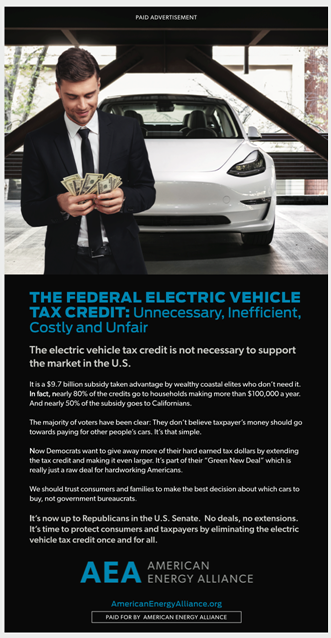
WASHINGTON DC (July 30, 2019) – Today, Thomas Pyle, President of the American Energy Alliance, issued a letter to Senate Environment and Public Works Committee Chairman John Barrasso highlighting concerns about the recently introduced America’s Transportation Infrastructure Act. Included in the legislation is an unjustified, $1 billion handout to special interests in the form of charging stations for electric vehicles.  AEA maintains that provisions like this are nearly impossible to reverse in the future and create a regressive, unnecessary, and duplicative giveaway program to the wealthiest vehicle owners in the United States. 
 
Read the text of the letter below:
 

Chairman Barrasso,

The Senate Committee on Environment and Public Works is scheduled to consider the reauthorization of the highway bill and the Highway Trust Fund today.  At least some part of this consideration will include provisions that provide for $1 billion in federal grants for electric vehicle charging infrastructure.  This is among $10 billion in new spending included in a “climate change” subtitle.  All of this new spending is to be siphoned away from the Highway Trust Fund (HTF), meant to provide funding for the construction and maintenance of our nation’s roads and bridges.  The HTF already consistently runs out of money, a situation that will only be exacerbated by these new spending programs.

We oppose this new federal program for EV infrastructure for a number of reasons, including, but not limited to the following:

  • The grant program, once established in the HTF, will never be removed.  Our experience with other, non-highway spending in the trust fund (transit, bicycles, etc.) is that once it is given access to the trust fund, the access is never revoked.  Our nation’s highway infrastructure already rates poorly in significant part due to the diversion of highway funds to non-highway spending.
  • As we have noted elsewhere, federal support for electric vehicles provides economic advantages to upper income individuals at the expense of those in middle and lower income quintiles.  This grant program would exacerbate that problem.
  • This program will result in taxpayers in States with few electric vehicles or little desire for electric vehicles having their tax dollars redirected from the roads they actually use to subsidize electric vehicle owners in States like California and New York.
  • This program is duplicative.  There is already a loan program within DOE that allows companies and States to get taxpayer dollars to subsidize wealthy electric vehicle owners.

For these and other reasons, we oppose the provisions that would create a regressive, unnecessary, and duplicative giveaway program to wealthy, mostly coastal electric vehicle owners.  This giveaway not only redirects taxpayer money from the many States to the few, in looting the Highway Trust Fund it also leaves those many States, including Wyoming, with less money to maintain their own extensive road networks.


Sincerely,

Thomas J. Pyle

Senator Barrasso Submits to the Subsidizers

This week brought the unfortunate news that Sen. Barrasso, normally a steady hand in energy policy discussions, has reportedly agreed to Democrat demands for new subsidies for expensive green dreams. The senator from Wyoming has apparently given the nod to include subsidies for electric vehicle charging stations in an infrastructure bill expected to be unveiled today. Left unclear is why, exactly, federal taxpayers should be on the hook for subsidizing the build-out of a retail network for a niche consumer product.

It should be obvious that subsidizing retail outlets for a particular product is not a proper role for government, but since we are here, let’s look at this in other contexts. Should federal taxpayers subsidize the construction of gas stations? After all, the vast majority of cars are gasoline-powered. Or speaking of niche products, should federal taxpayers pay for the construction of E85 pumps, which can dispense fuel with up to 85% ethanol? There are far more flex-fuel capable vehicles on the road than electric vehicles. Or more speculatively, compressed natural gas (CNG) is a potential transportation fuel, should federal taxpayers pay for that? Is there a limiting principle here? Drone ownership is growing rapidly, should the federal government subsidize charging stations for drones? Should the federal government subsidize the construction of Apple stores, too?

Subsidizing retail outlets for a particular product should be facially ridiculous. The rationale for federal funding for infrastructure is to provide the kinds of goods that everyone uses: roads, bridges, ports, maybe even stretching to cover sewerage or water treatment if local governments are not able to provide. The point isn’t to pay for private infrastructure. Amazon’s nationwide infrastructure of warehouses provides a valuable service to millions of Americans, but no one would suggest that the federal government should subsidize those buildings.

Other than electric vehicles being a fetish for environmental leftists, there is no reason for their charging infrastructure to qualify for special treatment. Electric vehicles are less than 2 percent of the vehicle fleet in the United States. Electric vehicles already receive a federal tax credit for purchase, preference in federal regulations like the fuel economy mandate, as well as extensive state and local level subsidies and mandates. The federal government under the Obama administration even forced Volkswagen to commit $2 billion to building electric vehicle infrastructure as part of a legal settlement.

Now Sen. Barrasso seems to have agreed to add on yet another layer of support for electric vehicles. The question has to be asked: when is enough, enough? Sen. Barrasso is on record in numerous other contexts opposing federal support for particular products, picking winners and losers. He has even introduced legislation to eliminate the electric vehicle tax credit. So why is he making an exception for electric vehicle charging stations?

Fundamentally, taxpayers should not be paying for private infrastructure. Many people enjoy the convenience of having a coffee shop on every corner, but it is not the federal government’s job to support the build-out of this caffeine infrastructure. Where there is a need for electric vehicle infrastructure, private companies can provide it. Electric vehicles should be no exception. Senator Barrasso shouldn’t let the Democrats inject their Green New Deal into the highway bill.

Nationwide Free Market Coalition to President Trump: Hold Firm on CAFE Reform

WASHINGTON — A coalition of 30 organizations, led by the American Energy Alliance, sent a letter to President Trump today expressing its unified support for his administration’s effort to reform the federal Corporate Average Fuel Economy (CAFE) mandate.

The coalition comprises leading free market think tanks in Washington, such as the Competitive Enterprise Institute, FreedomWorks, and Americans for Tax Reform, along with more than 10 groups based in state capitals across the country. The coalition argues that the Trump administration’s proposed changes to the Obama-era expansion of the fuel economy mandate are both legally appropriate and economically necessary, despite arguments to the contrary from a group of automakers. The Obama-era CAFE expansion allowed regulators in the State of California to hijack our system of federalism at the expense of car buyers from coast to coast. The proposed changes would put car buyers back in the driver’s seat, save them money, and reestablish the states’ and the federal government’s proper roles with respect to the national fuel efficiency mandate.

American Energy Alliance President Tom Pyle issued the following statement:

“American families choose cars, trucks, and SUVs based on our own unique needs. In a free market, automakers would compete to give us the best combination of features, including safety, performance, and, yes, fuel economy, at the lowest price. No one wants an unelected bureaucrat from Sacramento getting the final say on how we get from place to place.”

Grover Norquist, President of Americans for Tax Reform, made the following comment:

“California bureaucrats should not decide what kind of cars and trucks Americans are allowed to drive. That decision rightly belongs to consumers, not regulators. Californians may have to live under the thumb of California politicians and bureaucrats but no one in Iowa or Michigan voted for California’s nanny state rules. 

Allowing the government of California to dictate national standards for the rest of the country has led to higher vehicle prices for consumers while forcing them to subsidize vehicles preferred by California’s regulators. ATR urges President Trump to maintain his stance on reforming the federal fuel mandate and to revoke the special waiver granted to California under the Obama administration.”


Jason Hayes, Director of Environmental Policy for Michigan’s Mackinac Center for Public Policy, issued these remarks:

“Existing law restricts any state from setting a national fuel economy standard. But the previous administration’s extreme CAFE standards have paired with California’s unlawful demands, effectively allowing one state to mandate a national fuel efficiency standard. One state forcing the other states to abide by their regulatory structures ignores the concept of federalism and, in this case, ends up increasing automobile prices for every other American.

American drivers have repeatedly demonstrated that a primary concern when considering a new car purchase is the ability to afford their monthly payments. Michigan residents and our big three auto manufacturers should not be forced to buy and build more expensive cars to meet the whims of California regulators. The proposed CAFE standards represent the best option to ensure free-markets continue to operate, technological advances are implemented, and American consumers can purchase the vehicles they want at prices they can afford.”


The full letter and list of signatories can be read here.

For more information on the President Trump’s CAFE reform, click here.

To view AEA’s latest public opinion research on the topic, click here.


Key Vote: H.R. 3055 Amendments

28335477-46e7-4f21-8f39-04a91134013b.png

In voting on amendments to H.R. 3055, the American Energy Alliance urges all members to support amendments #135, #143, #147, and #158, and oppose amendments #54, #128, #132, and #176.

NO on amendments #54, #128, #132, and #176: All these amendments seek to obstruct or prevent development of our domestic energy resources located in offshore federal waters. Domestic energy production creates jobs and economic growth, provides revenue to federal and state governments, and reduces our need for imports. Congress should not be preemptively blocking possible future development.

YES on amendment #158 (Graves): Regarding the same issue as the above amendments, this amendment would strike the bill’s harmful language which unreasonably interferes with development of domestic energy resources.

YES on amendment #135 (Duncan): While the administration has withdrawn and replaced the Clean Power Plan, prohibiting funding would prevent efforts to revive the regulation through litigation.

YES on amendment #143 (Duncan): Developing the energy resources located in a small part of ANWR is long overdue and the decision of Congress to authorize that development should not be revisited.

YES on amendment #147 (Mullin): While the administration is working to fix the unnecessary and harmfully restrictive methane rule, prohibiting funding would prevent efforts to revive this regulation through litigation.

AEA urges all members to support free markets and affordable energy with the above votes.  Should a vote on any of these amendments occur, AEA will include it in its American Energy Scorecard.

The Art of the Push Poll

WASHINGTON – As you may have seen, there’s a new poll out from Frank Luntz and the Climate Leadership Council that purports to show widespread GOP support for a carbon tax. Here’s what The Hill reported:

“Prominent GOP pollster Frank Luntz is warning Republican lawmakers that the public’s views on climate change are shifting and that ignoring the issue could cost them important votes at the ballot box.

In a memo circulated to Republican congressional offices on Wednesday, Luntz Global Partners warned that 58 percent of Americans, as well as 58 percent of GOP voters under the age of 40, are more concerned about climate change than they were just one year ago…Luntz Global conducted the online poll of 1,000 voters on behalf of the Climate Leadership Council, which is promoting its own carbon tax and dividend plan. The survey found that GOP voters supported the plan by a 2-1 margin.”

We’ve got some serious doubts.

For starters, check out the wording here: 

“Business and environmental leaders are proposing a bipartisan climate solution that charges fossil fuel companies for their carbon emissions and gives all the money directly to the American people through a quarterly check. This new climate solution is called ‘Carbon Dividends’, because all households would receive a quarterly cash payment as part of an effort to solve climate change. Would you support or oppose this plan?”

In layman’s terms, they’re asking: “Would you like fossil fuel companies to send you a big wad of cash?”

For more, read the full response from AEA President Tom Pyle.

For media inquiries, please contact Jordan McGillis
[email protected]